


Key Points and Summary – Canada’s CF-18 Hornet has carried the RCAF for 40 years through smart upgrades and structural life-extensions.
-The Hornet Extension Project can bridge to ~2032, but pushing further means rising maintenance, shrinking availability, and growing operational risk—especially against modern IADS.
-With F-35 training slated for 2026, first jets in 2028, IOC in 2030 and FOC mid-2030s, postponing the transition turns Canada into a net consumer of allied capability for NORAD and NATO.
-The small force can’t run two fleets for long without hollowing squadrons. Bottom line: CF-18s can cover sovereignty patrols a bit longer, but strategy demands accelerating F-35 fielding now.
In 4 Words: Just Keep the CF-18?
Here’s the uncomfortable truth about Canada’s fighter fleet: the CF-18 Hornet has carried the RCAF for four decades not because it was immortal, but because Ottawa kept postponing the inevitable. The jet has been rugged, upgrade-friendly, and superbly flown.
But postponement is not a policy. The question is whether Canada can wring a few more years out of the CF-18 if it punts—again—on fully fielding the F-35. Structurally, yes; operationally, at growing risk; strategically, at real cost.
There’s History
Canada acquired the Hornet in the early 1980s to replace the Voodoo and Starfighter, and to fulfill two key missions: continental air defense with NORAD and expeditionary operations with NATO.
The airframe proved adaptable. Throughout the 2000s, the Incremental Modernization Project digitized the cockpit, added Link 16, enhanced electronic warfare capabilities, and upgraded sensors—progressing A/B-model airframes toward C/D-like capabilities.
Center-barrel replacements and follow-on structural work significantly extended service life, pushing it far beyond design intent. This enabled credible deployments as late as Libya in 2011 and maintained sovereignty patrols over the Arctic and North Atlantic. None of this altered the jet’s birth certificate. The CF-18 was conceived in an analog, non-stealth era; its silhouette and radar cross-section still belong to that era, even with better avionics bolted on.
Can it keep flying? On paper, yes—into the early 2030s. The Hornet Extension Project (HEP) exists to bridge the gap to a permanent F-35 fleet. It has achieved initial operational capability, with upgrades to survivability, mission systems, and radars for a core subset of aircraft.
In short, Ottawa bought time. But HEP is a bridge with a posted weight limit: it is designed to carry the fleet to roughly 2032, not to reset the odometer for another decade of hard use.
Could Canada push beyond that? Only with more invasive structural work and increasingly heroic logistics. Airframes inch toward fatigue ceilings; pushing past control points would require further life-extension efforts to prevent metal from aging faster than budgets can accommodate.
Technically doable, yes—but at a rising price in readiness. The maintenance tail starts wagging the fighter dog. Every extra year buys diminishing availability, higher cost per flight hour, and a growing opportunity cost as pilots remain in aging cockpits instead of transitioning to the aircraft they will fly in the 2030s and 2040s.
Meanwhile, the global community of “classic” Hornet operators has thinned, resulting in a shrinking spares ecosystem and reduced deep supportability options.
Will Canada Proceed With the F-35?
Now map that against Canada’s F-35 timeline. RCAF training jets are scheduled to begin arriving at Luke AFB in 2026; the first aircraft is slated to arrive on Canadian soil in 2028. Initial operational capability is planned for 2030, with full operational capability in the 2033–34 window—dates that align with HEP’s end point.
This schedule is not a footnote; it is the logic that governs the bridge. Punting on F-35 fielding—through under-resourced transition, slow basing projects, or risk aversion about near-term costs—does not freeze the threat environment. It only lengthens the period in which Canada relies on a fourth-generation fleet for missions increasingly defined by fifth-generation realities.
Consider NORAD. For routine air sovereignty—scrambles, intercepts, identification—the CF-18 remains a credible air policeman. Modern data links, identification friend-or-foe systems, and improved electronic warfare keep it relevant for day-to-day presence across the North.
The problem is that continental defense is being rebuilt as a sensor-rich, all-domain architecture that detects, tracks, and engages faster, subtler threats at longer ranges.
A legacy airframe—even with upgraded radars and improved self-protection—can plug into that network; it cannot capitalize on it the way a low-observable jet with fused sensors can. Each extra year without sufficient F-35 mass nudges Canada toward being a consumer of U.S. capability rather than a contributor.
For NATO expeditionary operations, the calculus is harsher. Against modern integrated air defenses and proliferating passive sensors, the survivability margins for a legacy RCS fighter shrink. Yes, the CF-18 can carry precision weapons and execute standoff tasks.
What it cannot do—at acceptable risk—is create the windows of access a fifth-generation platform opens for itself and for others. Canada has earned its reputation by demonstrating credible capability, not just waving flags. Stretch the CF-18 further, and the menu of missions where “credible” applies narrows to permissive skies or roles made safe by someone else’s stealth.
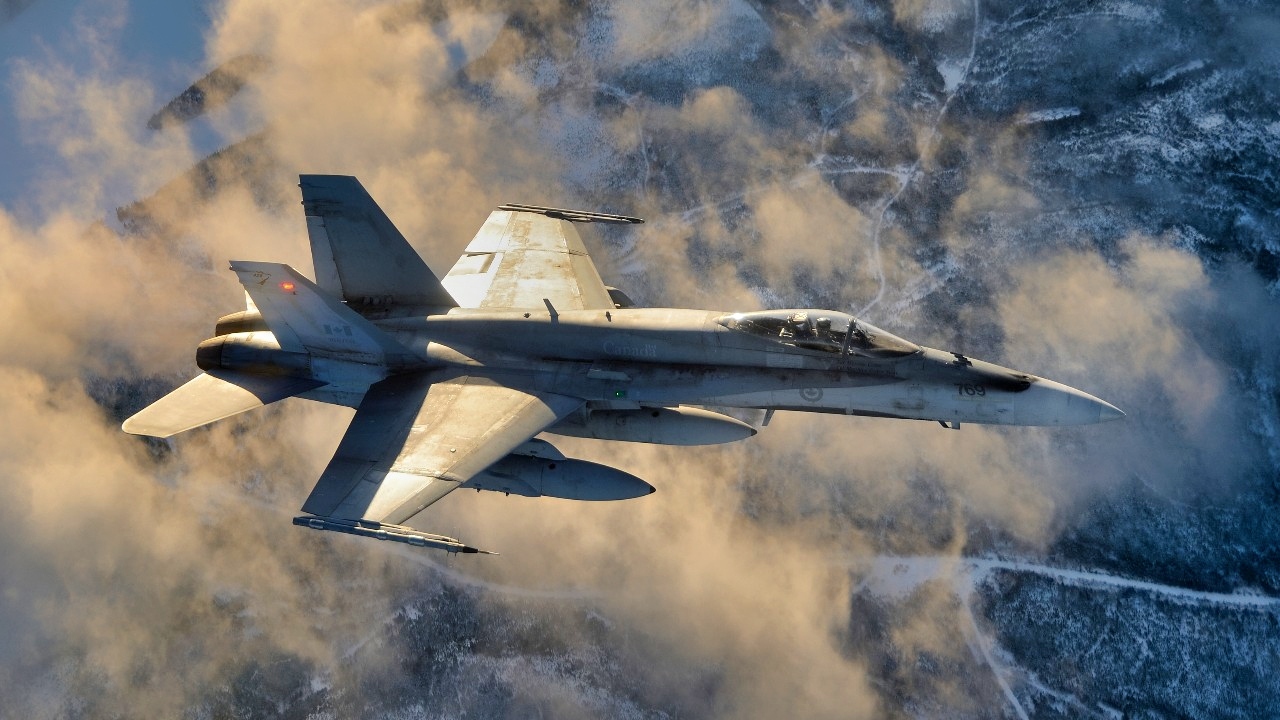
Canada Air Force CF-18. Image Credit: Creative Commons.
There is also the human geometry of transition. Canada’s fighter pilot pipeline has been under strain for years.
The one thing a small fighter force cannot do is run two fleets too long. The old fleet consumes instructors and maintainers; the new fleet struggles to build mass and culture.
A brisk, well-resourced transition concentrates scarce human capital where it matters—tactics development, sustainment, and training ecosystems tailored to the F-35. Delay scatters that capital across two communities and pays back in hollow squadrons.
What about cost? Extending a legacy fleet appears cheaper because the bills are spread across operations and maintenance accounts and minor capital lines. In practice, that approach levies a stealth tax: you pay in readiness, survivability, and alliance credibility while writing bigger checks to keep aging metal airworthy. The F-35’s acquisition and infrastructure lines are undeniably significant—another reason to move faster, not slower.
Every year of hesitation compounds sunk costs in the Hornet and flattens the F-35 learning curve, delaying its progress later than it should.
So, how much life is left in the CF-18 if Canada punts again? Enough to meet core NORAD commitments and routine sovereignty patrols to the early 2030s with careful husbandry, and perhaps a little beyond with more structural work. Not sufficient to meet the country’s full strategic obligations without leaning harder on allies. The Hornet’s longevity is a testament to Canadian ingenuity, maintenance excellence, and pilot skill. But the strategic horizon has moved.
The modern air fight is a contest of networks, signatures, software, and tempo. In that world, a legacy airframe—even one that has been tastefully upgraded—becomes a cost-imposing anachronism.
What Needs to Happen
There is dignity in retiring a great servant at the right moment. The CF-18 helped write a proud chapter in Canadian airpower; it deserves a clean final act, not a drawn-out coda. The bridge to the F-35 is already in place—training is scheduled for 2026, the first domestic jets are expected in 2028, IOC is anticipated in 2030, and full operational capability is expected in the mid-2030s. The strategic question is whether Ottawa crosses now, while the bridge still holds, or hesitates until the river rises.
About the Author: Dr. Andrew Latham
Andrew Latham is a Senior Washington Fellow with the Institute for Peace and Diplomacy, a non-resident fellow at Defense Priorities, and a professor of international relations and political theory at Macalester College in Saint Paul, MN. You can follow him on X: @aakatham. He writes a daily column for National Security Journal.
More Military
The F/A-18 Hornet Fighter Has a Message for the U.S. Navy
F-15E Strike Eagle Has Just 1 Mission
Russia’s Su-27 Flanker Fighter: Moscow’s Best Warplane Ever? You Decide
Iowa-Class Battleship USS Wisconsin Has a Message for the U.S. Navy
The U.S. Navy’s USS Connecticut Seawolf-Class Nuclear Attack Submarine Summed Up in 4 Words


