


Key Points and Summary – Canada’s military is in a “death spiral” and “rotting away” due to chronic underfunding, spending only 1.3% of its GDP on defense, well below the NATO target of 2%.
-This low investment has left the nation with a skeleton force—including only 40 naval vessels—struggling to patrol the world’s longest coastline and the strategic Arctic.

Canadian Tank Firing. Image Credit: Creative Commons.
-The armed forces also face a severe 16,000-personnel recruiting shortfall, raising concerns that new F-35s will arrive with no one to operate them.
-A lack of political will, focused on domestic issues, has turned Canada into a “laggard” in NATO.
Canada’s Military Is In Trouble
“O Canada, Our Home and Native Land.” That’s a fantastic start to a beautiful national anthem for the Great White North. Always lovely to hear at hockey games, but does anything about the anthem give you the impression that Canada’s military is one of the best in the world?
Unfortunately, Canada’s defense forces are rotting away. The Air Force may someday get 88 F-35 Lightning IIs. But without a substantial ground element, winning a war would be difficult.
Fortunately, the Canadians are not going to be invaded anytime soon.
Still, a capable armed force must maintain its sovereignty, or the country could be left unguarded and left to the dogs.
Just Not Enough Defense Spending
Canada is a member of NATO and aims to spend at least 2 percent of its GDP on defense spending – a pledge encouraged by Donald Trump.
But our northern neighbor is taking a swing at this pitch and missing. In 2024, Canada spent only 1.3 percent of its GDP on its military.
What Is Canada’s Grand Strategy?
It is not clear what Canadian grand strategy entails. Does it want to be an economic power that would allow for greater defense investment?
Does it desire to be a valuable member of NATO that can project military power in Europe if Russia attacks an alliance member?
Could it invest more in intelligence activities?

Student of the Advance Small Arms Instructor (ASAI) conducted a range with M-203 grenade luncher, C16 Automatic Grenade Luncher, C6 light machine gun and Carl Gustav 84mm anti-tank. These photos were taken at the Infantry School, 5th Canadian Division Support Base (5 CDSB) Gagetown, New Brunswick, on 31 October 2024.
Can its manufacturing sector become a more robust defense industrial base?
Canadian political leaders often articulate none of the answers to these questions.
It’s Difficult to Protect This Huge Country
One problem Canada faces defensively is its vast borders and coastline. Canada has the world’s most extensive coastline – over 151,000 miles.
It comprises the Atlantic, Pacific, and Arctic oceans.
There is no way that Canada knows everything militarily that goes on around its borders.
The Arctic is one strategic area that Canada must incorporate into its military operations.
This has become a critical playground for Russia, the United States, and even China due to the Arctic’s mineral, oil, and natural gas deposits, as well as its potential as a new transit route for commerce and trade.
The Navy Is An Afterthought
Canada does not have the navy to patrol such a vast amount of ocean. The Great White North only has 40 active vessels, including surface warships and submarines. That is just not going to cut it as the Arctic gets more crowded with exploration vessels and maritime shipping.

The Royal Canadian Navy long-range patrol submarine HMCS Victoria (SSK 876) arrives at Naval Base Kitsap-Bangor for a port call and routine maintenance. The visit is Victoria’s first to Bangor since 2004. (U.S. Navy photo by Lt. Ed Early/Released)
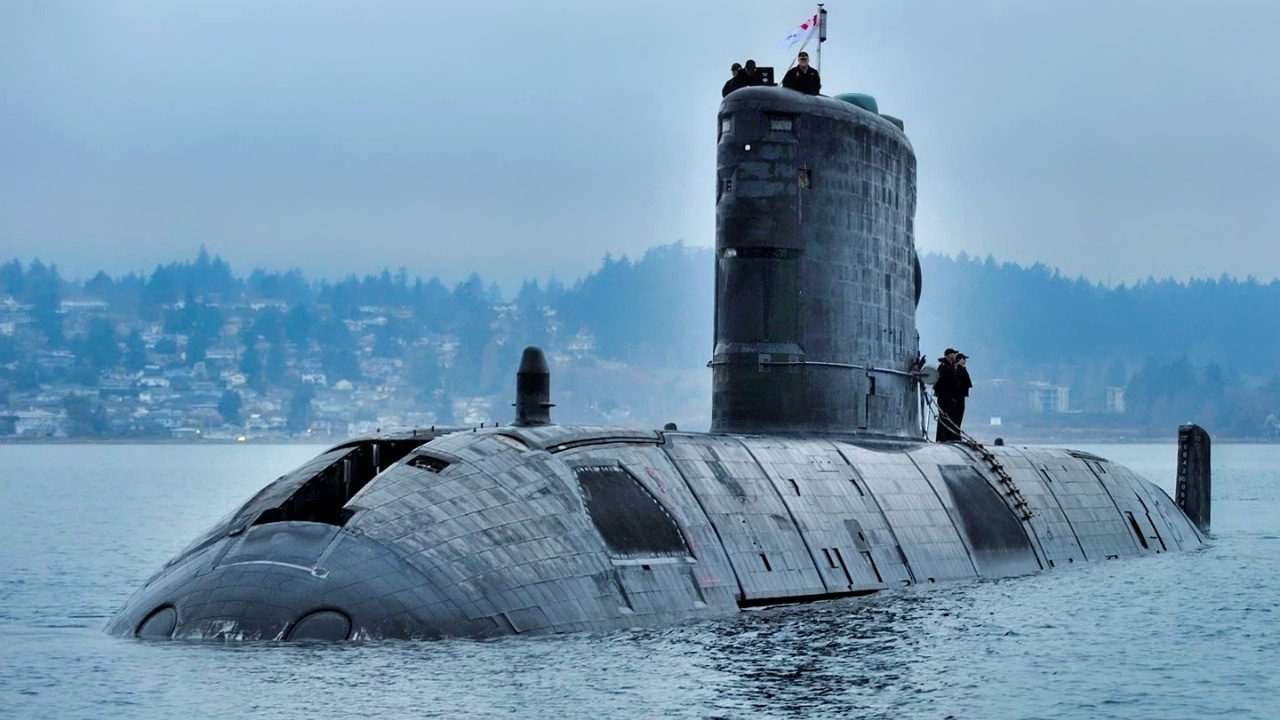
Victoria-Class Submarine Canada Navy. Image Credit: Creative Commons.
Priorities Are Domestic and Not International
One of the problems with the Canadian military is priorities. The government is more concerned with domestic politics than foreign policy.
And when there is international intrigue, it is about trade with the United States. Inflation is a problem, and housing is expensive in the cities.
The economy in the west of the country is based on oil and gas extraction, agriculture, and mining.
The east, which is closer to U.S. cities such as Detroit, has manufacturing capacity but is more focused on automobiles and other finished products—not on military end items.
Foreign policy and building up the defense forces are not top of mind to many Canadians.
Canada probably won’t meet the 2 percent GDP target for military spending until 2032. That’s just not acceptable, and Trump has even moved that target.
He would like NATO members to spend up to 5% of their GDP on defense. Canada will never hit that goal.
The Canadian military has around 71,500 active personnel and 30,000 reservists.
That’s not enough for an expeditionary force and strains the military requirement for coastal defense.
There’s also a shortfall of about 16,000 soldiers, sailors, and airmen. Many Canadians would never consider a career in the armed forces, so recruiting is difficult.
Canadian military experts and professors Philippe Lagassé and Justin Massie wrote in an article for War on the Rocks last year, “while the Canadian government has signed several high-profile contracts for new equipment such as F-35s, Predator drones, and P-8A Poseidons, at this rate, there may not be anybody to use these capabilities when they come online.”
Why Doesn’t Canada Spend on Defense? Politics
Canada is a prosperous country. It has the ninth-largest economy and the 12th-largest GDP per capita.
There is room for more defense spending, just not the political willpower. The Canadians mainly consider themselves a peace-loving “stick to your knitting” kind of country.
Any loud talk about military might is frowned upon by a leftist-leaning public that often elects progressives as prime ministers and members of parliament.
Politicians have promised to spend another $75 billion on defense in the coming years, but that is not enough for readiness, training, and defense acquisition of modern systems.
The peace dividend after the Cold War especially hurt the military. Without the Soviet Union threat, Canada figured it would not need a significant defense force. Canada cut defense personnel by 33 percent from 1990 to 2005.
The budget was reduced by 30 percent by the mid-1990s.
The military never recovered. Now it looks like a laggard in NATO, as Europeans spend more on defense and buy new planes and tanks.
Canada is not seen as a leader in the alliance.
The threat of a Russian incursion into the Arctic should spur Canada into action. It should be shocked into action by the war in Ukraine and Russia. Political leadership must focus on defense, and the ordinary Canadian must be patriotic enough to want to enlist in the military.
There is a shortage of grand strategy making that emphasizes defense. A new buildup is necessary from a relatively wealthy country distracted by domestic policy. Until social and economic problems within its borders are solved, Canada may never have an expeditionary military capable of protecting its immense coastline.
About the Author: Brent M. Eastwood
Brent M. Eastwood, PhD is the author of Don’t Turn Your Back On the World: a Conservative Foreign Policy and Humans, Machines, and Data: Future Trends in Warfare plus two other books. Brent was the founder and CEO of a tech firm that predicted world events using artificial intelligence. He served as a legislative fellow for US Senator Tim Scott and advised the senator on defense and foreign policy issues. He has taught at American University, George Washington University, and George Mason University. Brent is a former US Army Infantry officer. He can be followed on X @BMEastwood.
More Military
Nimitz-Class Aircraft Carrier USS Carl Vinson Has a Message for the U.S. Navy
The Navy’s New DDG(X) Destroyer Looks Like a Missile and Laser Machine
Germany’s Big F-35 Fighter Purchase Comes Down to 1 Word
Eurofighter Typhoon vs. JAS 39 Gripen E: Who Wins Summed up in 4 Words
JAS 39 Gripen E vs. Dassault Rafale Fighter: Who Wins in a Fight Summed Up in 4 Words


