


Key Points and Summary – Ottawa is again flirting with the idea of cutting its F-35 order and buying Saab Gripens, reviving Canada’s worst habit: treating defense as a political toy.
-The RCAF needs 88 F-35s to plug into NORAD and Five Eyes, share U.S. mission data, and help defend North America against advanced Russian and Chinese cruise and hypersonic missiles.
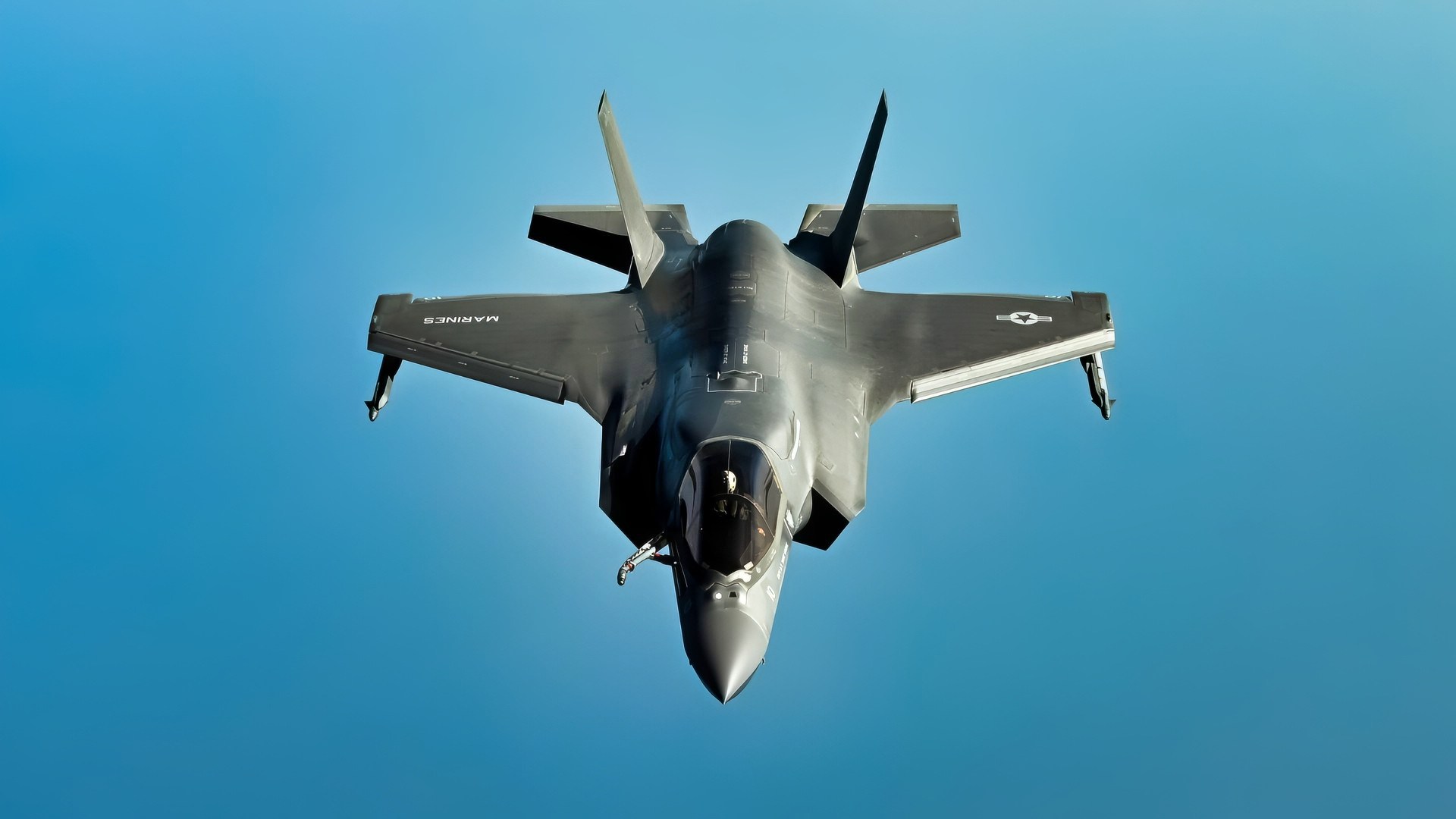
A U.S. Marine Corps F-35B Lightning II resumes a combat air patrol after aerial refueling with a U.S. Air Force KC-135 Stratotanker over the U.S. Central Command area of responsibility, Sept. 19, 2025. More than a fighter jet, the F-35’s ability to collect, analyze and share data, is a powerful force multiplier that enhances all airborne, surface and ground-based assets in the battlespace. (U.S. Air Force photo by Senior Airman Keegan Putman)
-The Gripen, a good but shorter-range, sensor-limited design, cannot match that networked role, and “kill switch” rumors are fantasy.
-Canada already has thousands of jobs tied to F-35 production. Splitting the fleet to chase industrial offsets would weaken deterrence and further erode Canadian credibility.
Canada’s F-35 Drama: Will Ottawa Sabotage Its Own Air Force?
Canada is still failing to take its defense seriously. The Government is contemplating continuing the worst Canadian political tradition of recent years — refusing to get the Royal Canadian Air Force (RCAF) the modern fighter it needs to replace its aging CF-18s. After selecting the F-35 three separate times (in 2010, 2014, and 2023), the government is considering curtailing its purchase of 88 jets and acquiring the Saab JAS 39 Gripen E to create a mixed fleet.
Unfortunately, the absurd political theatre of the Trump Administration has caused many Canadians to cut their noses to spite their face. Rhetoric about becoming the 51st state and the unfair, if not illegal, imposition of tariffs has inflamed anti-American sentiment. But Canada is far from blameless for this situation.

U.S. Air Force Maj. Kristin “BEO” Wolfe, F-35A Lightning II Demonstration Team commander, flies an F-35 assigned to the 356th Fighter Generation Squadron during the 2023 Arctic Lightning Air Show at Eielson Air Force Base, Alaska, July 21, 2023. The 2023 airshow theme was celebrating 50 years of women in military aviation.(U.S. Air Force photo by Staff Sgt. Kaitlyn Ergish)
Successive governments have convinced Canadians that they were safe from threats from abroad and that, therefore, our threadbare defense spending was commensurate with the challenges the country faced. This was an increasingly egregious falsehood to tell Canadians; we need serious investment in our defense to make up for decades of neglect. Failing to move forward with the F-35 acquisition would be a shameful act of placing the defense of the country (and continent) second to both global and domestic political concerns.
The F-35 is by far a more modern, capable fighter than the Gripen. Make no mistake: the F-35 is critical to the integrated defense of the North American continent. Specifically, it provides connectivity to enable the surveillance and interception of the new generation of cruise and hypersonic missiles.
The very Russian and Chinese aircraft and missiles that the Canadian Government (belatedly) identified as a core threat to the continent require a defensive response that is system-based on several integrated layers capable of detecting and responding to modern threats. The core principle behind the various multi-domain concepts that guide Western defense doctrines today is seamless data interoperability, which the F-35’s communication and sensor fusion capabilities embody. The data and programming that is loaded into an aircraft can have an immense consequence on its capability. Indeed, the acquisition of the F-35 was viewed by the RCAF as an opportunity to revolutionize all facets of its operations and to build in this broader need for data interoperability.
During the last competition, which ultimately (re)selected the F-35 in 2023, the government outlined a requirement for Five Eyes and “Two Eyes” interoperability. Five Eyes, the intelligence-sharing arrangement among Australia, Canada, New Zealand, the United Kingdom, and the United States, is well-known, but “two-eyes” is likely unfamiliar. “Two-eyes” refers to adopting U.S. intelligence and data security standards, if not interchangeability, in the continental defense mission.

SAAB JAS 39 Gripen Fighter. Image Credit: SAAB.
In fact, Canada was one of only three states that originally granted allies the enhanced ability to modify their own mission data files, which are critical for operational planning, through the AustCanUK Reprogramming Laboratory (ACURL). Canada’s ability to access operationalized American intelligence products through NORAD and NORTHCOM means that Canadian F-35s would be undeniably among the most capable alongside their American counterparts.
Canada, as the second foreign participant in America’s Joint Strike Fighter (JSF) program, helped shape the program’s requirements for the aircraft of choice, including cold-weather operation, which complemented its other characteristics, such as long range.
All our northern allies, including Finland, Denmark, and Norway (not the Swedes, for obvious reasons), know this and are in the process of buying and operating the F-35. The fact that these northern allies are, or will be, operating F-35s in the high north should be the only response needed to critics who suggest that the F-35 is not suitable for the north.
The Gripen, in contrast, was originally a short-range point-defense fighter that has been upgraded to provide multi-role capability, but many of its limitations remain (such as its relatively short range and sensor capabilities).
Indeed, many Gripen sales pitches involve the sale of the Globaleye AEW aircraft, in part to address these shortcomings.
Ironically, the F-35’s tactical and operational strengths have become its greatest political vulnerability in Canada. If you’ve heard rumors of a so-called F-35 “kill switch,” you’re not alone. Canadians are so mad at Americans that this widely debunked and completely untrue rumor (that buying the F-35s gives them the power to turn off our aircraft) is still gaining traction. Yes, to the benefit of all parties, the F-35 has data interoperability with the US; no, it doesn’t therefore have a “kill switch”. (Buying into the dangerous “kill switch” rumor also requires one to assume the fantastic scenario where the United States would intentionally remove three squadrons of aircraft from defending the North American continent).
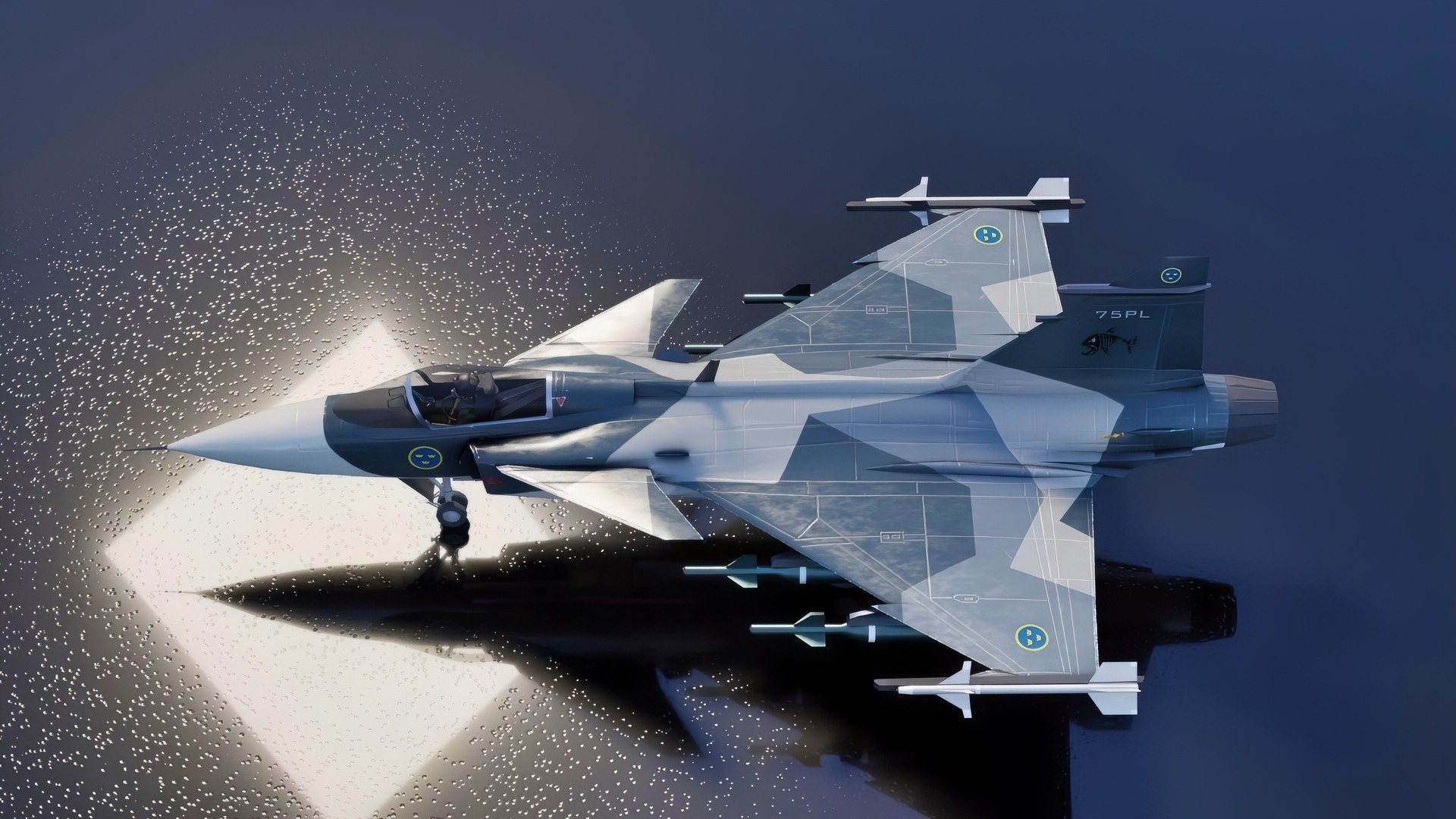
JAS 39 Gripen Artist Photo Creative Commons
Tactical capabilities aside, the most egregious rationale for the JAS 39 Gripen has been provided by the Canadian Industry Minister Melanie Joly, who claimed that Saab could bring 10,000 jobs to Canada. Saab only employs 24,000 people globally and just 8,000 in their aerospace division. Even in the US, where they make parts for one of the world’s most formidable defense spenders, they employ only just over 1,000 people.
Minister Joly’s numbers may rely on a new order from Ukraine to make up the difference, but this order is unlikely to materialize. Ukraine has signed a non-binding “memorandum of intent” to buy some 100-150 aircraft from Saab. Moreover, on Monday, Ukraine signed a similar agreement with France for 100 Rafale fighter jets. Yet Ukraine’s economic situation will be extremely poor for quite some time, and any purchase of fighters will require significant financing, likely from the EU or Sweden. In either case, it is highly unlikely that Canada will ever build any of those fighters.
Canada already has skin in the F-35 industry game. It was a level 3 partner on the Joint Strike Fighter development program, and has thus far received over $3.1 billion in contracts to sustain or build components for the F-35, before the RCAF ever received one.
By some measures, a large share of the 2,500 existing jobs that support the JSF program are already at risk amid speculation that Canada would back out of its commitment to the F-35s.
Regardless of jobs, the Gripen is still the wrong choice. Preventing conflict comes from deterrence, and Canada should choose the option that convinces an enemy not to engage. An air force consisting of just 16 F-35s (fewer than Saudi Arabia), combined with an unknown number of Gripens, simply cannot compare with the deterrence that is provided by fulfilling the order sheet for 88 stealth-capable F-35s.
Americans should help Canadians remember the key things: First, there is no strategic autonomy or true independence from the United States that would come with a Gripen order. Second, the decision to buy a replacement for the 1980-vintage CF-18 must be based on strategic considerations rather than economic payback.
Canada needs defensive systems that meet the new threats it faces, not more political games.
About the Authors: Rob Huebert and Jamie Tronnes
Rob Huebert is a senior fellow at the Macdonald-Laurier Institute and a professor in the Department of Political Science at the University of Calgary. Jamie Tronnes is the executive director of the Center for North American Prosperity and Security (CNAPS).


Brian A Murray
December 8, 2025 at 4:01 pm
You are extremely misled on your article on the F -35 ,just one point you reference 88 f-35s buddy only 30% are operational at any one time so 28 or so airplanes in time of crisis .And with Canada Dismal state of the RCAF probably much less ,that’s if we had the pilots were 400+ pilots short now with NO mechanism to train more ,all farmed out …..when available .you are woefully uninformed on the article you write ….i could destroy every one of your points on the f-35 …anytime mister B
Elias Moreau
December 8, 2025 at 5:04 pm
F-35 supporters keep grasping at straws. When are we going to stop pretending NATO allies bought the F-35 based on its capabilities and recognize the truth—they bought it despite its many flaws. Their decision can be summed up in one word: politics.
Apparently a genuine multirole fighter with a proven 90%+ availability rate is supposed to “cripple the RCAF”. If that’s the case, I’d hate to imagine what a jet averaging 30% availability would do.
The Gripen has cutting-edge sensors and networking, but somehow that still isn’t “enough.” What the RCAF really needs, we’re told, is a fighter that’s perpetually delayed, chronically overpromised, and delivered at an eye-watering price that only keeps climbing. Add a bit less speed, less range, outgunned, and we’re supposed to call that a winning formula?
If the F-35 is genuinely what Canada needs, wouldn’t the more “effective” choice be to buy no fighter at all? Why pay for full capability and end up with 70% of the fleet grounded, when you can buy nothing and achieve 100% inefficiency—free of charge.
Andrew
December 8, 2025 at 7:53 pm
When will we all get serious and look at twin engine designs like our legacy F/A-18 Hornets are?
Stephan Larose
December 8, 2025 at 9:15 pm
Neither Gripen nor F35 are appropriate. Canada isn’t being threatened by Russia or China, the only realistic threat comes from the USA—which has a very long track record of regime change wars to install client regimes in nations of interest to US hegemony. Canada needs twin engine jets for long range patrol. If it wants sovereignty, it should build its own. There’s no reason Canada can’t considering it has advanced aerospace manufacturing and was producing top-tier military aircraft decades ago. If Sweden can’t do so, why not Canada. If this budget-busting military purchase is indeed about sovereignty and defense, and not placating Washington, then made-in-Canada is the only realistic threat comes option.
David
December 9, 2025 at 2:56 am
Our current fighters primarily intercept Russian incursions to our airspace what is the point of being sneaky during an interception,
It’s a tactical advantage to manufacture the parts for your aircraft at home,
And the f-35 is only stealth as long as the coating is reapplied after each long flight, which would be every interception mission
Emil
December 9, 2025 at 10:40 am
Another, paid ny Lockheed, F-35 fanboy.
I won’t even bother pointing out the factual errors in this jumbled mess of a hit piece.
BK Humphreys
December 9, 2025 at 11:24 am
Take this ridiculous article down. How well do you think the F35 will do in the Arctic? We would need to built facilities everywhere, specialty maintenance capabilities, specialty mechanics, etc, etc, etc and still a lot of aircraft would be unavailable for service. The Gripen is made for the north. Take off and land on roads, simple maintenance, no special technicians, and beat the hell out of F35.
Chuck Dickson
December 9, 2025 at 11:37 am
This is an interesting and well thought out perspective and I enjoyed reading it. On the issue of KILL SWITCHES, we did not invent that idea, it came directly from the individual in charge of the country on our southern border. While your article claims that is fiction, and wouldn’t serve a purpose I am having a harder time believing that. Would you have believed 12 months ago that 1 of those 5 Eyes that we are a part of (the UK) would be refusing to share intelligence with the U.S. over concerns of being implicit in war crimes, as is currently happening in the Caribbean? That has been reported and confirmed by MS Now. There seems to be no end to how far the American military will go to appease the current administration. The landscape has changed to the detriment of everyone. What is the problem with having a mixed fleet of aircraft? Canada has flown mixed fleets in the past and not having all of your eggs in one basket would seem to make sense. F-35 gives us the inter operability you’re claiming is needed to stay up to speed with other NATO allies, and Grippen-E provides jobs and Canadian investment. The U.S. has claimed for years that we have been dependent on them in defense, which is true. Maybe it’s time to take back some of that dependency and make decisions that are better for Canada by changing the rules of the game.
Joe
December 9, 2025 at 10:26 pm
Canada has never fought a war by itself in the last 100 years. It’s not going to start that any time soon. Any allies they fight along side, will have the F-35. If Canada buys the gripen, it doesn’t mean it is defensively compromised. Because their allies will fly the F-35. You don’t need an expensive plane like the F-35 to move mud. You will still need planes like the gripen to do CAS and other dirty work. Even the USAF is not replacing their F-15 and F-16 fleets with F-35.
Mike
December 10, 2025 at 12:05 am
Feb. 20 1959 Arrow Program
Bomarc Missile
Need a deal with Rolls-Royce produce engines retro fit to Gripen. Canadians building planes for Canada. Makes way more sense add our tech and Engineering next Gen of Saabs are even better…
Sean mcleod
December 10, 2025 at 9:37 am
It’s time to build defensive positions along the Canada u.s.a border.
Cancel the American contracts in retaliation to b.s tariffs
Build trade with Mexico without the middle man.
Boycott usa products in our stores.
Welcome free trade with Asia and Europe.
When usa comes looking for water and electricity we simply will raise the cost 1000% to usa.
Canada fought hard in the 70s with buy Canadian campaign, we will again.
Usa plated vehicles are being targeted by Canadians with unwelcome rude comments and jesters.
Would expect this turns into snowballs soon..
BUY CANADIAN
BOYCOTT usa.
Ron Fischer
December 10, 2025 at 4:26 pm
I was going to say my usual stuff about the bias and the BS but everyone else stole my thunder. Buy Gripen
Christopher Arthur White
December 10, 2025 at 11:09 pm
These authors are being deliberately disingenuous about the kill switch. It’s the software updates that ultimately Trump controls and if they don’t think he would use that against us, than the authors have clearly been living on Mars for the past year. They also failed to point out that the F35 spends half its time in the shop for maintenance, a brilliant attribute for a fighter aircraft. Lastly, Trump is clear that he wants the F35 jobs back in the United States. Sovereign countries don’t give the power over their major weapons systems to a hostile foreign power. Which is what the United States has become.
Larry
December 11, 2025 at 12:17 pm
As an American I beg you to do all these things you wrote. Do it now and don’t delay. As a matter of fact, Canada should cut all ties to the US now. As an American I don’t want any dealings with Canada now or ever again.
Izno
December 29, 2025 at 8:17 pm
“Europe would feel honoured if Canada applies to EU membership” – SPOX of the EU Commission, early 2025.
Be careful what you wish for, it may happen and you might end being sorry for the despicable acts of the orange Nero from Marde-a-Lago…
Canada will have free trade with theEU andAsia while YOU pay tariffs on ANYTHING!
John
December 14, 2025 at 10:34 am
Your article mistakes dependency for strategy and obedience for seriousness. You speak to Canadians as though they must be instructed, corrected, and ultimately guided back into line, dismissing democratic debate as “political theatre” and autonomy as naïveté. This is not analysis; it is condescension disguised as expertise. You assume—without ever justifying it—that U.S. leadership is permanent, benevolent, and reliable, and that Canada’s role is simply to accept deeper integration on American terms. At a moment when U.S. politics have become openly coercive, transactional, and hostile even toward allies, treating tighter subordination as the only “responsible” option is not realism—it is willful blindness.
If NORAD is truly about defending Canada as much as the United States, then Canada should not fear testing that claim. A complete withdrawal from NORAD would quickly reveal whose security the institution primarily serves. Likewise, Canada’s growing alignment with Europe in defense procurement and cooperation should be read clearly in Washington: the era of automatic compliance is over. Diversifying partners and reducing strategic dependence is not anti-American hysteria—it is a rational response to an ally that has demonstrated it can no longer be taken for granted. Canada has understood the message coming from the United States. This article suggests it is time for American commentators to understand Canada’s response.
Izno
December 29, 2025 at 8:49 pm
The best choice for Canada might not be Gripen but Rafale instead :
– It has now a new system of active stealth
– Is twin engine
– Has a stealth wigman drone the weight of a Mirage-2000 available.
– Dassault says Bombardier is geared for production
– F-35 and F-22 are not stealth for Rafale, thanks to its 3rd gen quantum optronics.
– Rafale can carry Mach3 stealth nuclear cruise missile and soon an hypersonic one. France is OK to enter a nuclear sharing program. There is nothing crying more “deterrence” than the ability to NUKE your aggressor.
– Rafale and its “nEUROn” wingman together cost only $20,000 per hour
– Rafale takes off into 400m at full load, can use roads, and is so easy to maintain it can fly up to 12 hours a day, onlu 2-3 techs are needed, exceptionally 4.
– Canada is building its own trans horizon radar, making NORAD useless
– F-35 is older than either the Gripen-E/F or the Rafale F5.
– F-35 has no Meteor LRAAM
– F-35 needs $600 millions white room hangars hangars and 28 hours of re-coating per flight hour, theoretically limiting the number of yearly flight hours to 309, in fact, in practise, none has managed to only reach 200 hours a year… In 2011, the 9 Rafale-M onboard the DeGaulle CVN were catapulted 100 times A DAY !!! 11 combat missions per 24h over Libya !
– Instead of buying F-35, Canada will have no issues at sustaining a fleet of 144 Rafales with 144 nEUROn wingmen for even cheaper than the 72 non-ordered F-35 hangar queens
– It’s Trump himself who spoke about the kill-switch as well as deliberately degraded capabilities on aircraft delivered to allies…
– Gripen-NG has near double the range of the old Gripen-C/D and if the GE F414 is replaced by the 100kN dry thrust version of the Safran M88 engine, it will even be able to carry 5000L of internal fuel where a F-16 only has 3200L. Safran can also deliver the M88 up to a 115kN afterburner… Note that with 100kN dry thrust and supersonic payload, Gripen would be able of a Mach2 supercruise.
Rafale can receive the same engines and increase its payload to 12 tons
– Canada needs defensive systems that meet the new threats it faces and the new threats include an US invasion… And there’s no better way to deter this than being able to make DC go up into a big mushroom!
– Maybe Rob Huebert and Jamie Tronnes should consider moving to Texas in order to work for Lockheed-Martin since they obviously consider the best interest of the USA instead of Canada.
– USA will break appart into Northern Mexico and Southern Canada while California and Texas will become independent and Louisiana will return to France (if the French want it back but considering the hell-hole it has became, I’m no sure about it).
Brian
April 5, 2026 at 8:49 am
Now i am not an expert but I’m very curious…How do you get a single-engine, low-range, low-payload, low-maneuverability aircraft that is optimized as a Stealth Ground Strike Aircraft . . . to operate effectively in the vast Northern reaches of Canada Arctic as a Long Range Air Interdiction Air Superiority Fighter Jet ?? ..
The F 35 is THE WRONG CHOICE for His Majesty’s Royal Canadian Aircraft , it was the wrong choice in 1997 when Canada first joined the program and its still the wrong choice and every expert who in not on the Pay Roll of the U.S. Military Industrial Complex has stated this OVER and OVER for the LAST 30 YEAR’S . This has nothing to do with the present U.S. Administration or pollical considerations . However add that can of worms in and it just add to the massive number of reasons why the F35 is the wrong choice for Canada.
The F35 is not an Air Superiority Fighter Jet or a Long Range patrol Aircraft , the F35 is a Stealth Strike Aircraft . Now i don’t know if the F35 is good at its roll but lets assume it is for the sake of argument, U.S. makes good weapon systems to say other wise is a lie. Yes it would behoove His Majesty’s Royal Canadian Airforce to operate a few squadrons of these, two squadrons of 8 , maybe 3 totaling 16-24 Aircraft . NOT 88-100 totaling all your Air Power FOR GOD’s SAKE lol . First and most important priority is a Air Superiority Fighter Jet with good range and endurance built for the horrible conditions it will endure for the next 30 years , Second / Third priority’s are Strike Aircraft ( if its stealth even better ) and long range patrol aircraft .
The Back bone of any Air Force must be Air Superiority , that’s there MAIN JOB and FIRST and MOST important Task . I’ll say it again Canada purchasing the F35 for the back bone of His Majesty’s RCAF for use as an Air Superiority Fighter Jet is a MASSIVE and EXPENSIVE mistake which CANADA still has a chance to fix.