


Key Points and Summary – China has built a layered “aircraft carrier killing” network—DF-21D/DF-26B anti-ship ballistic missiles, YJ-12/YJ-18 cruise missiles, expanding submarine forces, and a space-to-sea kill chain of satellites, drones, OTH radars, and seabed sensors—to push U.S. carriers beyond the first island chain.
-The aim: deter intervention, control nearby seas, and erode American power projection.

Forrestal-Class Aircraft Carrier in Drill U.S. Navy Photo
-Washington’s answer is stand-off strike, next-gen missile defense, carrier-borne UAVs, and distributed lethality with allies to operate at range and complicate targeting.
-The carrier still matters for reach and signaling, but it now sails under the missile’s shadow. The contest is shifting from sea control to survivability and deterrence.
China Will Do What It Takes to Sink Navy Aircraft Carriers In a War
America’s maritime supremacy is under threat. For most of the past century, the image of a United States aircraft carrier—packed with fighter jets, cruise missiles, and some 5,000 sailors and airmen—steaming powerfully across the Pacific has been the ultimate symbol of US military supremacy. But that may no longer be the case. Over the past decade, China has assembled a formidable arsenal of weapons systems explicitly designed to find and sink US aircraft carriers. The goal is clear: to keep Washington’s most powerful warships at a safe distance from China’s shores.
Asymmetric Warfare in the Pacific
Beijing knows it can’t match the US Navy in terms of ships per fleet or carrier-for-carrier. So it has invested in a form of asymmetric warfare that attacks American strength at its weakest point. Suppose the United States can’t safely deploy its carriers near Asia’s hotspots. In that case, it can’t credibly intervene to influence the outcome of a war over Taiwan, the South China Sea, or anywhere else along China’s maritime border.
At the center of this strategy are land-based ballistic missiles, such as the DF-21D, commonly referred to as the “carrier killer.” Capable of hitting moving ships as far away as 1,500 kilometers (932 miles) from China’s coast—and as far away as 2,000 kilometers (1,242 miles) according to some reports—the DF-21D is a road-mobile, solid-fueled, short-range ballistic missile that’s difficult to detect before it’s fired. As it streaks toward its target, a maneuvering warhead—conventional or nuclear—will make it nearly impossible to intercept.
A next-generation Chinese derivative, the DF-26B, increases the range and threatens to reach farther into the Western Pacific, including US bases on Guam. The missiles are accompanied by experimental hypersonic glide vehicles that are said to fly at more than five times the speed of sound, surpassing the speed of current US missile defenses.
China’s anti-ship cruise missile arsenal fills out the picture. DF-21D’s older cousin, the YJ-18, as well as the YJ-12, and a suite of newer hypersonic models, can approach targets from different directions, flying low to avoid detection before zooming in at supersonic speeds. Fired from aircraft, destroyers, submarines, or even small coastal boats, China has enough anti-ship cruise missiles to saturate a carrier strike group’s air defenses with salvos numbering in the dozens, or even hundreds. The objective is not finesse but attrition: overwhelm a carrier’s umbrella until something penetrates.
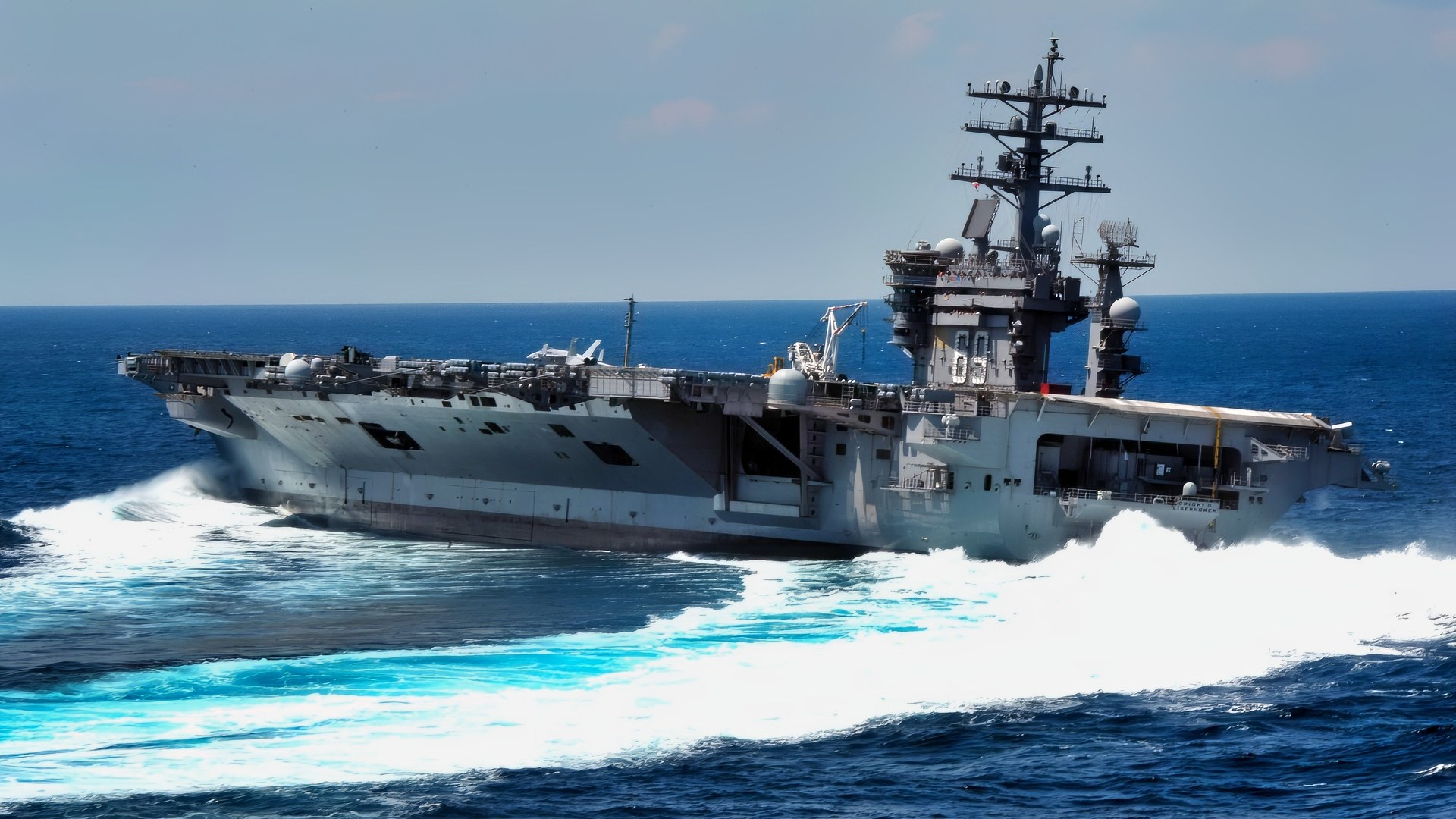
The Nimitz-class aircraft carrier USS Dwight D. Eisenhower conducts rudder turns during sea trials. Dwight D. Eisenhower completed a nine-month planned incremental availability at Norfolk Naval Ship Yard on June 10, 2011.
China’s expanding submarine fleet adds to the threat. The Shang-class nuclear attack submarine and the stealthier, quieter Yuan-class diesel-electric boats both carry torpedoes and cruise missiles. Operating in conjunction with land-based missile batteries, China’s undersea legions could pounce on US carrier groups as they approach the edge of China’s A2/AD (“anti-access/area denial”) perimeter.
Even the threat of such coordination forces US carriers to hang back farther from the coast, reducing their power-projection capability and increasing the flight times for their aircraft.
Targeting the Target
A missile is only as good as the targeting information it receives.
That’s why China has also been building up its surveillance and targeting capabilities over the past decade, a process that military experts refer to as a “kill chain.” Satellites, long-range drones, over-the-horizon radars, and underwater listening posts combine into a complex network of reconnaissance tools that can find, track, and relay targeting information to missile batteries in near real-time. In theory, this could allow China to detect a carrier strike group, pinpoint its position, and initiate coordinated attacks from multiple directions within minutes of its appearance.
China’s fixation on nullifying U.S. carrier power serves three strategic objectives. First, it deters American intervention by making large-scale operations near China’s periphery prohibitively risky. Second, it secures control over the waters of East Asia by making the near seas—the so-called “first island chain” too dangerous for US warships to enter at will. And third, it challenges American global power. Aircraft carriers have been the linchpin of US military strategy since World War II. Weaken that pillar, and America’s ability to project influence around the world falters, clearing space for China’s own rise.
The US Response and the New Naval Reality
Washington is not about to abandon the carrier. But it understands the game has changed. The US Navy is investing heavily in long-range unmanned aerial vehicles, or UAVs, next-generation missile defenses, and extended-range strike weapons, all aimed at keeping carriers effective, even when operating at a distance from China’s shores. It’s also scattering its forces, experimenting with more agile and less expensive ships, and adopting a strategy of “distributed lethality,” while working to better integrate its warships with those of its allies in the Indo-Pacific. The Pentagon’s goal is to maintain deterrence without wagering a $13 billion carrier and its crew on a single volley of missiles.
But even with these adjustments, one thing is sure: the carrier’s aura of invulnerability has faded. China’s overlapping matrix of anti-access measures—missiles, submarines, and surveillance—has rewritten the rules of maritime warfare.
America’s aircraft carriers may continue to be a symbol of U.S. power, but they are also a testament to the country’s strategic vulnerability.
As great-power competition accelerates across the Pacific, it is no longer a contest to see who has command of the sea. It is a competition to see who can best survive in it. China’s web of missiles, submarines, and sensors has turned the oceans from highways of power projection into contested spaces of risk and restraint.
The US carrier still matters – its reach, flexibility, and symbolism are formidable. But the carrier now fights in the crosshairs of an adversary determined to deny its freedom of action.
The days of easy dominance are over. The balance of power at sea will belong to the side that best learns the art of fighting – and deterring – in the missile’s shadow.
About the Author: Dr. Andrew Latham
Andrew Latham is a non-resident fellow at Defense Priorities and a professor of international relations and political theory at Macalester College in Saint Paul, MN. You can follow him on X: @aakatham. He writes a daily column for the National Security Journal.
More Military
Northrop Grumman Is Likely Winner of F/A-XX, But Big Questions Remain
USS United States: The Aircraft Carrier Designed to Launch Bombers
The U.S. Air Force’s B-21 Raider Bomber Nightmare Has Just Begun
How Long Can a Nuclear U.S. Navy Aircraft Carrier Stay in Service?
The Air Force’s B-52 Stratofortress Bomber ‘Nightmare’ Is Real


