

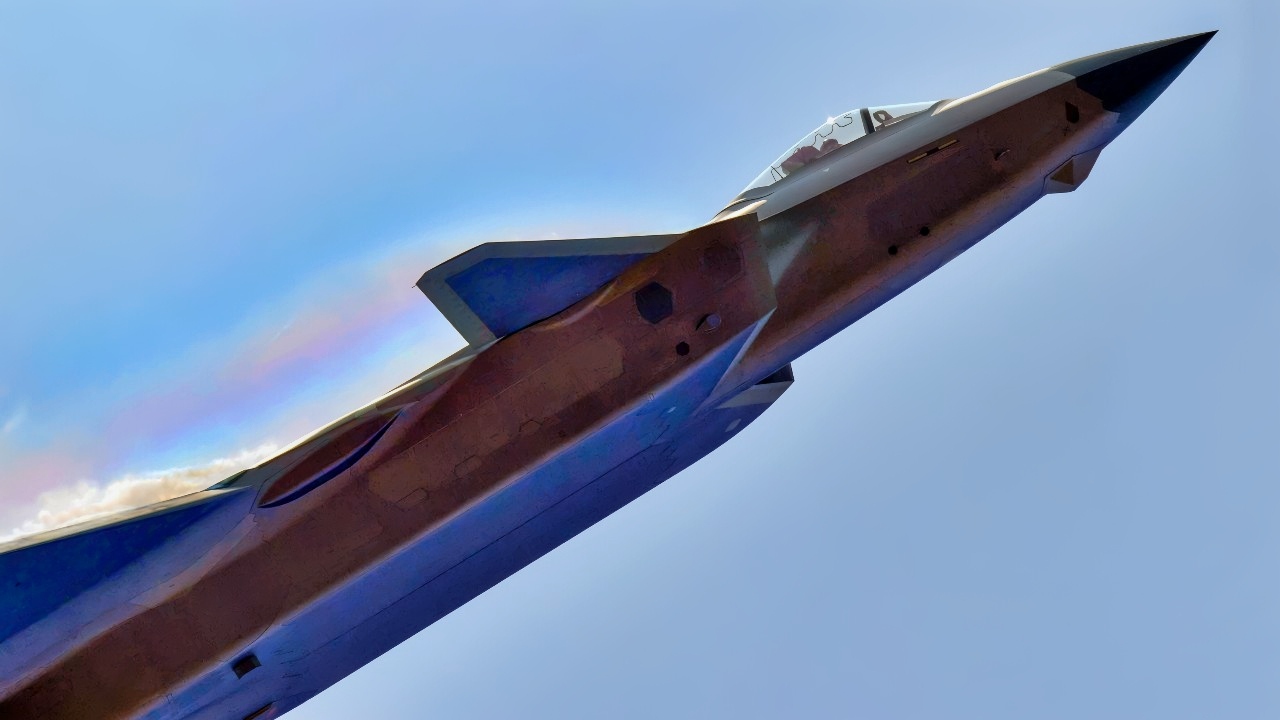
Key Points and Summary – China is developing two distinct fifth-generation stealth fighters, the J-20 and J-35, to fulfill separate but complementary strategic roles.
-The J-20 “Mighty Dragon” is a large, land-based air superiority fighter, analogous to the U.S. F-22, designed for long-range interception and mainland defense.
-In contrast, the J-35 is a smaller, multi-role, carrier-based fighter, similar to the U.S. F-35, optimized for maritime operations from China’s new aircraft carriers.
-Together, these two advanced platforms provide China with a comprehensive and formidable stealth air combat capability for the coming decades.
China’s J-20 Mighty Dragon vs. J-35 Fighter: We Explain
In recent years, China’s aerospace industry has advanced by leaps and bounds. Whereas China was once known for reverse-engineering Soviet technology, it is now preparing to put its second domestically produced fifth-generation fighter into service.
The Chengdu J-20 and Shenyang J-35 are China’s two most prominent stealth fighters (though the J-35 is still undergoing trials currently).
Those who do not follow military affairs or aerospace news might wonder what the difference is between these two aircraft and why China should spend money developing two stealth fighters.
The J-20 and J-35 are two very distinct fighters that have separate but complementary roles in the PLAAF and PLAN.
China’s Fifth-Generation Air Fleet
The J-20, also known as the “Mighty Dragon,” was developed by Chengdu Aerospace Corporation and made its first flight in January 2011. It officially entered service with the People’s Liberation Army Air Force (PLAAF) in 2017.
The aircraft originated from the J-XX program, which aimed to develop a stealth fighter capable of challenging U.S. air superiority. The J-20 is designed primarily for air dominance, long-range interception, and precision strike missions. It is a symbol of China’s leap into stealth air combat and is intended to serve as a strategic asset for mainland defense and deterrence.
In contrast, the J-35, formerly known as the FC-31 “Gyrfalcon,” was developed by Shenyang Aircraft Corporation. Its prototype first flew in 2012, and a naval variant took to the air in 2021.
Initially conceived as a privately funded project aimed at export markets, the FC-31 was not adopted by the PLAAF. However, the design was later repurposed for naval use, and the aircraft is now expected to serve aboard China’s new aircraft carriers, such as the Type 003 Fujian. The J-35 is a carrier-based multirole stealth fighter optimized for maritime operations and tactical missions.
Design Differences
In terms of design, the J-20 features a twin-engine, canard-delta wing configuration. It is approximately 20.3 meters long with a wingspan of around 13 meters. The aircraft features forward canards for enhanced maneuverability, internal weapon bays for stealth, and diverterless supersonic inlets (DSI) to minimize its radar cross-section. Its larger airframe allows for extended range and payload, making it suitable for deep penetration missions.
The J-35, on the other hand, features a more conventional stealth layout with twin engines and a sleek, compact design similar to the F-35. It measures about 17 meters in length with an 11.5-meter wingspan.
The aircraft features folding wings for carrier storage, strengthened landing gear for deck landings, and a smaller radar cross-section compared to the J-20. Its design is tailored for naval operations, with improved stealth features and agility.
Stealth Capabilities
Stealth and survivability are critical aspects of both aircraft. The J-20’s radar cross-section is estimated to be between 0.05 and 0.1 square meters, optimized for frontal stealth. It incorporates radar-absorbent materials and moderate infrared suppression.
The J-35 is believed to have a slightly smaller radar cross-section, approximately 0.05 square meters, and utilizes newer materials suitable for maritime environments. Both aircraft aim to reduce detectability, but the J-35’s compact design may offer better overall stealth in certain scenarios.
On the inside, both fighters feature different electronics and avionics suits. The J-20 is equipped with a Type 1475 active electronically scanned array (AESA) radar, electro-optical targeting pods, passive infrared sensors, and data links for networked operations.
While it offers partial sensor fusion, it is not as integrated as Western counterparts, such as the F-35. The J-35 is expected to feature a carrier-optimized AESA radar, helmet-mounted displays, and basic sensor fusion capabilities. Its avionics are designed to support naval missions and multirole functionality.
Engine Output and Armaments
Engine performance is another area of divergence. The J-20 initially used WS-10 engines but is transitioning to the more powerful WS-15, which is estimated to provide 18,000 kilograms of thrust per engine. This allows the J-20 to reach speeds over Mach 2 and potentially achieve supercruise capability.
Its combat radius is around 2,000 kilometers, making it suitable for long-range missions. The J-35 likely uses upgraded WS-13 or WS-19 engines, with thrust estimated between 13,000 and 14,000 kilograms per engine. It can reach speeds up to Mach 1.8 and has a combat radius of approximately 1,200 to 1,500 kilometers. Supercruise capability remains unconfirmed for the J-35.
When it comes to weapons and payload, the J-20 features one central internal bay and two side bays. It can carry PL-15 long-range air-to-air missiles, PL-10 short-range missiles, and precision-guided bombs. Both fighters feature external hardpoints for non-stealth missions. The J-35 has two main internal bays and is capable of carrying similar weapons, including anti-ship missiles for naval operations. It’s total carrying capacity is still classified but reports indicated that it can carry around 18,000 lbs of ordinances.
Strategic and Operational Roles
The most crucial distinction between the two aircraft is their roles within China’s broader military structure.
The J-20 is primarily used for air superiority, strategic interception, and anti-access/area denial (A2/AD) missions. It is deployed across PLAAF bases in China, including regions near Tibet and the coast. Variants include a single-seat production model, a twin-seat version for AI teaming, and an upgraded engine variant with thrust vectoring. The J-35 is designed for carrier-based multirole missions and is expected to operate from China’s aircraft carriers. Variants include a carrier version with folding wings, a land-based version (J-35A), and a potential export model.
Strategically, the J-20 enhances China’s reach and deterrence capabilities, positioning it as a competitor to the U.S. F-22 and F-35 in air superiority. It symbolizes China’s commitment to developing indigenous stealth technology and asserting control over its airspace.
The J-35, meanwhile, expands the People’s Liberation Army Naval Air Force’s (PLANAF) blue-water capabilities, enabling stealth operations from carriers and supporting maritime force projection. It also holds potential as an export platform for countries like Pakistan or Egypt.
About the Author: Isaac Seitz
Isaac Seitz, a Defense Columnist, graduated from Patrick Henry College’s Strategic Intelligence and National Security program. He has also studied Russian at Middlebury Language Schools and has worked as an intelligence Analyst in the private sector.
More Military
Su-57 vs. J-20 Fighter: Who Wins?


