

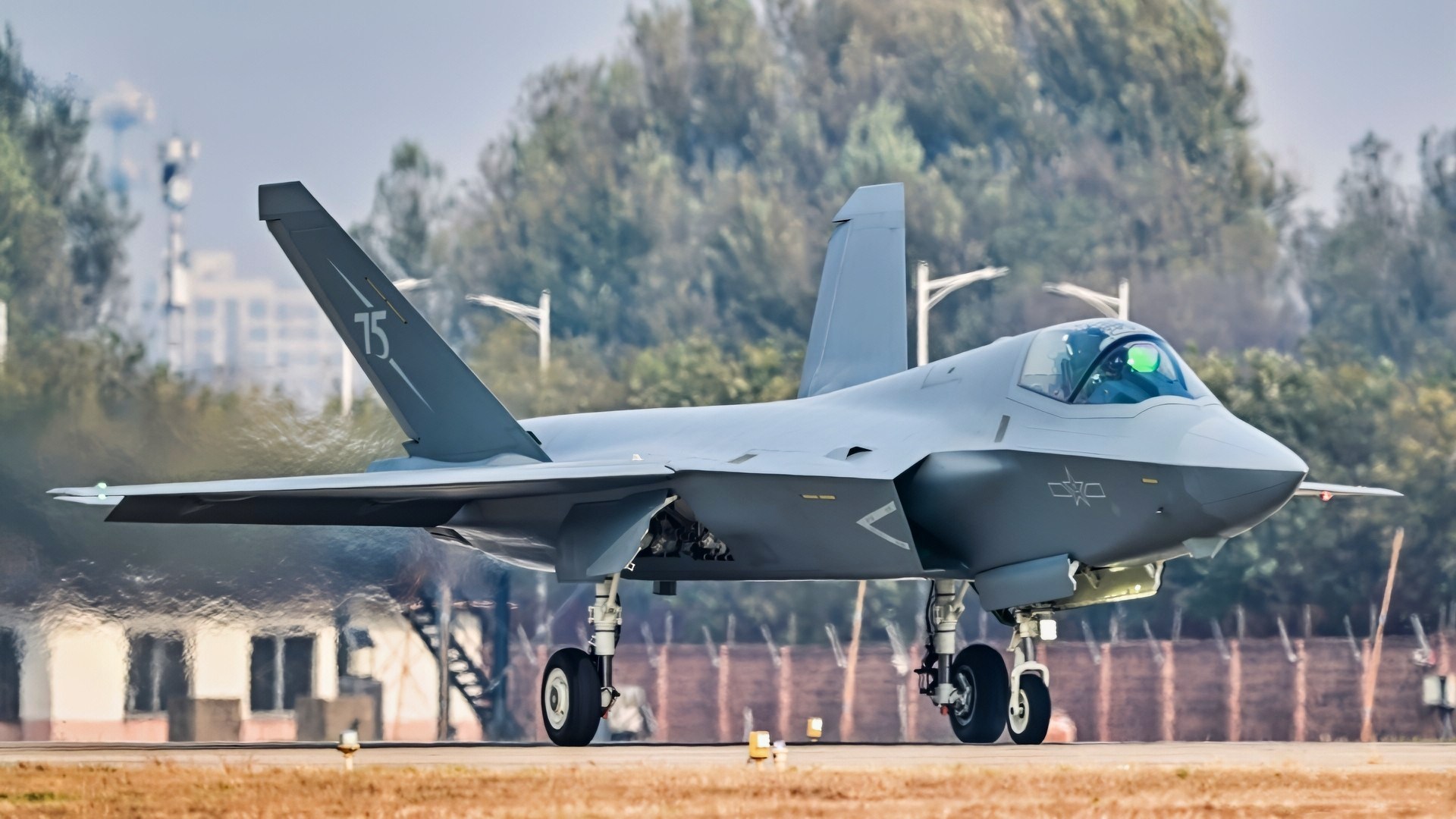
Key Points and Summary – China’s Shenyang J-35 is Beijing’s answer to the F-35 at sea, a carrier-capable stealth fighter derived from the FC-31 “Gyrfalcon” and now evolving into the land-based J-35A.
-Still officially in the prototype stage, it’s expected to haul roughly eight tons of weapons, from PL-10 and PL-15 air-to-air missiles to internal strike loads, all wrapped in low-observable shaping and a cleaner engine installation.

J-35. Image Credit: Creative Commons.
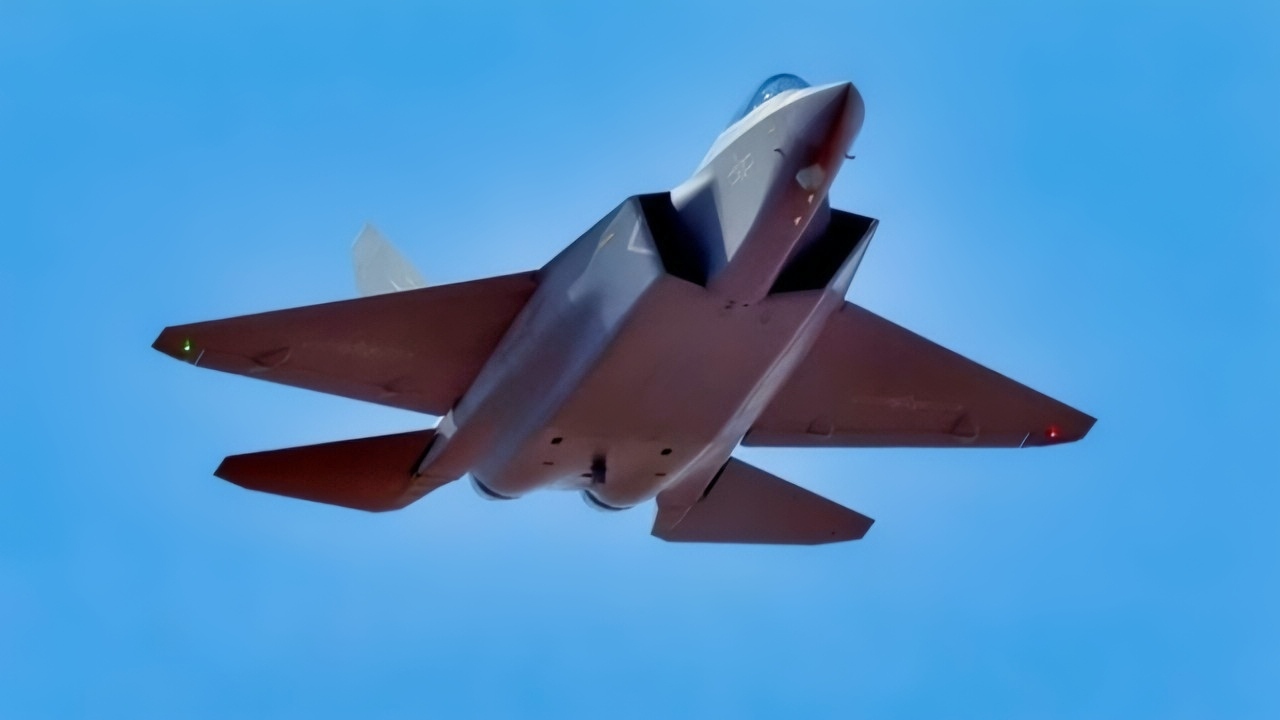
J-35 Fighter from China. Image Credit: PLAAF.

J-35 New Stealth Fighter from China
-Powered by improved WS-21 engines, the J-35 won’t match the J-20’s raw speed, but it doesn’t have to.
-As China fields more modern carriers, this “budget F-35” could become a serious problem for U.S. and allied navies.
China’s J-35 Naval Stealth Fighter (Update)
When discussing the airpower capabilities of the United States of America’s Great Power rivals, much of the conversation revolves around China’s People’s Liberation Army Air Force (PLAAF), and understandably so.
However, the People’s Liberation Army Naval Air Force (PLANAF; Zhōngguó Rénmín Jiěfàngjūn Hǎijūn Hángkōngbīng) is no slouch either.
(Yes, China’s air force and navy alike incorporate the word “army” as part of their official service name; how’s that for interservice jointness and the spirit of “One Team, One Fight,” eh?)
According to the World Directory of Modern Military Aircraft (WDMMA), the PLANAF has a total of 436 airframes in its active aircraft inventory (as of 2024), ranking it 15th out of 103 total air services tracked by the website.
And, not to be outdone by their PLAAF counterparts, the PLANAF is also getting in on the 5th Generation stealth fighter game, via both a naval version of the Chengdu J-20 Weilong (“Mighty Dragon”) and our current subject, the Shenyang J-35.

J-35A Fighter at Le Bourget Air Show. Image Credit: Author/National Security Journal.
(NOTE: The land-based version of the J-35 is designated the J-35A, whilst the naval version is simply called the “J-35.” Also, unlike the J-20 “Fagin,” the J-35 has not yet been assigned an official NATO reporting name.)
J-35 Initial History
This fighter is made by the Shenyang Aircraft Corporation (SAC), headquartered in the eponymous provincial capital city of Liaoning Province. SAC is, in turn, a subsidiary of Aviation Industry Corporation of China (AVIC), headquartered in Beijing, the national capital.
The first prototype of the J-35—in turn a navalized variant of the land-based FC-31 “Gyrfalcon”—reportedly made its maiden flight in October 2021, whilst the second known flying J-35 prototype was subsequently observed in July of 2022 (this time incorporating a low-visibility gray tactical color scheme).
Speculative Specifications: How Fast and How Well Armed?
Exact specifications of the J-35 are currently speculative, as Beijing hasn’t officially confirmed its operational status. Presumably, the J-35 will pack a payload of 8 tons (including a carrying capacity of up to 8 missiles in its bays and on its hardpoints under its wings).
As already mentioned, the J-35 is based on the “Gyrfalcon,” allowing us to use the latter warbird’s vital statistics as a useful baseline for making educated guesses about the former’s technical specifications.
A November 08, 2015, report by Greg Waldron for FlightGlobal indicated that the FC-31 “has six external hardpoints, with an internal weapons bay that can carry a further four munitions. Payload is 8,000kg (17,600lb), of which 2,000kg [4,409 lb.] can be carried internally.” Presumably, that payload capacity could consist of the following specific ordnance types:
Air-to-Air Missiles
PL-10 (“Thunderbolt-10;” NATO reporting name: CH-AA-9) short-range infrared (IR) homing
PL-15 (“Thunderbolt-15;” CH-AA-10 “Abaddon”)
PL-17 long-range active radar homing (in the planning stage)
PL-21 long-range active radar homing (in the planning stage)
Meanwhile, in a November 9, 2016 writeup for HIS Jane’s Defence Weekly, defense analyst Richard D. Fisher Jr. reported that the warplane would also wield “four internal plus four wing-mounted supersonic air-to-surface missiles; four internal plus four wing-mounted 500 kg deep-penetration bombs; or 12 internal and 18 wing-mounted smaller bombs (or presumably combinations of those options).”
As is also true of the J-20, a gun is conspicuous by its absence from the FC-31’s/J-35’s arsenal, which is a sharp contrast to the cannon-armed stealth fighters of the rest of the world, namely America’s Lockheed Martin “Skunk Works” F-22 and F-35 *and* Russia’s Sukhoi Su-57 “Felon” alike.
Apparently, six decades after the fact, the PLAAF and PLANAF are ignoring the “Better to have and not need than vice versa” lessons learned from the aircrews of the non-gunned early versions of the American F-4 Phantom during the Vietnam War.
As for the speed factor, the FC-31 tops off at Mach 1.8 (2,222 km/h; 1,381 mph), which makes it 10 percent slower than the J-20’s Mach 2.0 (2,469 km/h; 1,534 mph).
However, it’s worth noting that the J-35 will apparently use the WS-21 engine—a heavily improved version of the earlier Guizhou WS-13 “Taishan“—which generates 93.2 kN (21,000 lbf.) of thrust; perhaps this will also result in an increase in max airspeed compared with the Gyrfalcon.
How Stealthy Is It?
Especially in comparison with the F-35, that is?
-Both Gen 5 fighters share notable aerodynamic components, such as vertical stabilizers arranged in a distinctive V-like structure, which is crucial not only for maintaining a stealth profile but also for reducing turbulence and enhancing radar invisibility.
-The Chinese plane’s cockpit is narrower with a simpler design and less curvature in the canopy glass, which suggests a focus on practicality and cost-efficiency, but at the price of slightly elevating the radar cross-section (RCS), albeit still adhering to stealth norms.
Meanwhile, the Lightning II’s canopy has specialized coatings that enhance its stealth capabilities, significantly reducing its radar signature while prioritizing pilot comfort and visibility via its more expansive cockpit.
-The J-35 features a more enclosed engine design with fewer visible edges and a smoother outline around the exhaust, aimed at minimizing radar reflections.
About the Author: Christian D. Orr, Defense Expert
Christian D. Orr is a Senior Defense Editor. He is a former Air Force Security Forces officer, Federal law enforcement officer, and private military contractor (with assignments worked in Iraq, the United Arab Emirates, Kosovo, Japan, Germany, and the Pentagon). Chris holds a B.A. in International Relations from the University of Southern California (USC) and an M.A. in Intelligence Studies (concentration in Terrorism Studies) from American Military University (AMU). He is also the author of the newly published book “Five Decades of a Fabulous Firearm: Celebrating the 50th Anniversary of the Beretta 92 Pistol Series.”
More Military
Could America Have Lost the Revolutionary War?
The Marines Don’t Have Tanks Anymore
The Essex-Class Aircraft Carriers Have An Embarrassing Message for the U.S. Navy
‘New’ Mach 4 MiG-41 6th Generation Stealth Fighter Has Warning for U.S. Air Force
Boeing’s F-47 NGAD 6th Generation Stealth Fighter Is No ‘Mission Impossible’


