

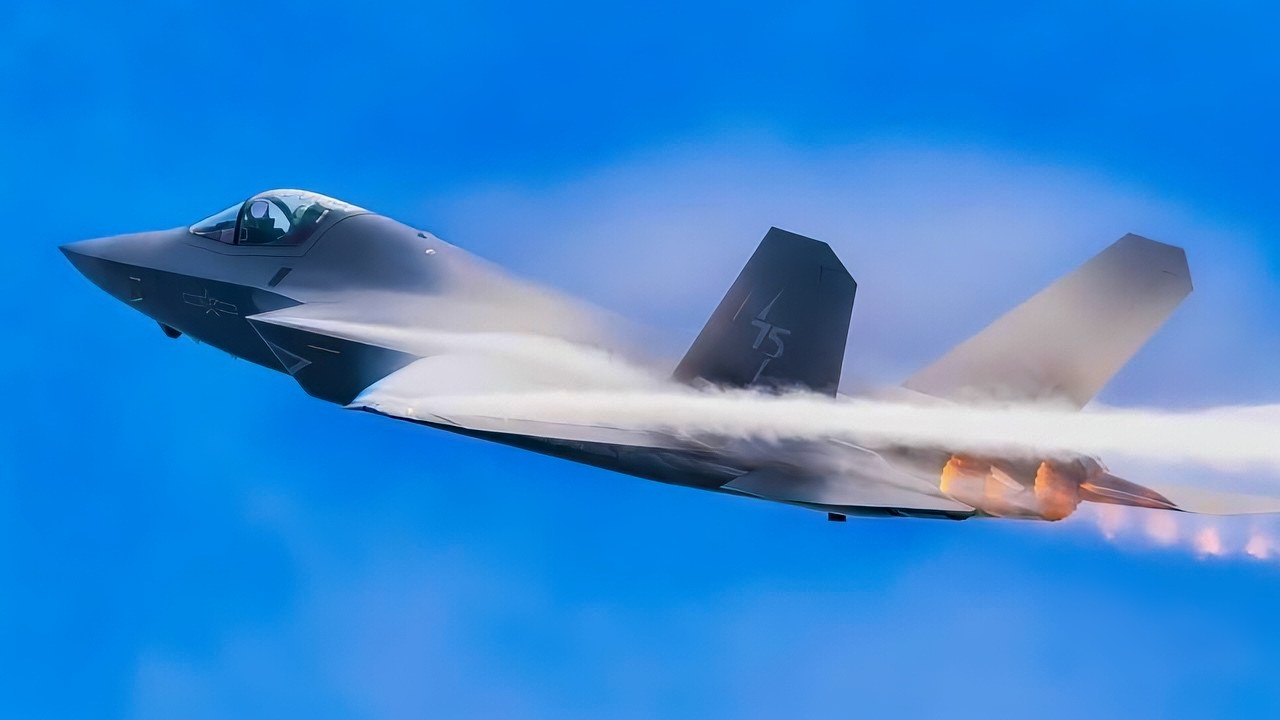
Key Points and Summary – China’s carrier-borne J-35 is the missing piece in Beijing’s blue-water ambitions.
-Paired with the EMALS-equipped Fujian, the twin-engine stealth jet promises heavier loads, longer reach, and networked sensing that can force U.S. carrier groups to change tactics and commit more defenses.

J-35 China Weibo Screenshot.

China’s New J-35 Stealth Fighter

China New J-35 Fighter on Aircraft Carrier. Image Credit: Chinese Weibo.
-Born from the FC-31 and echoing F-35 contours, the J-35 aims for “first detect, first shot” advantages while cueing ship and missile batteries across domains.
-Whether driven by indigenous advances or borrowed designs, the result is the same: a stealth air wing that boosts China’s power projection, complicates Western planning, and accelerates the PLAN’s shift from coastal defense to global presence.
Why China’s “Blue Water Navy” Needs The J-35
China aims to modernize its naval and air power, establish a true “blue-water” navy capable of global operations, and project power in the East and South China Seas.
This stealth fighter, designed for aircraft carriers and equipped with electromagnetic catapults, is intended to challenge US or allied carrier groups and enhance air superiority.
By fielding a stealth fighter that can operate from a carrier, China can create uncertainty for U.S. carrier groups, forcing them to change operational tactics and commit more resources to their own defense.

J-35 Fighter on Chinese Aircraft Carrier. Image Credit: X Screenshot.
Its development signals China’s growing military self-reliance and its ability to create advanced platforms that can complicate Western military planning.
China unveiled the J-35A—its second stealth fighter aircraft—during an airshow late last year. This makes China the second country, after the United States, to operate more than one type of stealth fighter jet, alongside its J-20.
The strong visual resemblance to the US F-35 and F-22, in stealth contouring and intake design, though the J-35 is twin-engine, fuels ongoing accusations of espionage.
True Development or Just Espionage?
In March 2016, a 51-year-old Chinese national named Su Bin pled guilty to charges associated with what the American Justice Department described as a “years-long conspiracy” conducted in concert with high-ranking members of the Chinese military to steal American military secrets – most notably, the designs for advanced stealth fighters like the F-22 and F-35.

U.S. Air Force Maj. Joshua “Cabo” Gunderson, F-22 Raptor Demonstration Team commander and pilot, performs during the Orlando Air and Space Show at the Orlando Sanford International Airport, Florida, Oct. 30, 2022. The F-22A is a fifth-generation fighter incorporating fourth-generation technology, radical maneuvering capabilities, the ability to fly at supersonic speed without afterburners and unprecedented pilot situational awareness. (U.S. Air Force photo by Airman 1st Class Joshua Hastings)
“Su admitted that he conspired with two persons in China from October 2008 to March 2014 to gain unauthorized access to protected computer networks in the United States – including computers belonging to the Boeing Company in Orange County, California – to obtain sensitive military information and to export that information illegally from the United States to China,” reads the Justice Department release.
China’s J-35 Background:
China’s J-35 is a carrier-based fighter built to fly off China’s aircraft carriers.
The J-35 traces its roots back to the Shenyang Aircraft Corporation’s FC-31, a prototype aircraft with some stealth features that first flew in 2012. A land variant of the J-35 is called the J-35A.
The FC-31 was initially conceived of as a stealth fighter for export, but instead evolved into the J-35 as a test and research platform for a carrier-based fighter.
Around a decade later, the first iteration of the J-35 took flight. It featured folding wings and robust landing gear for tight storage and hard landings on aircraft carriers. China recently made its first-ever catapult takeoffs from its new carrier, the Fujian.
The Chinese Government-backed Global Times says the J-35 is quite different from its preceding J-20 when discussing its arrival. The Chinese paper compares the J-20 to its J-35 and says its newer J-35 stealth fighter is lighter, faster, similar to an F-35, and engineered for “strong surface attack capabilities.”
“The J-35A has a different design than China’s first stealth fighter jet, the J-20. The J-20, with a canard wing configuration, is a heavy fighter jet with a focus on air superiority missions comparable with the US’ F-22, while the medium-sized J-35A uses a tailplane wing configuration similar with the US’ F-35 that also has strong surface attack capabilities,” The Global Times says.
The China Daily reported that Wang Yongqing, chief researcher at the Aviation Industry Corp of China’s Shenyang Aircraft Design and Research Institute, said the J-35A provides what he described as “systems coordination” or “multi-domain coordination” in combat.
“It [the J-35A] can lock on the targets, share the targets’ position with other weapon systems, such as surface-to-air missiles, and even use its own radar to guide other weapons to bring the targets down,” he told the state-run newspaper in an interview published on May 13.
More Capabilities Explained:
“Our adversaries will definitely use their stealth aircraft or low-observable cruise missiles to penetrate our air defense networks,” Yongqing Wang explained, without naming any specific countries. The U.S. and its allies operate over 1,200 F-35 stealth fighter jets, including Japan.
Lockheed Martin, the manufacturer of the F-35, has claimed that the aircraft, described as a “force multiplier,” has demonstrated its ability to link with missile defense systems to detect, track, and destroy threats “sooner and safer” by providing sensor data in a network.
“The J-35A has significant advantages in terms of first detection, first strike, and securing operational advantages,” Wang said. He added that in combat against previous generations of aircraft, “the J-35A can remain outside the effective detection range of the enemy, achieving one-way transparency of the battlefield situation and possessing overwhelming advantages that disrupt traditional air combat patterns,” the Global Times states.
Carriers Are Key For China’s Power Projection Aims:
“Carriers are key to Chinese leadership’s vision of China as a great power with a blue-water navy,” or one that can project power far from its coastal waters, said Greg Poling, director of the Asia Maritime Transparency Initiative at the Center for Strategic and International Studies.
And for China’s carriers to be effective, the aircraft operated from them have to be ready for air superiority missions. The J-20, and J-35 are designed for this. With the new Fujian carrier with the electromagnetic catapult, has allowed China to launch heavier, more advanced aircraft.
The J-35 is a crucial component of the People’s Liberation Army Navy’s (PLAN) transformation into a global “blue-water” force.
Publicizing the J-35’s capabilities is a way for China to signal its technological advancements to both domestic and international audiences, asserting its growing military might on the global stage.
About the Author: Steve Balestrieri
Steve Balestrieri is a National Security Columnist. He served as a US Army Special Forces NCO and Warrant Officer. In addition to writing on defense, he covers the NFL for PatsFans.com and is a member of the Pro Football Writers of America (PFWA). His work was regularly featured in many military publications.
More Military
Europe’s New 6th Generation GCAP Stealth Fighter Looks Unaffordable
49 ‘New’ M1A1 Abrams Tanks Were Sent to Ukraine by Australia and America Doesn’t Approve
The U.S. Marine Corps Is Facing a Tough Drone Reality
‘300 Percent More Lethal’: The U.S. Army Is Putting China and Russia on Notice


