


Key Points and Summary – China’s stealth push just jumped: the J-35 is beginning carrier ops, while purported 6th-gen prototypes—J-36 and J-50—have surfaced. They exist for one reason: to be the U.S. military in combat over the skies of the Indo-Pacific
-Specs are unclear; the edge will hinge on sensors, software, weapons integration and range, not shapes alone.
-Production pace may matter most. Civil–military fusion grew the J-20 fleet from 100 to 300 in five years, and shipyards are fielding Type 055s and EMALS carrier Fujian.
Key unknowns: how fast J-35 scales, whether J-36/J-50 are early prototypes or near-operational, and if Beijing can outbuild U.S. F-47/F/A-XX.
-In a great-power conflict, networked mass and reach could trump boutique capability.
China’s Stealth Fighter Fleet Has Arrived
The impact of China’s widely recognized 5th and 6th-generation stealth aircraft explosion remains to be seen, depending upon the performance parameters and production scale of the new jets.
The People’s Liberation Army – Air Force has for years been operating at a considerable deficit compared with the West and its allies, in significant measure due to its lack of ocean-launched 5th-gen stealth capability, until now.
Very recently, PLA AF progress in the realm of stealth jet technology has reached a new level with the arrival of the carrier-launched J-35 5th-gen aircraft and two previously unseen 6th-generation stealth aircraft, the J-36 and J-50.
Chinese 6th-Gen Aircraft Appear
The J-36 and J-50 prototype stealth aircraft have only appeared publicly in recent months, and it is not yet clear how many exist.
Perhaps of greater significance, less is known about the J-36 and J-50 performance parameters; they indeed appear stealthy, yet the actual margin of difference likely lies amid variables less visible, such as sensing, computing, weapons, and range.
The PLA AF now operates a formidable fleet of roughly 300 5th-Gen J-20 aircraft, yet their purely land-launched nature likely constrains their reach within the first island chain.
China has not operated any F-35C or F-35B 5th-generation aircraft with ocean-takeoff capability until now.
The PLA’s J-35, a 5th-generation carrier-launched stealth jet, is now operational in small numbers, and it is entirely conceivable that the nascent J-36 triple-engine stealth fighter-bomber hybrid and 6th-gen J-50 could launch from the ocean as well.
China’s “Civil-Military” Fusion
The arrival of these three aircraft raises as many questions as concerns, given that very little is known about their computing, sensing, weapons interfaces, and targeting range.
An equal if not more significant question relates to production. Simply put, how quickly can the PLA produce significant numbers of these aircraft?
How long until the J-35 appears in large enough numbers to rival the hundreds of US F-35s? Will China’s J-36 and J-50 production outpace the US F-47 production pace and scale?
The answer to this question is likely to raise some concern at the Pentagon, given the well-known and often-discussed PRC “civil-military fusion.”
Unlike the defined separation in the United States between government and private industry, the PRC essentially “merges” the two, massively expediting fast-paced, high-volume manufacturing.
There is considerable evidence of this throughout China’s military and greater society, as one can clearly observe the pace at which the PLA AF built hundreds of J-20 aircraft.
The PLA AF operated roughly 100 J-20s just five years ago, yet the fleet is now estimated at more than 300.
The PLA Navy’s pace of warship and aircraft carrier construction has also been breakneck, given the rapid arrival of Type 055 Destroyers and the current sea trials of China’s 3rd carrier, the Fujian.
Capability & Fleet Size
There are two distinct elements to this: the aircraft’s performance and the pace and scale at which they will arrive.
How far along are the J-36 and J-50?
Were the recently captured photos of the J-36 and J-50 early prototypes 6th-gen jets?
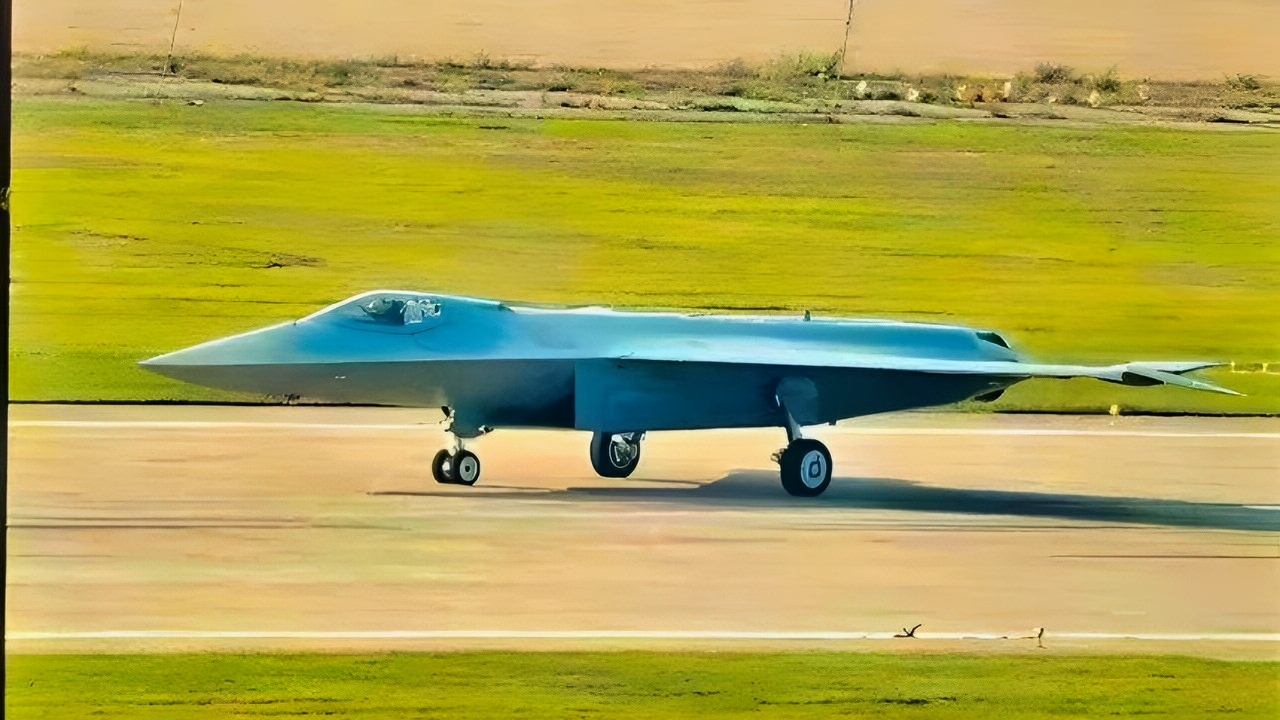
J-50 Image. Image Credit: X Screenshot.
Or did the images show more evolved demonstrators closer to operational status?
Even if the 6th-gen aircraft are comparable to the Pentagon’s emerging F-47 and F/A-XX, the operative question is whether they can be produced in large numbers quickly.
In any kind of great-power conflict, mass and formation reach will prove extremely critical, given that 5th- and 6th-gen aircraft can network across long distances.
About the Author: Defense Expert Kris Osborn, Warrior Maven President
Kris Osborn is the President of Warrior Maven – Center for Military Modernization. Osborn previously served at the Pentagon as a highly qualified expert in the Office of the Assistant Secretary of the Army—Acquisition, Logistics & Technology. Osborn has also worked as an anchor and on-air military specialist at national TV networks. He has appeared as a guest military expert on Fox News, MSNBC, The Military Channel, and The History Channel. He also has a Masters Degree in Comparative Literature from Columbia University.
More Military
The Russian Military Is In Crisis
The U.S. Military’s Superpower Status Is Slipping Away
The F-35 Looks Like It Might Be In Real Trouble Now
The F-22 Raptor Has 1 Enemy It Can Never Beat (Not Russia or China)


