

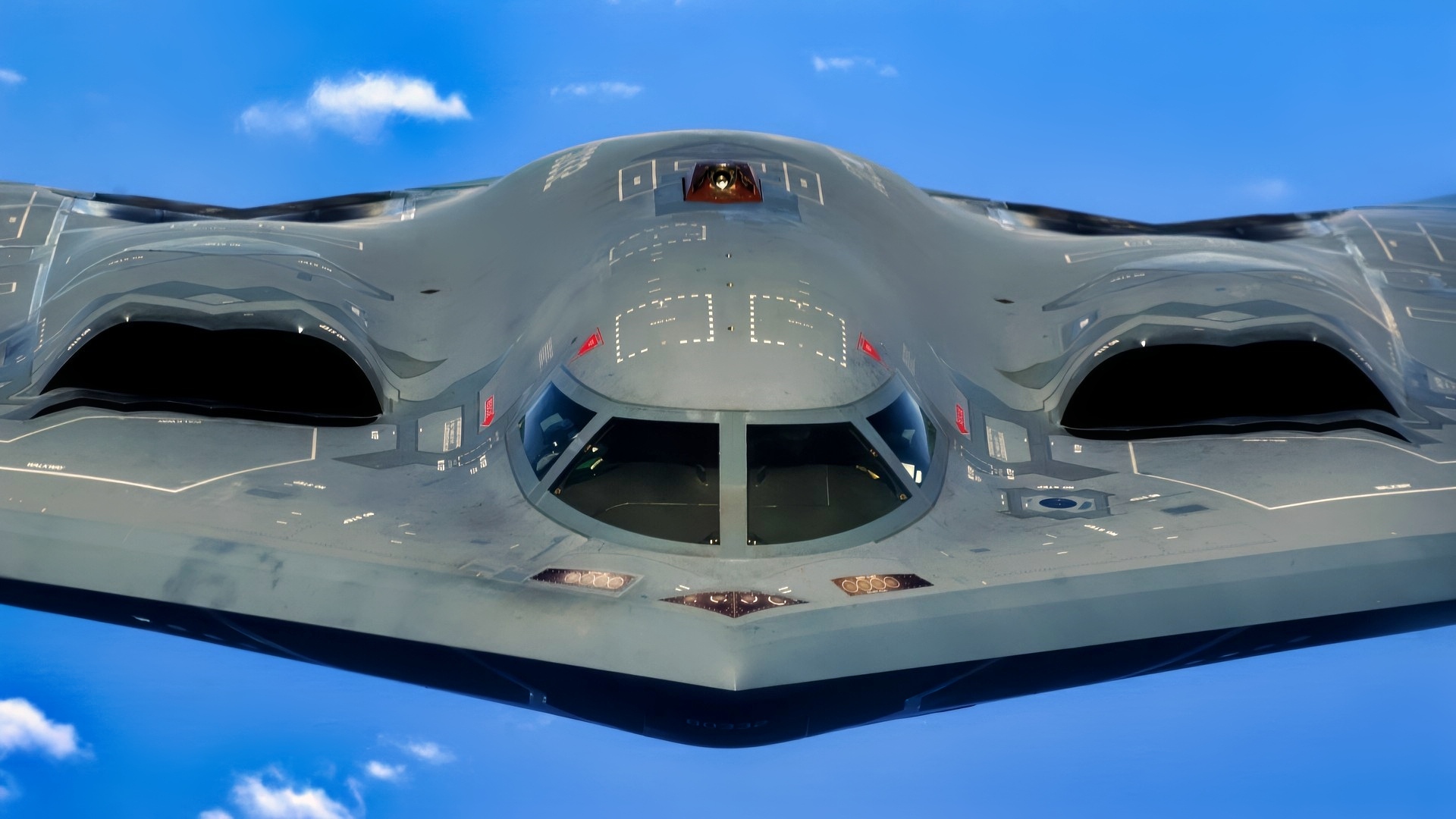
Key Points and Summary – Years of speculation surround China’s H-20 bomber, likely from Xi’an.
-Despite a missile-heavy arsenal, Beijing needs a low-observable, long-range, dual-capable platform to reach beyond the Second Island Chain and to keep its large-aircraft design base current.
-Today’s H-6, a Tu-16 derivative, is generations old. Recent video shows a diamond-shaped, blended-body aircraft with expanded wings and large tail surfaces—suggesting low RCS but not a pure flying wing—possibly a testbed.
-Unknowns remain: final configuration, timing, and quantities. What’s clear is the PLAAF is moving to replace H-6 roles with a modern stealth bomber.
H-20 – Why The PRC Needs its Own Flying Wing Bomber
WARSAW, POLAND – There have been years of speculation about a People’s Liberation Army Air Force (PLAAF) next-generation strategic bomber.
Designated some years ago as the H-20, what was said to be a subsonic stealthy platform has long been thought to have been developed by the Xi’an Aircraft Industrial Corporation (XAC).
XAC has been the traditional design center for bomber and heavy transport aircraft in the People’s Republic of China (PRC) and within the state-owned Aviation Industry Corporation of China (AVIC) aerospace conglomerate. During the past decade and a half, however, there have been several new fighter aircraft produced in the PRC—some of them, like the Chengdu J-20, in large numbers—but in that same time, no new heavy bombers.
This absence has led some to assume that a new bomber was no longer a priority for the PLAAF. Perhaps with the plethora of new missiles seen entering the force’s inventory, bombers were considered superfluous, the argument went.
However, there are some reasons why this thinking is invalid.
One is that with the evolution and expansion of the PLA’s war plans, the air force component of any future Chinese campaign would need to include a stealthy, dedicated long-range bomber platform that could operate beyond the Second Island Chain.
The platform would have to be capable of delivering both conventional and nuclear payloads on targets at extended ranges. The dual requirement of being fuel-efficient enough to operate at those distances and yet remain stealthy during its entire mission would dictate a “flying wing” configuration not unlike the American B-2 and B-21 designs built by Northrop.
Generational Development and Technology
The other factor dictating the development of a new bomber aircraft design for the PLAAF is that the current platform the force is using is several generations behind the state-of-the-art. This is the case both in terms of aerodynamic design and in the use of new-age materials.
The aircraft in use today by the PLAAF is the Xi’an H-6, which is a license-built version of the Soviet-era Tupolev Tu-16, an aircraft that first flew in 1959. XAC has built multiple versions of the aircraft, the most recent of which is the H-6K. There are currently about 120 H-6 variants in Chinese service.
The aircraft is typical of the Soviet design of that period. It is built of entirely conventional ferrous materials and other alloys. Its platform is like that of a traditional bomber that would have been in service in the 1960s, more than half a century ago.
“If you are going to maintain a competent design team that can develop large, stealthy aircraft you have to then have that team working on new-age designs,” said a US aerospace military aircraft design engineer.
“If all they are doing is continuing to work on warmed-over versions of aircraft that their fathers could have been designing before even the Vietnam War was taking place then their design skills will atrophy. You cannot maintain a credible industry in this manner, so developing a current-generation stealth bomber is the only way to keep that industry alive—to keep it relevant,” he concluded.
Images of a Flying Wing (Really the H-20?)
In early January, about a week after videos of 6th-generation fighters flown by both of the PRC’s fighter aircraft design bureaus in Chengdu and Shenyang were seen posted on a Chinese website, footage of what might be the H-20 appeared as well. The location and date of this imagery were not mentioned. As is always the case with unofficial social media postings, there was no comment made by the PLAAF or any other government entity.
#BREAKING: China’s H-20 stealth bomber has successfully undertaken its maiden flight. pic.twitter.com/jSSDrh06oN
— Defence Index (@Defence_Index) January 4, 2025
The appearance, if actually real, was still surprising, in that the US Department of Defense and the intelligence community had predicted only a short time before that it might be years before a new Chinese bomber would be in service. The question now is whether the aircraft seen is a finalized configuration that will be what XAC will someday have in series production or if it is a testbed that was built to validate various aerodynamic and radar cross-section (RCS) reduction concepts.
The footage seen this year shows a large aircraft with a stealthy diamond shape. It is a blended-body design that is optimized for a low RCS. Surprisingly, it is not a pure “flying wing” configuration. It has distinct and very expanded wings, a large empennage, and a large central fuselage.
Overall, it appears to be very similar to a Chinese wind tunnel model of a generic bomber platform that was seen on the internet in 2022. Those images showed an aircraft with a large-area tail with expansive control surfaces that could either be employed in lieu of vertical control surfaces or to generate lift for the aircraft.
Again, no official comment was made by the PLA on this possible H-20 flight. What can be said is that work on this type of aircraft continues, and eventually, there will be a new Chinese bomber platform to replace the H-6 missions. The only question is how many will be built and how soon.
About the Author: Reuben F. Johnson
Reuben F. Johnson has thirty-six years of experience analyzing and reporting on foreign weapons systems, defense technologies, and international arms export policy. Johnson is the Director of Research at the Casimir Pulaski Foundation. He is also a survivor of the Russian invasion of Ukraine in February 2022. He worked for years in the American defense industry as a foreign technology analyst and later as a consultant for the U.S. Department of Defense, the Departments of the Navy and Air Force, and the governments of the United Kingdom and Australia. In 2022-2023, he won two awards in a row for his defense reporting. He holds a bachelor’s degree from DePauw University and a master’s degree from Miami University in Ohio, specializing in Soviet and Russian studies. He lives in Warsaw.
More Military
The U.S. Army’s Big Strategic Long Range Cannon (1,150 Mile Range) Mistake Still Stings
The F-4 Phantom II Has a Message for the U.S. Military
The Iowa-Class Battleships Have a Message for the U.S. Navy
Russia’s Kirov-Class Battlecruisers Have a Message for the U.S. Navy
Russia’s PAK DA Stealth Bomber Has a Message for the U.S. Air Force


