

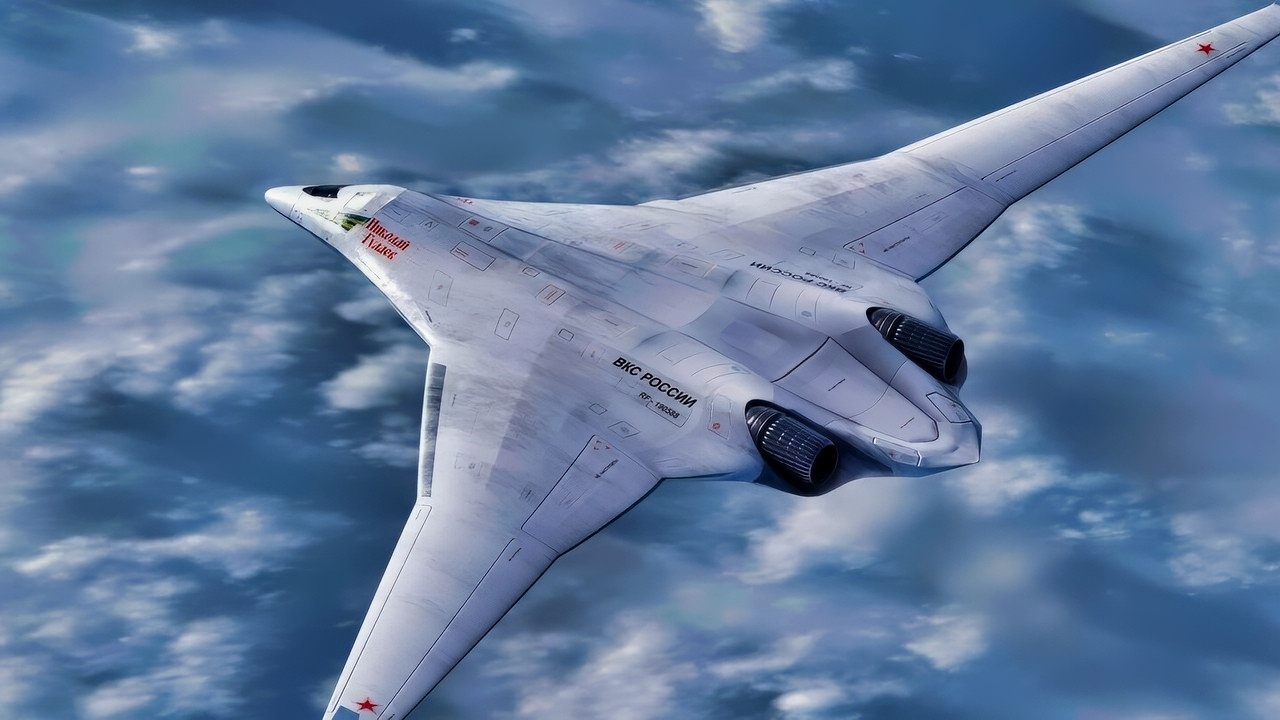
Key Points and Summary – Russia’s PAK DA was conceived to replace aging Tu-95 and complement or supplant Tu-160 bombers with a subsonic, stealthy flying-wing optimized for long-range standoff strikes.
-On paper, it would carry modern cruise missiles and possibly hypersonic weapons while acting as a networked command node.
-In practice, the program trails U.S. and Chinese efforts, colliding with design complexity, engine and avionics constraints, soaring costs, and wartime priorities.
-Sanctions and Ukraine-driven attrition have forced Moscow to refurbish legacy bombers and restart limited Tu-160M production instead.
-The future holds three paths—slip, shrink, or stop—and none looks likely to deliver a B-21-class capability soon.
PAK DA: A Stealth Bomber Russia Needs—But May Never Get
Stealth bombers aren’t prestige projects anymore; they’re essential tools for modern air campaigns. The U.S. has the B-21 Raider in flight testing with a second test jet now in the program’s rhythm, and the Pentagon intends to field it before decade’s end. China’s H-20 is less mature and not flying (at least, we think it isn’t), but Beijing openly signals a long-range stealth bomber to round out its nuclear triad and strike Western Pacific targets at range. Against that backdrop, Russia—a country with formidable aerospace heritage—finds itself behind the timeline.
The Kremlin understands the gap. Its bomber leg today depends on airframes conceived during the Cold War, updated with new sensors and missiles but still carrying the penalties of size, signature, and age. That’s the strategic context for PAK DA: a next-generation, low-observable bomber that can survive in contested airspace, strike from standoff ranges, and reduce reliance on vulnerable, legacy platforms.
The Aging Backbone: Tu-95 And Tu-160 Can’t Carry Forever
The Tu-95MS “Bear” has been a durable missile truck for seven decades, but durability isn’t invisibility. In a world of proliferating sensors, counter-stealth radars, and long-range SAMs, a large, turboprop bomber is no one’s idea of stealth—useful for launching cruise missiles from deep Russian airspace, but increasingly at risk at forward operating bases or on predictable routes.
Meanwhile, Russia’s Tu-160 “Blackjack”—fast, modernized, and still potent—is also a big radar target that depends on standoff weapons and permissive approaches to survive.
Moscow has restarted Tu-160M production and is upgrading existing aircraft, but even that effort has been slow, costly, and limited in scale. None of this negates their relevance; it simply underlines why the next bomber must be truly low observable.
Moscow’s Answer On Paper: A Subsonic Flying Wing
PAK DA is designed—as far as open sources suggest—as a subsonic flying wing with internal bays, long endurance, and payload capacity suited for Kh-101/102-class cruise missiles and future standoff munitions.
Think less “fast dash” and more “vanish and wait”: minimize radar cross-section, manage thermal and electronic emissions, and let stealth and range open routes through modern air defenses. The airframe’s planform trades sheer speed for signature control, fuel economy, and loiter, aligning with how the U.S. and China are shaping their stealth bomber families.
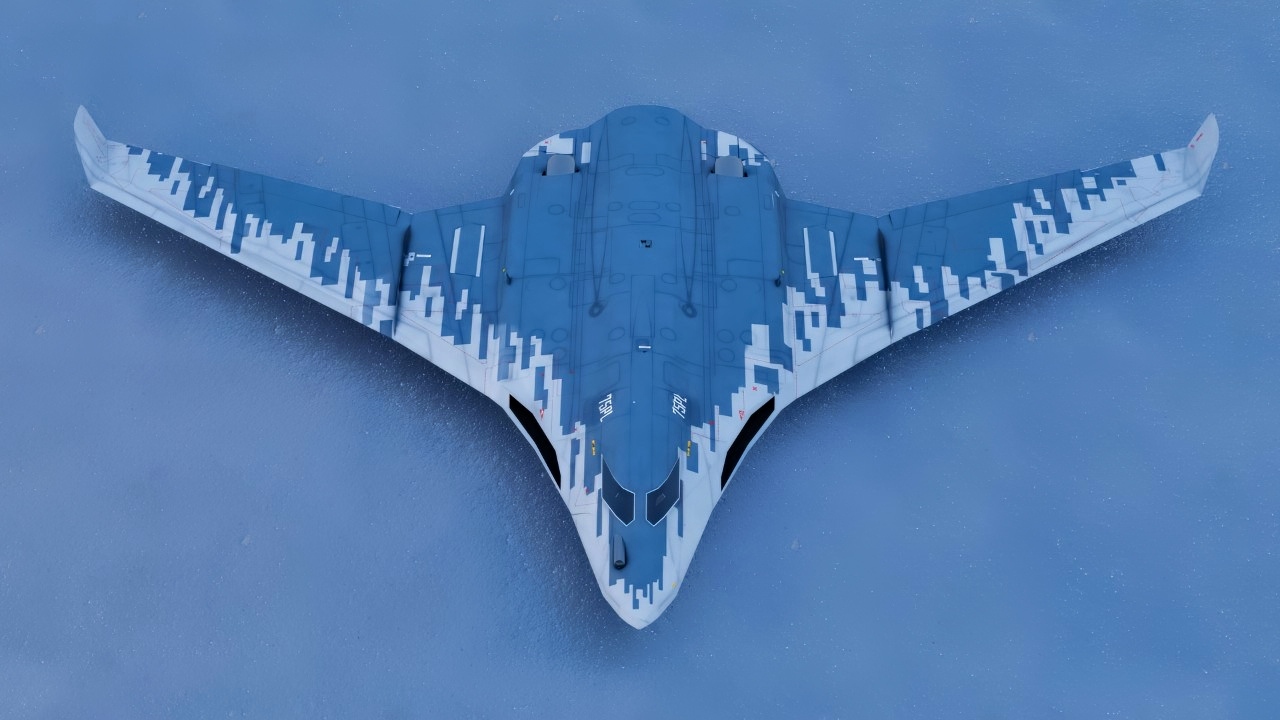
PAK DA Stealth Fighter Screenshot from X Artist Image.
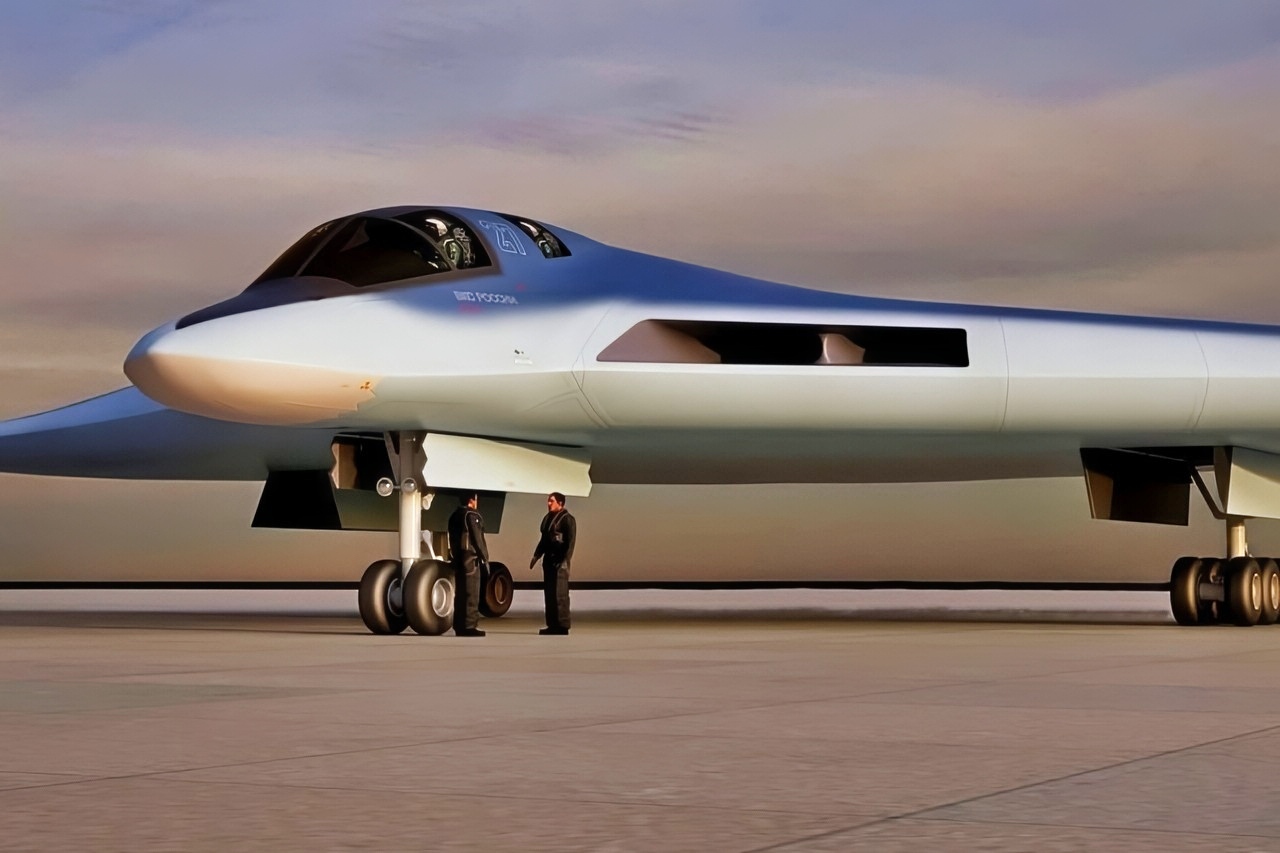
PAK DA Stealth Bomber Artist Rendering. Image Credit: Creative Commons.
That concept makes sense for Russia’s geography and doctrine. A bomber that can creep undetected to launch points—Arctic, Far East, or northern Atlantic—shrinks timelines for targets in Europe, the Middle East, or the Pacific and complicates NATO and allied defensive planning.
What It Was Supposed To Be—And When
Before the war in Ukraine, public comments from Russian officials and state media floated an optimistic cadence: preliminary designs, mockups, bench tests of a new non-afterburning engine derived from the NK-32 family, and first flight mid-2020s, with the late 2020s penciled in for early production. The aircraft had also been touted as more than a bomber—potentially a “flying command post” able to orchestrate strikes and act as an airborne node for long-range operations. Those ambitions mirrored the trend lines in Western programs: stealth plus battle management equals higher strategic payoff.
The Real World: Design Complexity Meets A Stressed Industry
A stealth bomber is a systems-of-systems challenge. The airframe is only one part; everything from inlet geometry to edge alignment, RAM coatings, thermal management, sensor fusion, EW, avionics cooling, and maintenance access must work together—or performance collapses. Even the engine, if it shares a core with the Tu-160’s NK-32, must be re-optimized for subsonic efficiency, low signature, and high reliability across long missions. That demands precision manufacturing and robust quality control.
Here, Russia hits hard limits. Post-2022 sanctions and export controls squeeze microelectronics, high-end machine tools, composite feedstocks, and specialty materials. Workarounds exist, but they inflate costs, slow schedules, and often yield inconsistent quality. At the same time, a war economy prioritizes near-term output—missiles, shells, refurbishments—over moonshots. The bomber bureau is competing for engineering talent and funding against urgent wartime repairs, drone programs, and legacy aircraft sustainment. Those are brutal tradeoffs, and bomber programs don’t thrive in that climate.
The Ukraine War: Attrition, Diversions, And A Moving Goalpost
Ukraine’s long-range drone and missile strikes have damaged or destroyed bombers on Russian bases and forced dispersal, hardening, and more maintenance—all of which consume resources. Replacing Soviet-era bombers is not feasible at any meaningful rate, so the Ministry of Defense has doubled down on modernizing Tu-95s and Tu-160s and keeping them launching standoff weapons.

PAK DA Stealth Bomber. Image Credit: Creative Commons.

PAK DA Bomber from Russia. Image Credit: Creative Commons.
That is a rational wartime choice, but every ruble and engineering hour that keeps old iron flying is a ruble and hour not spent maturing a stealth bomber from drawing board to runway.
Engines, Avionics, And The Quiet Dragon’s Tail
No modern bomber moves without a modern engine. Reports have mentioned a new non-afterburning turbofan for PAK DA based on NK-32 technology, aimed at endurance and low acoustic and infrared signatures. Bench tests are one thing; serial, reliable production is another—especially for an industry already tasked with churning out NK-32-02 for Tu-160M. Meanwhile, the avionics suite—mission computers, radar, EW receivers, data links—requires steady access to radiation-hardened chips, FPGAs, and precision RF components. Sanctions make those chains brittle; domestic substitutes are improving but patchy.
Bomber-class stealth also lives and dies on finish and fit: coatings, panel gaps, edge treatments—areas where supply chain hiccups can directly erode stealth.
The Promise Of Weapons—And The Pitfall Of Integration
PAK DA’s punch would almost certainly center on standoff cruise missiles (conventional and nuclear), with future room for hypersonic or high-speed air-launched weapons as carriage and thermal signatures allow. But integrating a diverse, evolving missile portfolio into an all-internal weapons bay is non-trivial: you must manage aerodynamics, ejectors, bay acoustics, electromagnetic compatibility, and flight-control software to avoid store-separation surprises. Every new store adds test points, range time, and design tweaks. In wartime, test ranges are crowded and budgets are triaged—again, the long-term project takes a back seat.
A Culture Of Announcements—And A Record Of Slips
Russia is not unique in over-promising; every nation’s defense industry plays schedule optimism. But Moscow’s recent track record—T-14 Armata’s stuttering path, Su-57’s slow trickle to units, the long slog to restart Tu-160M production—suggests a systemic pattern: big unveilings followed by years of limited deliveries and quiet deferrals. PAK DA has already drifted right on the timeline more than once.

Russia Tu-160 Bomber on Tarmac. Image Credit: Creative Commons.
It’s not malice or incompetence; it’s that complex aerospace under sanctions and war is unforgiving. The danger now is that the bomber becomes a permanent prototype: just enough progress to keep hope alive, never enough to field squadrons.
Why Russia Still Needs It—And Why That Matters
All the obstacles don’t erase the operational need. Modern air defenses, space-based surveillance, and distributed sensor networks make non-stealthy bombers predictable and geographically constrained. Russia can compensate by firing more standoff missiles from safe sanctuaries, but that strategy cedes initiative and escalates cost per effect. A low-observable bomber gives options: novel approach axes, deeper launch points, survivable ISR/EW roles, and deterrence by uncertainty—the adversary never quite knows what path the bomber took. As the U.S. and (eventually) China add stealth bombers, their planners will expect to operate farther forward. Without a comparable tool, Russia’s Long-Range Aviation risks becoming more predictable and more deterrable.
Sanctions: The Long Grind, Not The One-Off Blow
The most important thing about sanctions isn’t the headline; it’s the friction over time. Every missing machine tool, every delayed chip batch, every substituted resin magnifies rework and maintenance. That sort of drag doesn’t usually kill a program outright—but it stretches timelines and shrinks ambitions. A bomber needs a clean runway of years to mature coatings, certify engines, qualify weapons, and write the software glue. Russia today is living in short cycles: replace, repair, replenish. That is not the ecosystem where a stealth bomber slips quietly from mockup to metal to squadron service.
What Success Would Require
If Moscow intends to actually field PAK DA—not just build a demonstrator—three conditions have to come together:
Protected Funding Over Years. The bomber must be insulated from wartime surges and politics. That means multi-year lines for engines, composites, avionics, and coatings even when frontline commanders want more drones now.
Supply Chain Stabilization. Russia would need sustained, reliable access to the electronics and tooling that a stealth program devours, whether via domestic substitution that meets specs or shadow imports robust enough to avoid month-to-month turbulence.
Industrial Focus. Kazan and key subcontractors must balance Tu-160M work with PAK DA without starving either. That likely implies a smaller initial PAK DA batch with a crawl-walk-run philosophy—proving the airframe and engine first, then spiraling in sensors and weapons.
Even in the best case, that still points to late-decade prototypes and post-2030 meaningful numbers. Best cases are rare.
Three Futures: Slip, Shrink, Or Stop
Slip. The most likely path: the first airframe(s) do appear—a technology demonstrator and a flyable prototype—and the program slides right. Limited test flying happens, press footage rolls, but squadron service remains distant, while Tu-95/160 carry the operational burden with incremental upgrades.
Shrink. A more pragmatic variant: Moscow re-scopes PAK DA into a lower-risk stealth cruise-missile carrier, deferring the most ambitious sensors and EW. That could produce a workable bomber faster, but at the cost of capability—and still demands a stable supply chain.
Stop. The darkest branch: budget pressure and war demands atrophy PAK DA into a perpetual R&D line—useful for coatings, inlets, and software, but never yielding an operational fleet. Russia would then rely on standoff missile salvos from legacy bombers, plus whatever the Tu-160M line can deliver, and declare victory in modernization communiqués.
Why The Plane May Never Fly (Operationally)
Could a PAK DA prototype fly? Yes—Russia has the brainpower to build a demonstrator. But operational flying—dozens of aircraft, trained crews, robust sustainment, and repeatable stealth performance—is the Everest. That requires consistent materials, tight tolerances, RAM maintenance cycles, and electronics that don’t fall afoul of the next sanction wave. It requires a decade of doctrinal work to extract value from stealth without exposing the jet to the exact defenses it’s meant to bypass. It requires money measured in steady rivers, not sporadic floods. Look at Russia’s recent big-ticket programs: some fly, few scale.
The Bottom Line on PAK DA
The logic behind PAK DA is impeccable: reduce signature, extend reach, complicate defenses, and modernize deterrence. But logic doesn’t build airplanes—industrial depth, time, money, and freedom from disruption do.
With the U.S. already flying B-21 test jets and China moving—however unevenly—on H-20, Russia’s next bomber risks becoming a ghost: highly rendered in concept art, eternally promised in speeches, but rarely seen on a ramp.

A second B-21 Raider, the world’s sixth-generation stealth bomber, test aircraft arrives at Edwards Air Force Base, Calif., Sept. 11, 2025. The addition of the second test aircraft expands mission systems and weapons integration testing, advancing the program toward operational readiness. (Courtesy photo)
If Moscow can protect the program, tame its supply chain, and accept a modest early capability, a handful of PAK DAs could appear in the 2030s. If not, the Bear and Blackjack—patched, upgraded, and always visible—will carry the load, launching standoff missiles from safe airspace while others rewrite the bomber playbook.
For a country that once defined long-range aviation, that is less a tragedy than a warning: in the stealth era, yesterday’s speed and payload won’t outrun tomorrow’s sensors. Either Russia builds the bomber the world is moving toward—or it keeps paying more to survive with the ones it has.
About the Author: Harry J. Kazianis
Harry J. Kazianis (@Grecianformula) is Editor-In-Chief and President of National Security Journal. He was the former Senior Director of National Security Affairs at the Center for the National Interest (CFTNI), a foreign policy think tank founded by Richard Nixon based in Washington, DC. Harry has over a decade of experience in think tanks and national security publishing. His ideas have been published in the NY Times, The Washington Post, The Wall Street Journal, CNN, and many other outlets worldwide. He has held positions at CSIS, the Heritage Foundation, the University of Nottingham, and several other institutions related to national security research and studies. He is the former Executive Editor of the National Interest and the Diplomat. He holds a Master’s degree focusing on international affairs from Harvard University.
More Military
The Sturgeon-Class Nuclear Attack Submarines Have a Message for the U.S. Navy
The USS Nautilus Nuclear Attack Submarine Has a Message for the U.S. Navy
The Forrestal-Class Aircraft Carriers Have a Message for the U.S. Navy
The Canada-F-35 Divorce Could Have Consequences
The B-58 Hustler Mach 2 Bomber: The Air Force’s Big Blunder?


