


Key Points and Summary – China’s J-35A didn’t follow a straight path to squadron service.
-It began as the privately funded FC-31 demonstrator, a “maybe” export jet that never found a buyer.
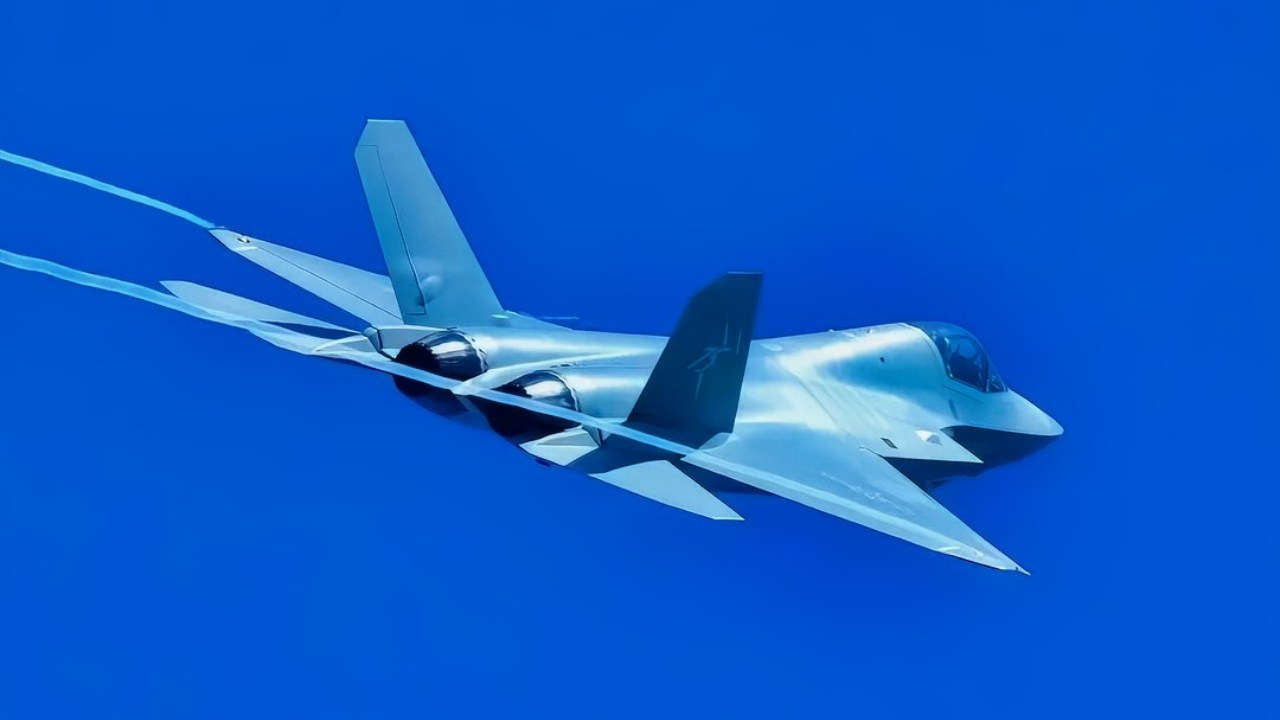
J-35A Fighter from China. Image Credit: PLAAF
-The Chinese navy’s carrier ambitions gave the airframe a home, and a land-based version for the air force followed.
-The result is a medium twin-engine stealth fighter meant to complement, not replace, the larger J-20.
-Airframe tweaks, new sensors, and evolving engines aim at better stealth and range, while naval testing on China’s Fujian carrier has accelerated development.
-In 2025, China began initial induction and operational testing—enough to make U.S. planners pay close attention.
J-35A: From Airshow Curiosity To Serious Contender
A decade ago, the FC-31 looked like a dead end—sleek in flybys, thin on customers, and overshadowed by China’s flagship J-20 program.
What changed was China’s decision to field a modern, catapult-equipped carrier.
The sea service needed a compact, low-observable jet built for catapult launches and deck life. Shenyang Aircraft Corporation refocused the FC-31 into a naval design that could fold its wings, handle the violent shove of a catapult, and live amid salt and steel.

J-35A Fighter at Le Bourget Air Show. Image Credit: Author/National Security Journal.
That shift created a platform family. Once a navy-centric J-35 took shape, a land-based variant—the J-35A—was a logical spinoff for the air force.
The “A” version trades carrier hardware for lighter gear and reshaped surfaces, then adds mission systems tailored to inland operations.
The First Big Pivot: Turning The FC-31 Into A Stealthier Family
At first glance, the J-35A still resembles the early demonstrator: mid-size, twin-engine, twin tails, internal weapons bay
. Look closer and the differences jump out. The planform has been cleaned up; the canopy and forebody lines are tighter; the inlets and bays look reworked for signature control and maintainability. The naval variant keeps a twin-wheel nose gear and bigger wing for low-speed handling; the J-35A uses a single-wheel nose gear and slightly different tails and wing area, saving weight and drag for land operations.
These details matter because “stealth” is more than shape. It’s how every edge lines up, how the inlet hides the fan face, how doors and panels close, and how the coatings survive rain, heat, and grime. The J-35A’s newer airframes show a design team iterating toward those realities rather than just posing for brochure angles.
Engines: The Quiet Race Inside The Airframe
Engines tell you where a fighter is going.
Early prototypes ran on derivatives of the WS-13 family; later test articles and naval airframes are widely reported with the WS-21, an uprated path that buys thrust and growth margin. For the J-35A, Chinese media and analysts repeatedly point to the WS-19 as the intended destination—a smaller, hotter engine derived from the J-20’s program, with the promise (not proof) of supercruise in a clean configuration.

J-35. Image Credit: Creative Commons.
Even without brochure-grade numbers, the trajectory is clear.
China is pushing for domestic engines that can power a stealth jet with useful radius and payload, not just a short sprint. That maturation curve—thrust, fuel burn, reliability—will determine how “front-line” the J-35A truly becomes over long deployments.
Sensors And Software: What Makes A Fifth-Gen Jet Feel Fifth-Gen
The J-35A’s value isn’t only in radar reflections; it’s in the way the aircraft gathers and shares information.
A modern active electronically scanned array (AESA) radar, distributed infrared sensors, and a fused cockpit picture would let a pilot act like a conductor, not just a soloist—quietly building a track file, cueing wingmen, or handing off targets to ships and ground batteries without flipping on a bright radio beacon.
China has invested heavily in that digital plumbing across its fleet. The J-35A’s job is to plug in cleanly—seeing first, shooting less often but smarter, and making other Chinese assets more lethal by sharing what it sees.
The Second Big Pivot: From Deck To Runway
The naval J-35 has already completed catapult launch and recovery trials from the carrier Fujian.
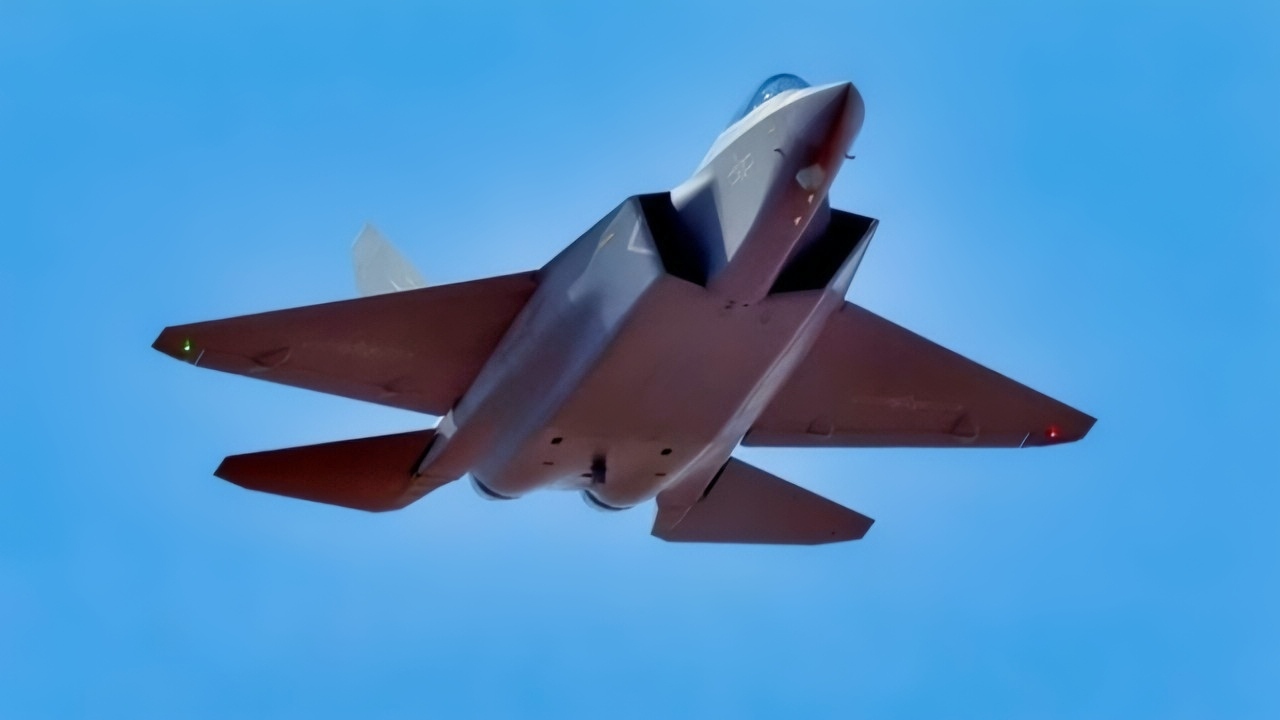
J-35 Fighter from China. Image Credit: PLAAF.
That’s important beyond the navy: carrier testing forces ruthless reliability improvements in landing gear, flight controls, and power systems that any frontline fighter benefits from.
The J-35A, meanwhile, is tailored for the air force: a leaner structure, different landing gear, and software optimized for runways, not decks.
Public showings in 2024 were followed by reports in 2025 of initial induction and training for operational test units—typical first steps before broad squadron fielding.
In other words, the program is past slideware and airshow passes. China is now grinding through the ordinary, unglamorous work of turning prototypes into fleet assets.
What Mission Does The J-35A Actually Fill?
China’s air force already flies the heavyweight J-20 for long-reach air dominance.

China J-20 With Parachute. Image Credit: PLAAF.
The J-35A slots in below it as a stealthy multirole fighter that can do air-to-air escort, strike against defended targets, and maritime interdiction—especially around the First and Second Island Chains.
Think of it as the flexible knife: small enough to base widely, stealthy enough to complicate enemy radar pictures, and networked enough to boost the lethality of everything flying around it.
Paired with the naval J-35s at sea and surveillance aircraft overhead, the land-based J-35A helps China stitch together a broader kill web over the Western Pacific. It is less about winning a Top Gun duel and more about creating bad choices for an opponent’s ships, tankers, and command nodes.
How It Evolved: The Mileposts That Mattered
The storyline has a few clean markers:
-The FC-31’s debut proved Shenyang could build a stealth-shaped, twin-engine demonstrator and fly it reliably.
-China’s pursuit of a catapult carrier created a defined customer and requirements, hardening the design into the J-35.
-A land-based J-35A prototype emerged with visible changes—single nose wheel, different wing area, revised tails—and later appeared publicly at Zhuhai in 2024.
-In 2025, naval J-35s conducted documented EMALS (electromagnetic catapult) launches from Fujian; around the same period, open-source reporting pointed to initial J-35A induction and pilot training for the air force.
Each waypoint moved the family from “promising” to “fielded enough to matter.”
What Worries U.S. Planners Isn’t Just The Jet
On paper, a single new stealth fighter doesn’t overturn air balances. What worries U.S. and allied planners is scale and integration.
China is the only country besides the United States fielding two indigenous stealth fighter families at once—one heavy (J-20) and one medium (J-35/J-35A)—and doing so alongside rapid progress at sea (a catapult carrier, a carrier-borne early warning aircraft).
Add improving domestic engines and a fast-maturing missile inventory, and the J-35A looks less like a one-off and more like a keystone in a larger arch.
China’s J-35A In 2 Words: ‘Hard Problem’
Three questions will tell us how far the J-35A can go:
Engines. Does the program settle on a domestic powerplant that meets thrust and reliability goals? That unlocks range and payload.
Production rhythm. Do we see steady deliveries to operational test and then frontline brigades—without the fits and starts that plagued earlier Chinese fighters?
Networking. Does the jet demonstrate quiet, resilient data-sharing with other platforms in large exercises? That’s the proof of a true fifth-generation ecosystem, not just a stealthy airframe.
If the answers are yes, the J-35A will evolve from “newish” to normal—another hard problem set for U.S. and allied air forces to plan around.
About the Author: Harry J. Kazianis
Harry J. Kazianis (@Grecianformula) is Editor-In-Chief and President of National Security Journal. He was the former Senior Director of National Security Affairs at the Center for the National Interest (CFTNI), a foreign policy think tank founded by Richard Nixon based in Washington, DC. Harry has over a decade of experience in think tanks and national security publishing. His ideas have been published in the NY Times, The Washington Post, The Wall Street Journal, CNN, and many other outlets worldwide. He has held positions at CSIS, the Heritage Foundation, the University of Nottingham, and several other institutions related to national security research and studies. He is the former Executive Editor of the National Interest and the Diplomat. He holds a Master’s degree focusing on international affairs from Harvard University.
More Military
The ‘Super’ B-52J Stratofortress Bomber Is Coming
The Air Force’s ‘New’ B-1B Lancer Super Bomber Is Coming Soon
‘Flying Dorito’: The A-12 Avenger II Stealth Bomber Summed Up in 1 Word
Never Finished: USS Illinois Is the U.S. Navy’s ‘Scrapped’ Iowa-class Battleship


A. User
October 26, 2025 at 2:37 pm
Unless the US plans to directly engage in combat against China wherever China intends to assert hegemony, comparisons to US capability is not particularly important.
Will China’s direct opponents other than the US have capabilitu to neutralize the new carriers and aircraft? I doubt it. And those other potential targets are far less likely, now, to assume the US will be a reliable ally.
For decades, the US has employed aircraft carriers as a nearly invulnerable standoff platform as base against the specific adversaries US was attacking/invading. Unless US intervenes directly, this will be true for China, even if carrier & stealth aircraft are merely 80% as effective of US assets.
Christian VanCura
October 26, 2025 at 9:21 pm
2 words… blatantly copied
Doug Ledel
October 27, 2025 at 9:03 am
Mostly American
2 words???
Krystal cane
October 28, 2025 at 4:42 pm
For those words Kung Fu 😂😂 😆😆😆🤡🤡👻👻😂😂💩💩🤣🤣