


China’s J-35A Stealth Fighter, Explained in One Word – Patience: If the J-20’s story is momentum, the J-35A’s is patience.
No aircraft in modern aviation waited longer, or more awkwardly, for someone to want it.
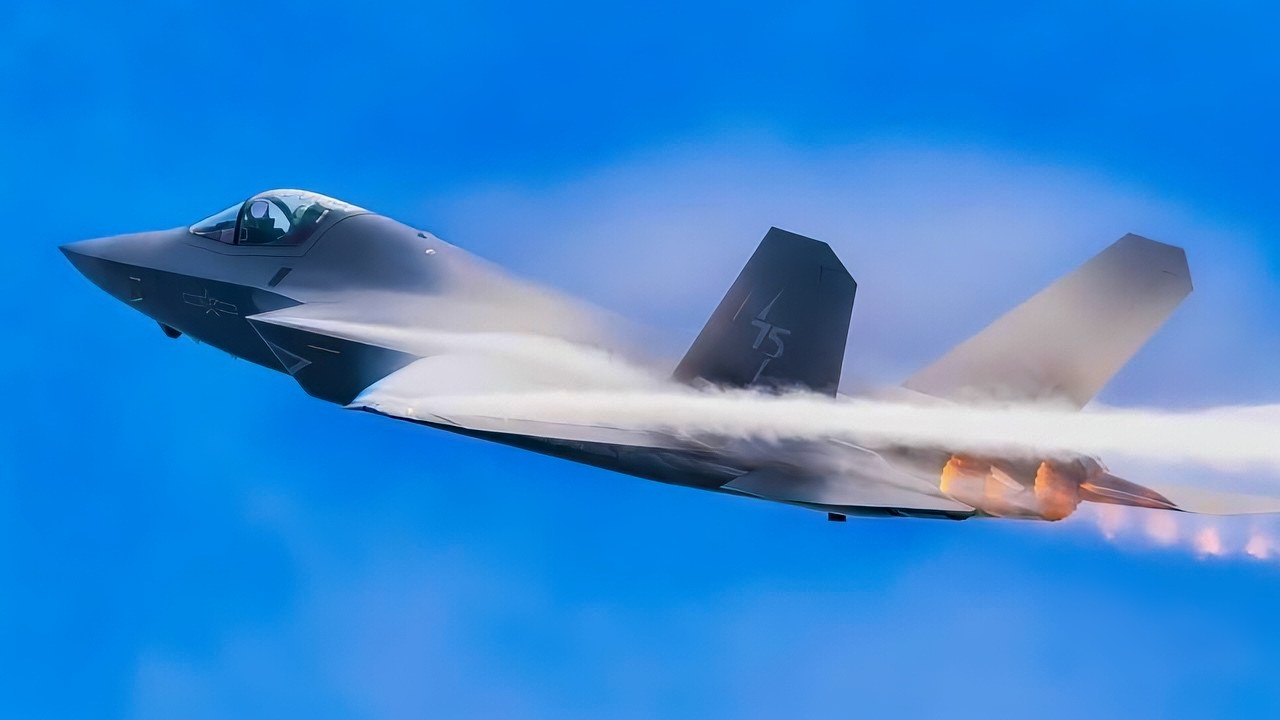
J-35A Fighter in the Clouds. Image Credit: Chinese Weibo.
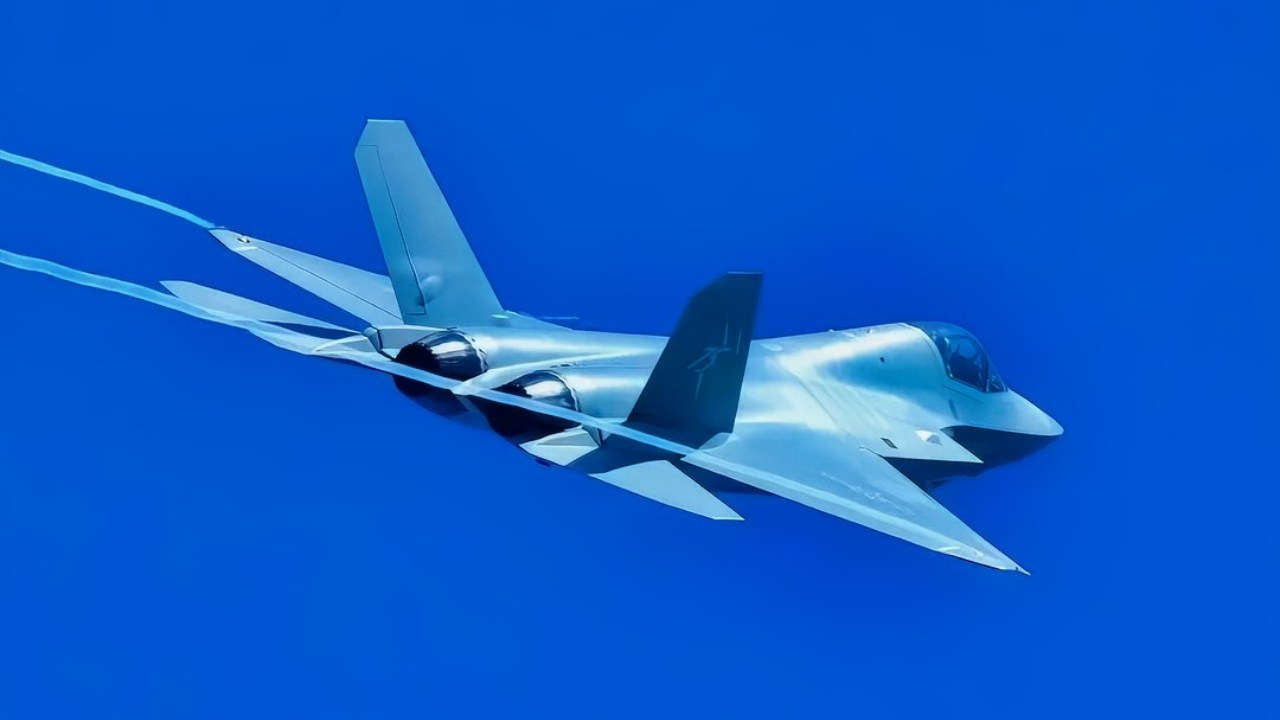
J-35A Fighter from China. Image Credit: PLAAF
Shenyang’s design lost the stealth-fighter competition that made Chengdu’s J-20 famous, flew for years as a self-funded demonstrator nobody ordered, and was written off abroad as a knockoff without a mission. Then China built an aircraft carrier with catapults, and the orphan became indispensable: a navalized J-35 for the fleet, a land-based J-35A for the air force, and an export version for everyone locked out of the F-35. Fourteen years of waiting, rewarded twice over.
The Orphan Nobody Wanted
The airframe first flew on October 31, 2012, as the FC-31 Gyrfalcon, a private venture Shenyang built on its own money after losing the People’s Liberation Army Air Force’s heavy-stealth contest to the J-20.
It flew on Russian engines, drew no domestic order, and found no export buyer despite years of airshow appearances. Its resemblance to the F-35 was noted immediately, and U.S. officials have long alleged that stolen Lockheed Martin program data fed Chinese stealth designs, allegations Beijing denies.
Whatever its origins, through the mid-2010s the jet’s most notable feature was its persistence: Shenyang kept refining the design through new prototypes with no customer in sight, a bet that a mid-weight stealth fighter would eventually find its buyer at home.
The Navy Changes Everything
The buyer arrived wearing a naval uniform. China’s third carrier, the Fujian, was built around electromagnetic catapults, and a catapult carrier without a stealth fighter is a fleet bringing yesterday’s air wing to tomorrow’s fight.
The orphan was reborn as the J-35 carrier fighter, and a land-based J-35A for the air force debuted in PLAAF markings at the Zhuhai airshow in November 2024. The milestones then came fast. By mid-2025, brigade-serialed J-35As were linked to the PLAAF’s 1st Air Brigade near Shenyang, a unit that has flown J-20s since 2021, making it the first identified unit anywhere in China operating two different stealth fighters at once.
Mixed formations flew over Beijing’s September 2025 Victory Day parade. And on September 22, 2025, the PLA Navy announced the J-35 had completed its first electromagnetic catapult launches and arrested recoveries aboard Fujian, alongside the J-15T and the KJ-600 early-warning plane.
That makes China the second nation ever to build and field its own carrier-based stealth fighter, and only one other country on earth fields two distinct stealth fighter types. It is not a coincidence that both countries build supercarriers.

China New J-35 Fighter on Aircraft Carrier. Image Credit: Chinese Weibo.

J-35 Fighter on Chinese Aircraft Carrier. Image Credit: X Screenshot.
Serial Production and the Sales Pitch
The patience is now paying industrial dividends. Shenyang has completed a vast new assembly complex, structurally finished in mid-2025 and ramping toward full-rate output, with open-source trackers identifying serial numbers indicating at least thirty production carrier airframes in the fleet by June, and the same lines building three variants at once: the naval jet, the land-based J-35A, and the export J-35AE.
The export push is aggressive, anchored on a reported price around $50 million and a no-political-strings pitch made openly at February’s Singapore Airshow. Pakistan is the perpetual first customer in waiting: reports since late 2024 describe an approved 40-jet plan and pilot training in China, but no contract has been announced, Pakistani officials have denied viral delivery claims, and the realistic timeline has slid toward 2027 while the jet remains in pre-series production for China’s own forces.
Beyond Pakistan, the Pentagon’s own report to Congress lists Egypt, Saudi Arabia, and the UAE as interested clients, while recording, as of its most recent accounting, zero sales. The sales brochure, for once, is chasing a real production line.
The Honest Ledger
Patience is not proof. The J-35 family flies on interim engines while the intended WS-19 matures, a familiar Chinese weakness the J-20 needed fifteen years to escape.
The jet has no combat record, its stealth has never been tested against a modern opponent, and the F-35’s shadow over its design invites permanent skepticism about what is original and what is derived. Its carrier variant is operational on exactly one ship, and its export program has so far delivered exactly zero aircraft. The gap between a jet that exists and a jet that is proven remains wide, and the J-35A sits squarely inside it.

Capt. Andrew “Dojo” Olson, F-35 Demonstration Team pilot and commander performs aerial maneuvers during the Wings Over Houston Airshow Oct. 18, 2019, in Houston, Texas. The show featured performances from the U.S. Air Force Thunderbirds, Tora, Tora, Tora, and Oracle. (U.S. Air Force photo by Senior Airman Alexander Cook)

NAS PATUXENT RIVER, Md. — An F-35 Lightning II test pilot conducts flight test Sept. 10 to certify the carrier variant of the fighter aircraft for carrying the AGM-158C Long-Range Anti-Ship Missile (LRASM). As part of ongoing integration efforts, the Pax River F-35 Integrated Test Force (Pax ITF) team flew two days of test flights to evaluate flutter, loads, and flying qualities with two AGM-158 loaded on external stations. LRASM is a defined near-term solution for the Offensive Anti-Surface Warfare (OASuW) air-launch capability gap that will provide flexible, long-range, advanced, anti-surface capability against high-threat maritime targets. The Pax River ITF’s mission is to effectively plan, coordinate, and conduct safe, secure, and efficient flight test for F-35B and C variants, and provide necessary and timely data to support program verification / certification and fleet operational requirements.

A U.S. Navy F-35A Lightning II with the U.S. Navy F-35C Airshow Demonstration Team performs an aerial demonstration over Rickenbacker International Airport during the Columbus Air Show, Aug. 24, 2025. This year’s event featured more than 20 military and civilian planes, including a KC-135 Stratotanker from the 121st Air Refueling Wing, which served as the base of operations for military aircraft participating in the show. (U.S. Air National Guard photo by Staff Sgt. Ivy Thomas)
Why the Word Fits
But consider where fourteen years of stubbornness landed the orphan of 2012: aboard the only non-American electromagnetic-catapult carrier afloat, inside the world’s only non-American two-stealth-fighter air force, and on the shopping lists of air forces across the region where the next great air war would be fought.
The J-20 sprinted. The J-35A waited and outlasted everyone who laughed at it. Patience, in the end, was the weapon.
About the Author: Harry J. Kazianis
Harry J. Kazianis (@Grecianformula) was the former Senior Director of National Security Affairs at the Center for the National Interest (CFTNI), a foreign policy think tank founded by Richard Nixon based in Washington, DC. Harry has over a decade of experience in think tanks and national security publishing. His ideas have been published in the NY Times, The Washington Post, The Wall Street Journal, CNN, and many other outlets worldwide. He has held positions at CSIS, the Heritage Foundation, the University of Nottingham, and several other institutions related to national security research and studies. He is the former Executive Editor of the National Interest and the Diplomat. He holds a Master’s degree focusing on international affairs from Harvard University.


