


China’s J-20 Mighty Dragon Stealth Fighter, Explained in One Word: Fifteen years after a gray prototype lifted off in Chengdu and embarrassed a visiting American defense secretary, China’s first stealth fighter has become the most consequential military aircraft of its generation that has never fired a shot in anger. One word explains why.
One Word: Momentum

J-20 on the Tarmac. Image Credit: Creative Commons.
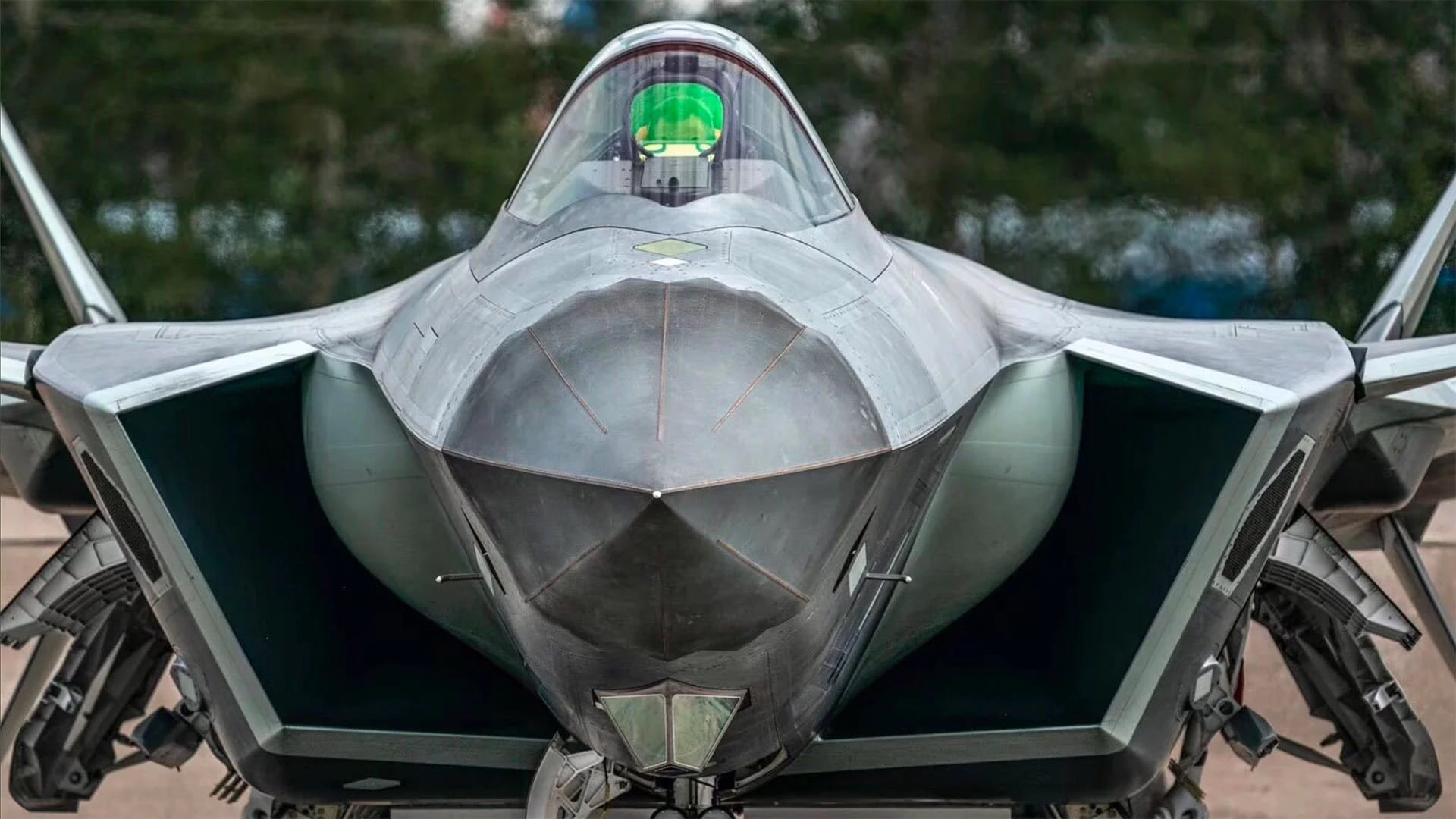
J-20 Fighter Image. Image Credit: Creative Commons.
If you had to break down the J-20 Mighty Dragon in a single word, it would be momentum.
Not stealth, which remains debated; not dogfighting, which was never really the point; not even numbers, though the numbers have become the story. Momentum, because the J-20’s defining feature is that every milestone skeptics said was a decade away kept arriving early, and the program has never once slowed down. First flight when Washington said China couldn’t. Frontline service six years later. The engine that it waited fifteen years for is now standard. The world’s first two-seat stealth fighter spun off along the way. And a fleet that has gone from one prototype to roughly 500 aircraft while America’s F-22 line sits closed. Judge the jet however you like; the trajectory only points in one direction.
The Debut that Announced Itself
The J-20’s first flight, on January 11, 2011, was timed, deliberately or not, to the exact Beijing visit of U.S. Defense Secretary Robert Gates, who had publicly estimated China was years further from a stealth fighter. Designed at Chengdu under chief designer Yang Wei as a big, canard-delta, twin-engine machine, the jet materialized far ahead of American intelligence timelines, and U.S. officials have long alleged that stolen F-35 program data helped it along, a charge Beijing denies. Whatever the recipe, the message of that first flight was unambiguous: the era of an American monopoly on stealth aviation was ending.
From Prototype to Frontline
The pace never let up. The J-20 made its public debut with a flypast at the 2016 Zhuhai airshow, entered service in March 2017 as the first non-American stealth fighter ever fielded, and reached combat units the following year. Its one chronic weakness was the engine: early jets flew on Russian AL-31Fs, then interim Chinese WS-10Cs, while the intended WS-15 powerplant, the key to supercruising at supersonic speed without afterburner, spent more than a decade in development. That gap has now closed. The WS-15 flew in a J-20 in 2023, and new-build J-20As are rolling out of Chengdu constructed around the engine from day one, with frontline units already converting.
The Numbers Nobody Predicted
Here is where momentum becomes strategy. The fleet officially crossed 300 aircraft last September, and analysts tracking the program now assess that around 500 J-20s have likely been delivered as of mid-2026, spread across 14 frontline units and all five of China’s theater commands. Production estimates range from Jane’s conservative 70-80 a year to nearly 120 delivered in a single recent year by a British RUSI analyst’s count, a pace that could push the fleet toward 1,000 aircraft by 2030. For scale: the entire F-22 production run was 187 jets, and the line closed in 2012. China has built more than two and a half times that many Mighty Dragons and is adding roughly an F-22 fleet’s worth every 18 months. The family keeps growing, too: the two-seat J-20S, the first twin-seat stealth fighter revealed by any nation, is built to quarterback drones and manage sensors, and Beijing used the program’s fifteenth anniversary in January to announce the variant is adding maritime strike to its portfolio. The Pentagon’s December report to Congress stated the conclusion plainly: the growing J-20 inventory is built to contest American and allied air operations in a conflict.
The Honest Ledger
Momentum is not the same as mastery, and the honest ledger matters.
The J-20 has no combat record. Its stealth quality has never been tested against a modern adversary, and its canard layout has fueled a decade of debate about its radar signature. The engines arrived fifteen years late, and reliability questions linger.
Readiness and pilot training remain opaque, with the Mitchell Institute cautioning that available data on the force is thin, and American officials periodically downplay the jet outright. And China’s own sixth-generation prototypes, flying since late 2024, are already beginning to reframe the Mighty Dragon as the mass fighter of the fleet rather than its cutting edge.
Why the Word Fits
But that reframing is itself the point. A program that was mocked in 2011 as a mockup with borrowed engines now outbuilds every Western fifth-generation line on earth annually, fields variants no one else has attempted, and forms the backbone of the air force America would meet in the Pacific war its own wargames keep struggling to win.
The J-20, in one word, is momentum, and after fifteen years, no one has found the brakes.
About the Author: Harry J. Kazianis
Harry J. Kazianis (@Grecianformula) was the former Senior Director of National Security Affairs at the Center for the National Interest (CFTNI), a foreign policy think tank founded by Richard Nixon based in Washington, DC. Harry has over a decade of experience in think tanks and national security publishing. His ideas have been published in the NY Times, The Washington Post, The Wall Street Journal, CNN, and many other outlets worldwide. He has held positions at CSIS, the Heritage Foundation, the University of Nottingham, and several other institutions related to national security research and studies. He is the former Executive Editor of the National Interest and the Diplomat. He holds a Master’s degree focusing on international affairs from Harvard University.


