

Newly published satellite imagery shows China testing multiple large stealth flying-wing drones at a secretive military site. The images, taken on March 26, 2026, show two previously identified large stealth drones operating simultaneously at China’s Malan test base in Xinjiang, alongside a third fighter-like unmanned aircraft. The imagery, provided by Planet Labs and published across multiple news outlets, marks the first time both large flying-wing aircraft have been observed together outside their hangars, suggesting a recent increase in testing activity.
The aircraft are part of an ongoing push by the Chinese to develop advanced unmanned systems capable of long-range surveillance and strike missions – a capability that is becoming central to future air combat concepts in both China and the United States.
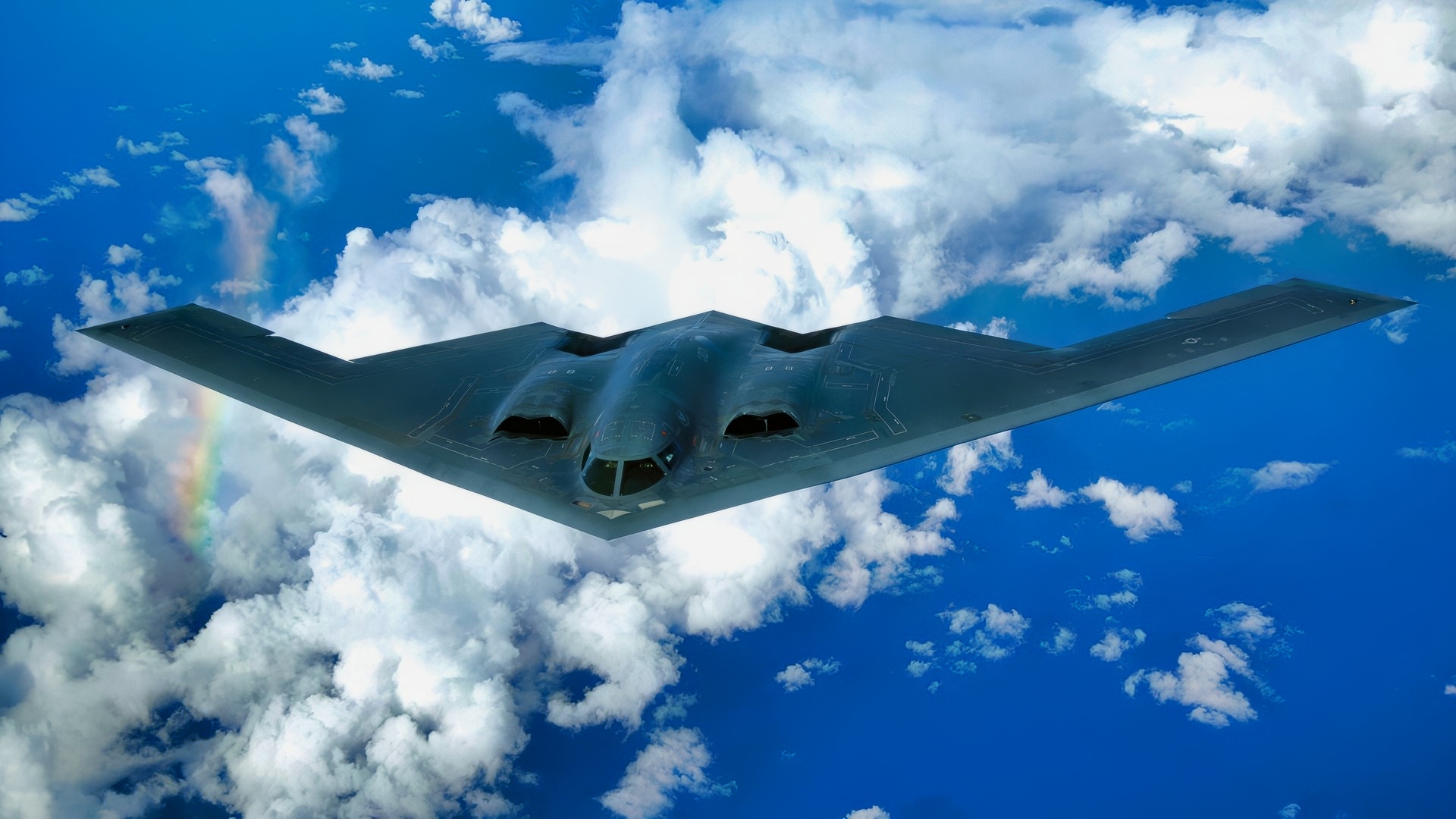
A B-2 Spirit soars after a refueling mission over the Pacific Ocean on Tuesday, May 30, 2006. The B-2, from the 509th Bomb Wing at Whiteman Air Force Base, Mo., is part of a continuous bomber presence in the Asia-Pacific region. (U.S. Air Force photo/Staff Sgt. Bennie J. Davis III)
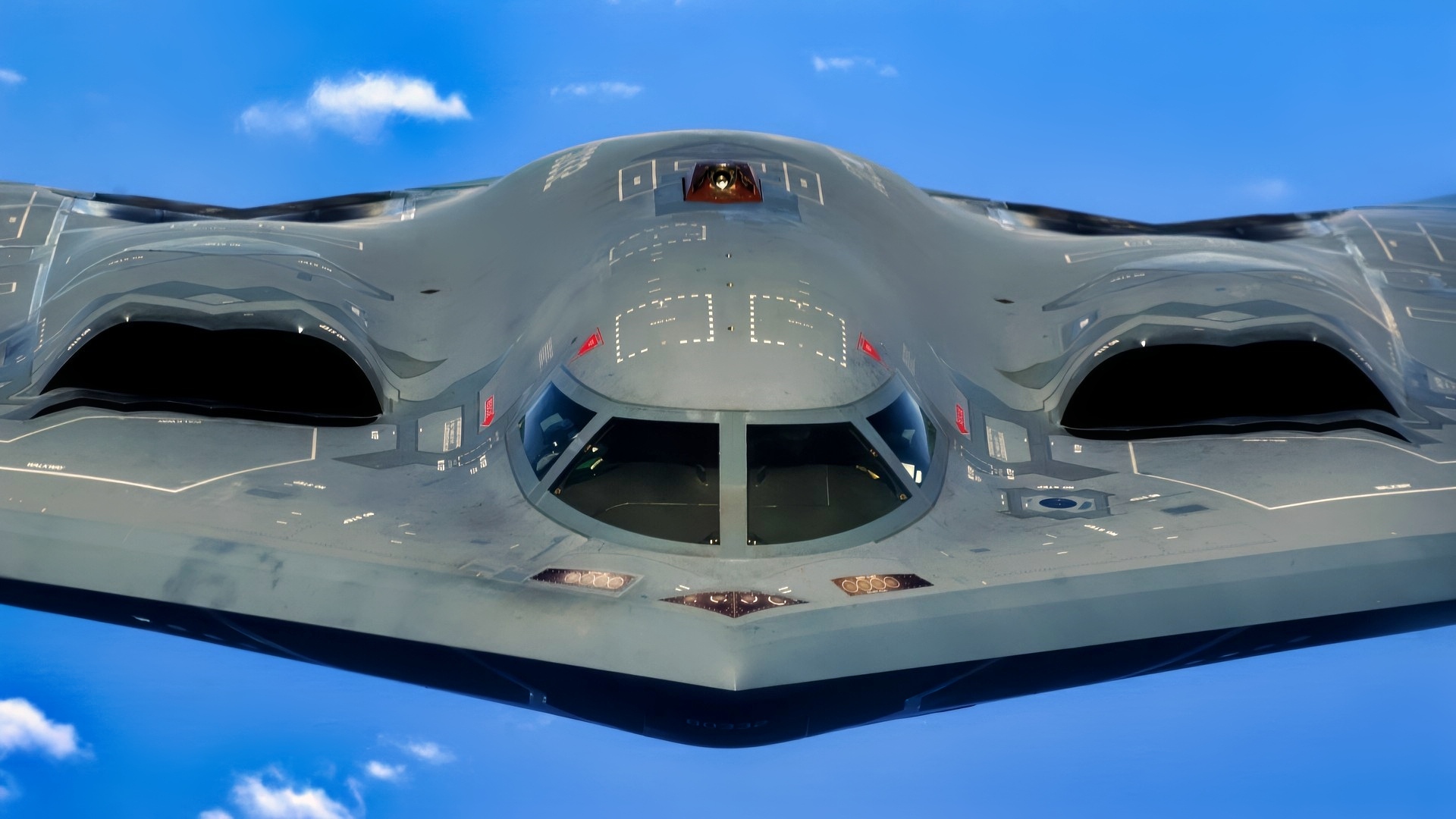
B-2A Spirit Stealth Bomber USAF Image.
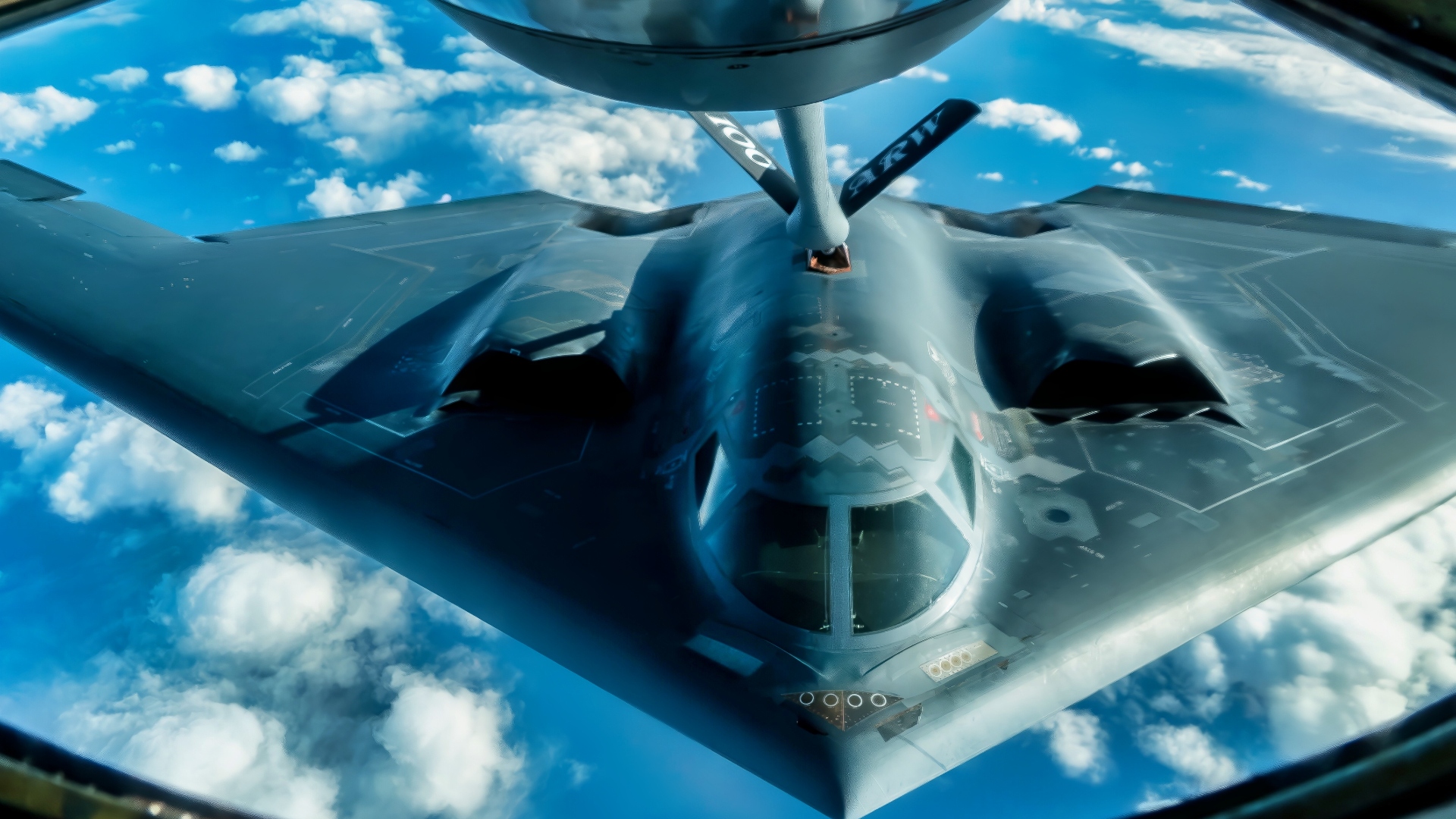
A U.S. Air Force B-2 Spirit assigned to the 509th Bomb Wing from Whiteman Air Force Base, Missouri, receives fuel from a 100th Air Refueling Wing KC-135 Stratotanker during Global Thunder 20, Oct. 28, 2019. Global Thunder is an annual command and control exercise that provides training opportunities for all of U.S. Strategic Command’s mission areas, tests joint and field training operations, and has a specific focus on nuclear readiness. (U.S. Air Force photo by Staff Sgt. Trevor T. McBride)
What We Just Saw
The recent imagery shows two flying-wing drones positioned at opposite ends of the Malan complex, along with an additional aircraft on the apron.
The larger of the two drones, sometimes referred to by analysts as “WZ-X,” has an estimated wingspan of roughly 52 meters (around 173 feet), placing it in the same class as the Northrop Grumman B-2 Spirit. Its long, slender wing design suggests it is optimized for high-altitude, long-endurance operations, likely focused on strategic intelligence, surveillance, and reconnaissance (ISR).
A second aircraft, featuring a cranked-kite wing configuration and a wingspan of approximately 42 meters (137 feet), appears heavier and more suited to strike missions. Its broader fuselage and internal volume indicate it could carry significant payloads, including weapons or additional fuel for extended range.
Also visible in the images is a smaller, tailless fighter-like drone, comparable in size to a light tactical aircraft, and a Xi’an Y-20 transport aircraft.
The fighter-type drone has appeared repeatedly in other images over the last year, indicating that it is part of an active test program.
The Secretive Malan Base Central to Drone Development
The aircraft are being tested at Malan Air Base, a remote and heavily secured facility in western China that has become a central hub for advanced aerospace programs. Malan’s isolated desert location provides both operational security and access to large volumes of restricted airspace, making it ideal for testing experimental aircraft. The base has previously hosted development work on reconnaissance drones, hypersonic systems, and other advanced platforms.
Satellite imagery over the past year has shown a steady increase in activity at the site, including large-scale exercises involving multiple unmanned systems operating alongside conventional aircraft.
The presence of several distinct drone types suggests that China is developing multiple platforms, betting that parallel programs covering multiple mission sets will ensure its air force gets the tools it needs to compete with the West.
Beijing Expands Stealth Drone and Loyal Wingman Programs
The aircraft observed at Malan appear to be part of an ongoing push by the Chinese to create stealthy, unmanned aircraft – particularly flying-wing designs that are best compared to the American B-2 Spirit and B-21 Raider.
China has already fielded or tested several similar platforms, including the GJ-11 Sharp Sword, a flying-wing unmanned combat aircraft that was shown only last year in semi-operational configurations.
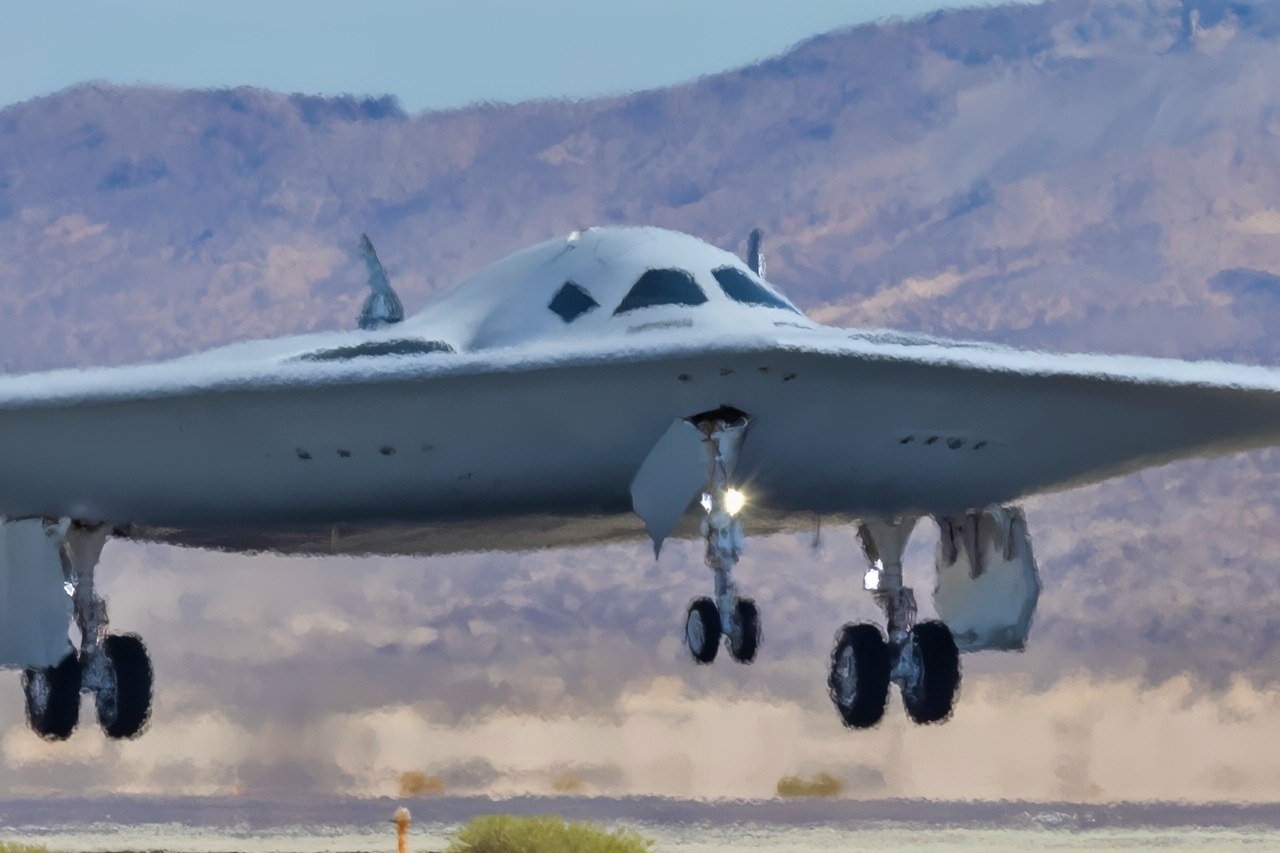
A B-21 Raider test aircraft lands at Edwards Air Force Base, Calif., during ongoing developmental flight testing, Sept. 11, 2025. The B-21 will be the backbone of the bomber fleet; it will incrementally replace the B-1 Lancer and B-2 Spirit bombers. (U.S Air Force photo by Todd Schannuth)

A second B-21 Raider, the nation’s sixth-generation stealth bomber, joins flight testing at Edwards Air Force Base, Calif., Sept. 11, 2025. The program is a cornerstone of the Department of the Air Force’s nuclear modernization strategy, designed to deliver both conventional and nuclear payloads. (Courtesy photo)

A second B-21 Raider, the world’s sixth-generation stealth bomber, test aircraft arrives at Edwards Air Force Base, Calif., Sept. 11, 2025. The addition of the second test aircraft expands mission systems and weapons integration testing, advancing the program toward operational readiness. (Courtesy photo)
Other programs, including the CH-7 flying-wing stealth drone and additional “loyal wingman”-type drones, reveal China’s ambitions: to integrate unmanned aircraft into future air combat formations in much the same way as the United States Air Force and Navy are planning. The drone systems are designed to complement fifth-generation and upcoming sixth-generation fighter jets, providing additional sensors and weapons capacity. China has made its intentions quite clear, too, displaying multiple drone concepts during its September 2025 military parade.
What It Means for the U.S.
While China rapidly develops its own drones, the U.S. is doing the same, with several key efforts currently underway and entering new phases of development. The U.S. Air Force’s Collaborative Combat Aircraft (CCA) program – designed to produce autonomous “loyal wingman” drones that operate alongside manned fighters – is expected to begin fielding operational systems before the end of the decade, with initial increments projected around 2028.
The aircraft are expected to fly with the service’s Next Generation Air Dominance (NGAD) platform, which will provide additional sensors and electronic warfare capabilities, among other upgrades.
At the same time, the U.S. has been operating the highly classified Northrop Grumman RQ-180 program for high-altitude, stealthy ISR missions, with its existence publicly confirmed in recent years. Just this year, the secretive drone was spotted flying over Greek airspace. It is understood to have been in development for more than a decade.
But while U.S. programs remain focused on integrating unmanned systems into a manned-unmanned team, imagery from Malan suggests China is working on multiple programs in parallel, potentially to field a more expansive and independent unmanned strike and surveillance capability to expand and secure its presence in the Indo-Pacific.
About the Author: Jack Buckby
Jack Buckby is a British researcher and analyst specializing in defense and national security, based in New York. His work focuses on military capability, procurement, and strategic competition, producing and editing analysis for policy and defense audiences. He brings extensive editorial experience, with a career output spanning over 1,000 articles at 19FortyFive and National Security Journal, and has previously authored books and papers on extremism and deradicalization.


