


Key Points and Summary – A recent collision between a Chinese Navy destroyer and its own Coast Guard vessel near Scarborough Shoal has publicly punctured Beijing’s narrative of seamless maritime dominance.
-This embarrassing “unforced error,” which occurred while intimidating a Philippine ship, has triggered a predictable and dangerous response from China.
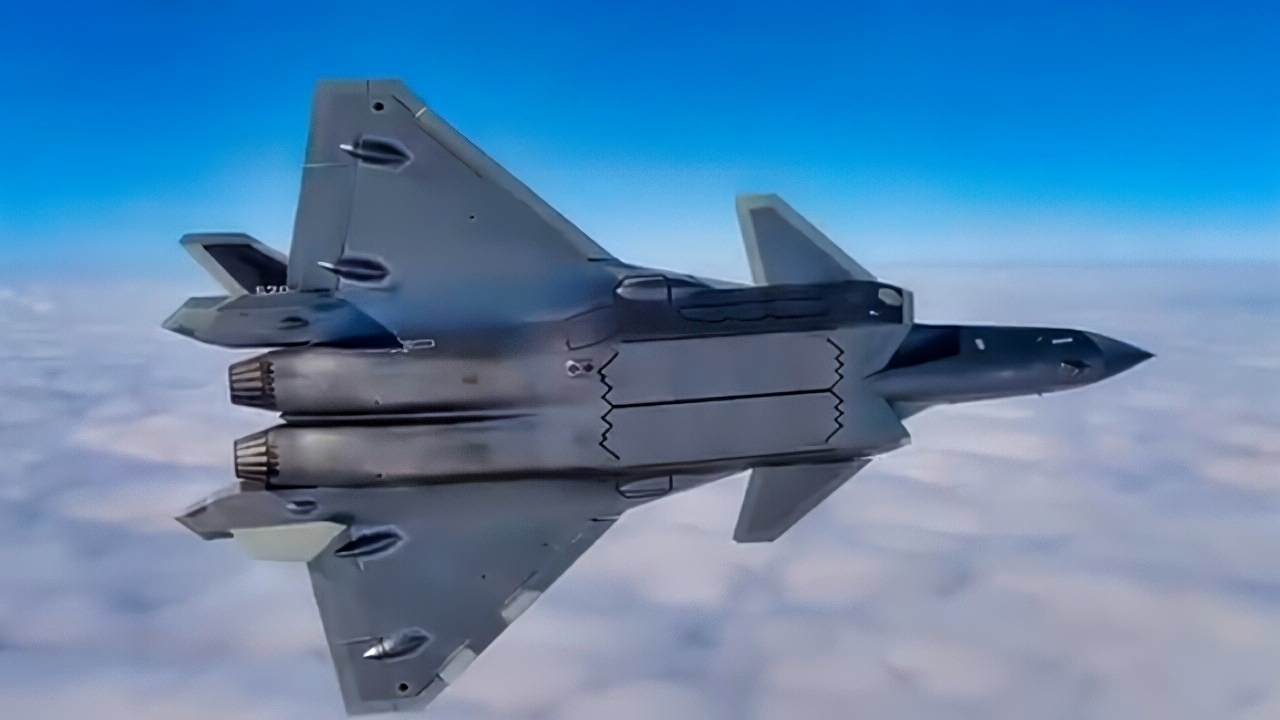
China J-20 Screenshot. CCTV Screenshot from State TV.
-Beijing is now escalating its aggression with unsafe aerial intercepts and is expected to swarm the disputed shoal with its naval and militia forces.
-This desperate attempt to “save face” is dangerously raising the stakes in a region where the U.S. has firm security commitments with the Philippines.
When Saving Face Risks Losing the Sea: China’s Dangerous Scarborough Escalation
When a People’s Liberation Army (PLAN) Navy destroyer rammed and crushed the bow of its own China Coast Guard (CCG) earlier this month China’s bid to project seamless maritime dominance instead exposed its own seamanship as a liability.
In the contested waters near Scarborough Shoal, the Chinese navy managed to deliver a humiliation to itself that no rival could have engineered. In a dangerous manoeuvre intended to intimidate a smaller Philippine Coast Guard (PCG) ship, a Chinese Type 052D destroyer collided with and crushed the bow of a CCG vessel that had been closing in on the same target. The intended show of seamless naval–coast guard coordination became, instead, a public display of confusion, miscommunication, and poor seamanship.
For Beijing, this was not simply a tactical mishap. In Chinese political and military culture, such incidents eroded the perception of competence and control—two pillars of the Chinese Communist Party’s claim to legitimacy in the South China Sea. The Party has spent over a decade building the image of an unstoppable maritime presence in these disputed waters. That image cracked when the PLA Navy and CCG vessels collided.
China is attempting to reassert dominance. A PLA fighter jet dangerously buzzed a PCG patrol aircraft, passing at an unsafe distance in a deliberate show of force. The message was unmistakable: the People’s Republic would not allow an operational blunder to undermine its claim to mastery over the South China Sea.
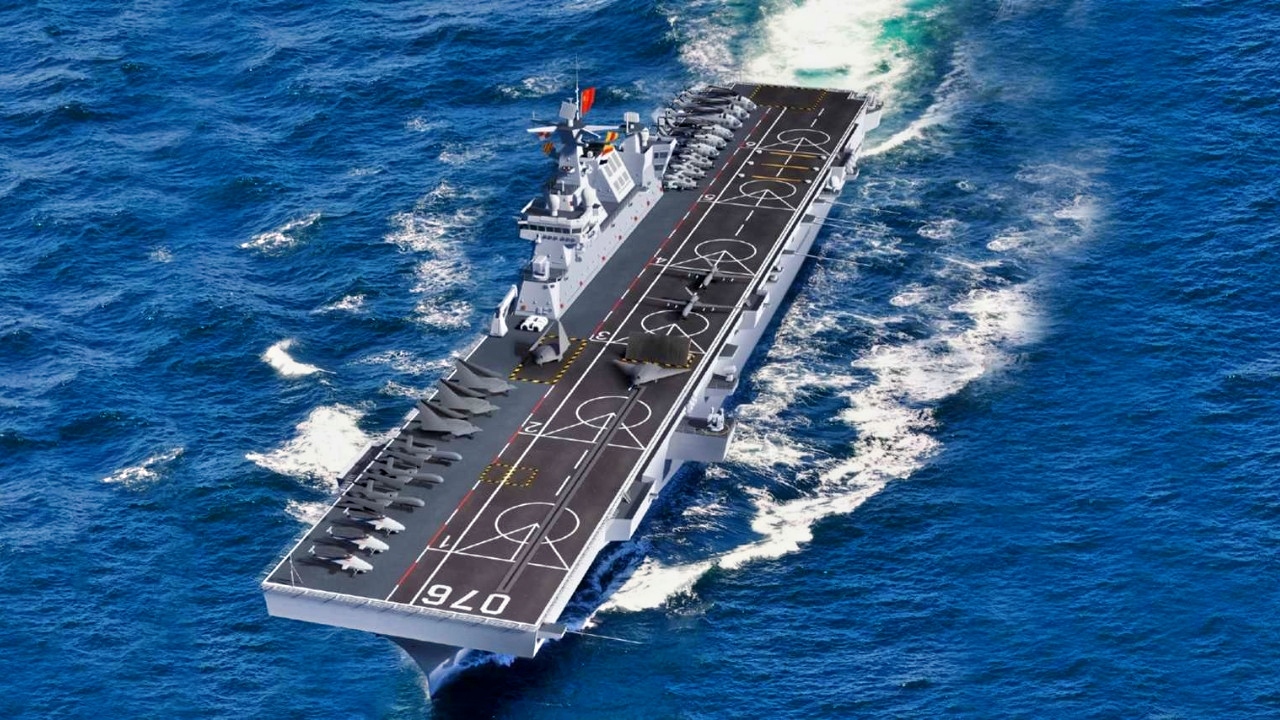
China Type 076 from Chinese Weibo Screenshot.
The South China Sea has long been the arena where Beijing combined ‘grey zone’ coercion, illegal warfare, and military intimidation to bend smaller neighbours to its will. The Scarborough Shoal is both a strategic outpost and a political symbol. Located well within the Philippines’ exclusive economic zone (EEZ) as defined by the 2016 Hague Tribunal ruling—which China has ignored—it has been under de facto Chinese control since 2012. Manila’s renewed patrols under President Ferdinand Marcos Jr. have been a direct challenge to that status quo, backed by the US explicit security guarantees.
In this context, the destroyer–coast guard collision was more than an operational embarrassment; it was a challenge to the narrative of Chinese inevitability. Adversaries now had a propaganda gift: proof that China’s “maritime machine” was capable of stumbling over itself. In a contested region like the South China Sea where perceptions shape deterrence, losing face could be as damaging as losing a battle.
Historically, Beijing’s response to such humiliations has followed a predictable pattern. First comes a show of strength—often through increased patrols, harassment of rival vessels, and assertive air manoeuvres. This is aimed at quickly re-establishing the image of control. Second comes a sustained campaign to alter the status quo in its favour, whether by deploying more assets, expanding artificial island facilities, or creating new “facts on the water” through construction and enforcement. Third, a parallel propaganda push reframes events so that China appears the victim of foreign provocation.
All three phases may now be in motion. The unsafe intercept of the Philippine patrol aircraft was almost certainly the opening act of a broader pressure campaign. We should expect to see Chinese warships and coast guard vessels swarm the Scarborough Shoal over the coming weeks, forcing Philippine vessels to either withdraw or risk repeated confrontations. Maritime militia craft—civilian in name only—will likely add to the numbers, making it harder for Manila to counter without appearing to escalate.
Economics may also be weaponised. Beijing has previously restricted agricultural imports, delayed customs clearances, and cut tourist flows to punish Manila. Such measures allow China to raise costs without firing a shot. And if these steps fail to erase the embarrassment, Beijing could resort to a high-profile seizure—a fishing boat detained, a reef blockaded, or a Philippine supply mission turned back—to produce the imagery of dominance that domestic audiences expect.

J-20. Image Credit: Creative Commons.
The risk in this pattern is that the Philippines is no longer isolated. Under Marcos Jr., Manila has deepened defence cooperation with the US, Japan, and Australia, and opened more bases to US forces. Washington has repeatedly affirmed that any armed attack on Philippine public vessels or aircraft in the South China Sea would trigger mutual defence obligations. That raises the stakes for every “buzz,” every ramming, every blockade attempt.
China’s desire to save face could therefore become the spark for a wider confrontation. A single miscalculated manoeuvre could injure or kill Philippine personnel, prompting Manila to invoke the US treaty. In such a scenario, China would find itself facing not a solitary coast guard cutter but a coalition naval presence, with all the strategic costs that entails.
Beijing’s leaders must weigh the value of symbolic recovery against the danger of strategic overreach. The Scarborough Shoal is important, but it is not worth a direct clash with US treaty allies. Yet if history is any guide, the political imperative to demonstrate resolve—especially after a public embarrassment—will outweigh the caution urged by professional sailors and diplomats.

J-10. Image Credit: Creative Commons.
The ramming of its own vessel was an unforced error that punctured the image of Chinese maritime infallibility. The dangerous aerial intercept that followed signalled that Beijing intends to erase that memory quickly. But in the high-stakes environment of the South China Sea, regaining face is rarely a cost-free exercise.
In the South China Sea, the greatest threat to China’s ambitions may not be its rivals, but its own need to prove it never falters—no matter how close that urge sails to disaster.
About the Author: Joe Verner
Joe Varner is a senior fellow at the Macdonald-Laurier Institute in Ottawa and the Center for North American Prosperity and Security in Washington, D.C.
More Military
The U.S.-Venezuela War of 2025?
The F-15EX Eagle II Doesn’t Need Your Stealth Pity


Vlad
August 27, 2025 at 4:11 pm
Misleading narrative.
The Philippines, like Taiwan, is being viewed as a useful cudgel for US confrontation with china.
That confrontation is totally inevitable, or fully unavoidable.
China’s leadership is seen as still rather myopic, not learning or understanding fast enough to handle the unfolding situation. Don’t worry about Taipei or manila. These are the LEAST of china’s worries (or danger).
On 26 august 2025, spaceX’s starship successfully blasted off from its pad in Texas.
The launch was rated a top success with the starship vessel landing in the Indian ocean, albeit with a big big bang.
Imagine what the US could do with a bunch of starships. A fleet of spacecraft fitted with thermonuclear warheads.
Instead of landing in the Indian ocean, they could very well land somewhere else.
The US is today on the verge of (if not already on it) possessing the ability to employ nuclear blackmail on its rivals.
That is the real dangerous danger staring china right in the face today.
Even without a fleet of starships, the US already has enough long-range aircraft to do the trick. Firing LRSOs, ARRWs, Mako missiles, HALOs and many many many other air-launched types, US has the potential today to totally finish off china.
Forget the Philippines and Taiwan. The real danger is the US itself.
How to confront the danger.
Learn from elon musk. Now is the TIME to develop a fleet of rockets and spaceplanes and spacebombers, all supervised by AI or AGI, so that the US will have to THINK TWICE before striking.
Otherwise the US will surely do an Iraq or a Libya on the country. There’s no time to lose.
Tim
August 28, 2025 at 12:30 pm
The Philippines joyfully booted us out of Subic Bay back in the 1980s (I remember the hooping and hollering in their legislature when the vote was passed).
But now they’re cowering before the big bad Chinese and, of course, want us to swoop in and save the day.
Forget them. Let them deal with the Chinese on their own…and let them rue the day they booted us out.
Andrew
September 1, 2025 at 4:38 am
The Chinese may be able to build ships and planes quickly. They may purport to have state of the art weapon systems. This may or may not be fully true. However, military effectiveness is driven by people and tactical efficiency.
The recent collision in the South China Sea shows that Chinese personnel are not the best. Not the best trained and certainly not the most experienced or tactically proficient. Better seamanship by the little old Philippines showed that China is a big dog without sharpened teeth.
Not only can the West and its Eastern allies match up with the Chinese and its lack of allies, the West has perfected interoperability and has honed tactical efficiency. If numbers and weapon systems alone were the ticket to military success, then the Russians would have defeated the Ukraine years ago. The Ukrainians do a lot more with a lot less because they fight better and are tactically superior to Russian forces utilizing what they do have to its greatest effectiveness. Just look at Russian losses compared to Ukrainian ones. If the Russians had to face the combined efforts of NATO along with Ukraine the war would be long over and Ukraine would be restored to itself. Only its nuclear arsenal and Putin’s hubris protects Russia from such an outcome.