
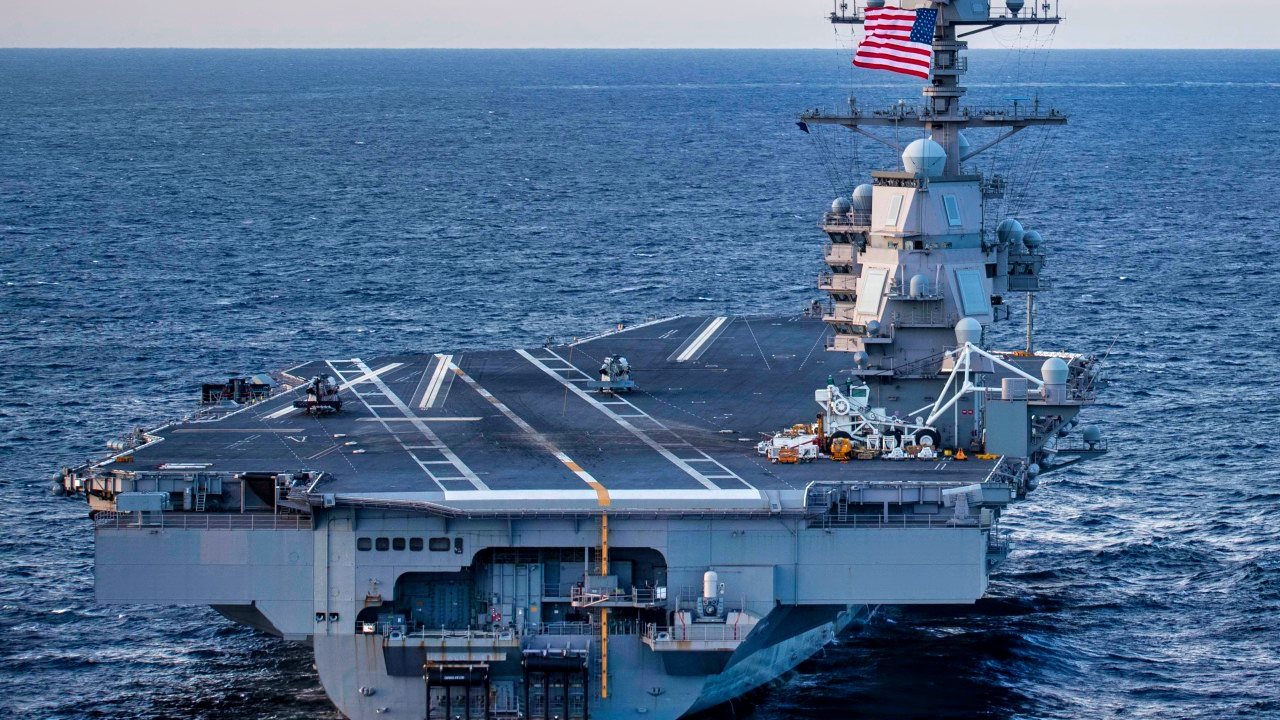
The Aircraft Carrier Isn’t Going Anywhere
Key Points and Summary
-The U.S. Navy’s top aviator, Vice Adm. Daniel Cheever, has reaffirmed the service’s commitment to maintaining a fleet of at least 11 aircraft carriers, calling them a vital “visible deterrent around the globe.”
-Speaking at a recent event, the “Air Boss” expressed excitement for the continued expansion of the Ford-class program, including the future construction of the USS William J. Clinton (CVN-82) and USS George W. Bush (CVN-83).
-This confirmation comes as Congress pressures the Navy to pursue a multi-ship “block buy” to control costs and stabilize the shipbuilding industrial base for decades to come.
Air Boss Confirms Future of American Aircraft Carriers
Vice Adm. Daniel Cheever, the commander of Naval Air Forces and Naval Air Force Pacific, said on Tuesday that aircraft carriers will continue to play a crucial role in projecting American power for years to come – and committed to maintaining a fleet of at least 11 carriers.
Speaking during an event hosted by the U.S. Naval Institute and the Center for Strategic and International Studies, the Air Boss also said that the U.S. Navy is committed to existing plans to expand the Ford-class program.
“We’re dedicated in the Navy to maintain the National Defense Authorization Act [quantity] of 11 aircraft carriers and nine airwings,” Cheever said. “The aircraft carrier is very symbolic of America and is very, very much [our] visible deterrent around the globe. Everyone knows when that aircraft carrier is near or even coming.”
Cheever added that the aircraft carrier usually indicates to adversaries that “we have a bigger air force than wherever we are.”
When asked about plans to procure two new carriers, Cheever expressed his excitement and confirmed that the William J. Clinton (CVN-82) and George W. Bush (CVN-83) are expected to be built after existing construction projects end.
“I’m excited about 82 and 83, which is the follow-on to the ones we’re building currently, and I’m excited how we’re going forward with that because once we get those, then we’ll have the majority of Ford-class carriers,” he said.
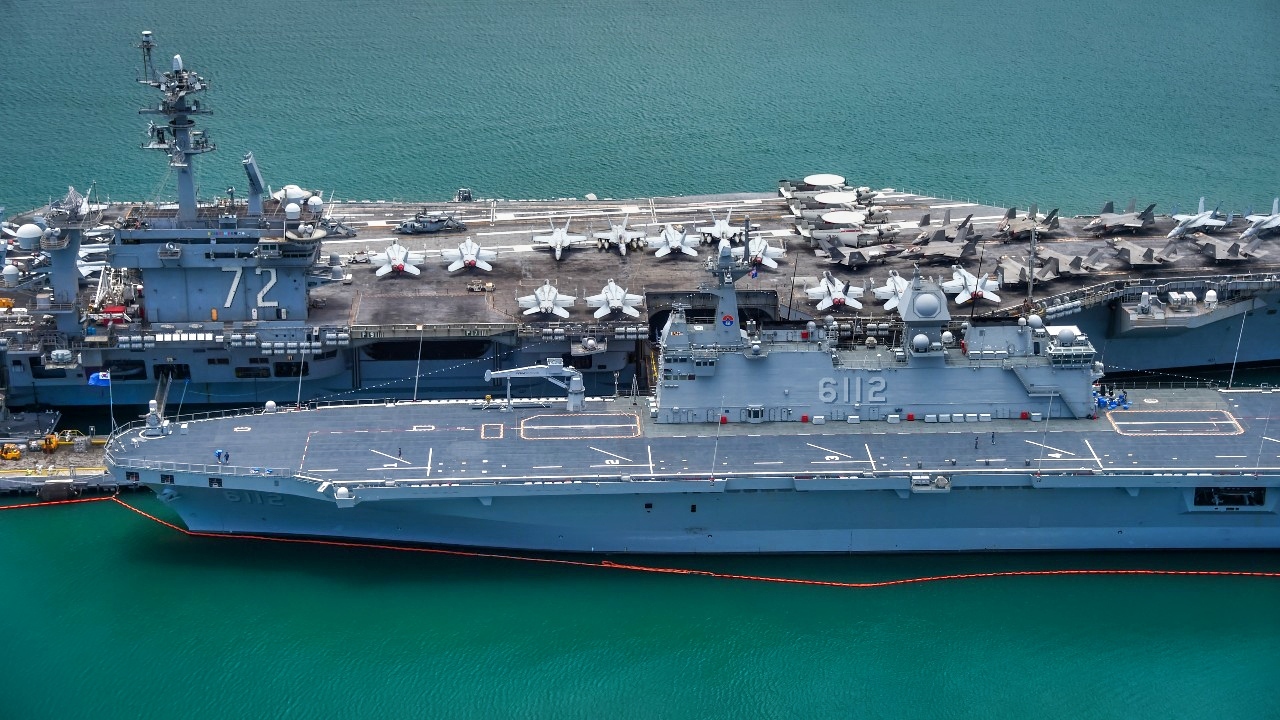
(July 7, 2022) – U.S. Navy nuclear-powered aircraft carrier USS Abraham Lincoln (CVN72) and Republic of Korea Navy amphibious assault ship ROKS Marado (LPH 6112) moored at Joint Base Pearl Harbor-Hickham, Hawaii, during Rim of the Pacific (RIMPAC) 2022. Twenty-six nations, 38 ships, four submarines, more than 170 aircraft and 25,000 personnel are participating in RIMPAC from June 29 to Aug 4 in and around Hawaiian Islands and Southern California. The world’s largest international maritime exercise, RIMPAC provides a unique training opportunity while fostering and sustaining cooperative relationships among participants critical to ensuring the safety of sea lanes and security on the world’s oceans. RIMPAC 2022 is the 28th exercise in the series that began in 1971. (U.S. Navy photo by Mass Communication Specialist Seaman Leon Vonguyen)
The Navy has moved forward with funding for its next supercarrier but stopped short of committing to a broader deal that would secure the service’s carrier pipeline into the 2040s.
More Carriers Coming…
As part of its Fiscal Year 2025 budget, the service earmarked $612 million in advance procurement for CVN-82, the future USS William J. Clinton. But unlike with earlier Ford-class contracts, officials have yet to establish a multi-year block buy covering both Clinton and CVN-83, the George W. Bush.
Congress is pressing the Navy to take that step, however. The House’s Fiscal Year 2026 defense policy bill directs the service to negotiate a package deal for the two ships, a move aimed at controlling costs and stabilizing the industrial base. Under current planning, CVN-82 would be purchased in 2030 with delivery projected for 2040, while CVN-83 would be acquired in 2034 and expected to arrive in the fleet by 2043.
The upcoming aircraft carriers both belong to the Gerald R. Ford-class of carriers, feature 100,000-ton displacement, A1B nuclear reactors, and EMALS/AAG launch systems.
The carriers’ automation technology is designed to cut crew size by 30%, though they retain robust self-defense capabilities with multi-layer missile systems and dual-band AESA radar.
About the Author:
Jack Buckby is a British author, counter-extremism researcher, and journalist based in New York who writes frequently for National Security Journal. Reporting on the U.K., Europe, and the U.S., he works to analyze and understand left-wing and right-wing radicalization, and reports on Western governments’ approaches to the pressing issues of today. His books and research papers explore these themes and propose pragmatic solutions to our increasingly polarized society. His latest book is The Truth Teller: RFK Jr. and the Case for a Post-Partisan Presidency.
More Military
The F-22 Raptor Fighter Question No One Dares Ask
The Virginia-Class Might Be the Best U.S. Navy Submarine
YF-118G Bird of Prey is the Lost Stealth Fighter
The Ford-Class Aircraft Carrier Has a Message for the U.S. Navy


