Key Points and Summary: While Iran possesses the largest and most diverse missile arsenal in the Middle East, its ability to develop a true Intercontinental Ballistic Missile (ICBM) capable of striking the United States remains limited by significant technological and industrial hurdles.
-Iran has yet to master critical technologies like multi-stage rockets and has not developed a propulsion system powerful enough for an ICBM.
-Recent Israeli and US strikes on Iran’s military infrastructure, particularly facilities for producing solid rocket fuel, have further curtailed its long-range missile development.
-For now, Iran’s missile threat remains regional, and its nuclear potential is a more pressing concern than its ICBM program.
The Iran ICBM Threat Explained
Iran’s nuclear program may be in shambles — but then again, it may not be, depending on the accuracy of recent reports citing a classified American intelligence analysis that says the setback to the regime is just a few months.
One question, aside from the nuclear question, is how close is — or was — Iran to building an intercontinental ballistic missile, or ICBM?
In light of the country’s nuclear ambitions, it’s a pertinent question and one that may be somewhat clearer than the country’s current ability to launch nuclear weapons at Israel, the United States, or other countries.
Iran’s Missile Capabilities
First and foremost, Iran’s missile arsenal is prodigious.
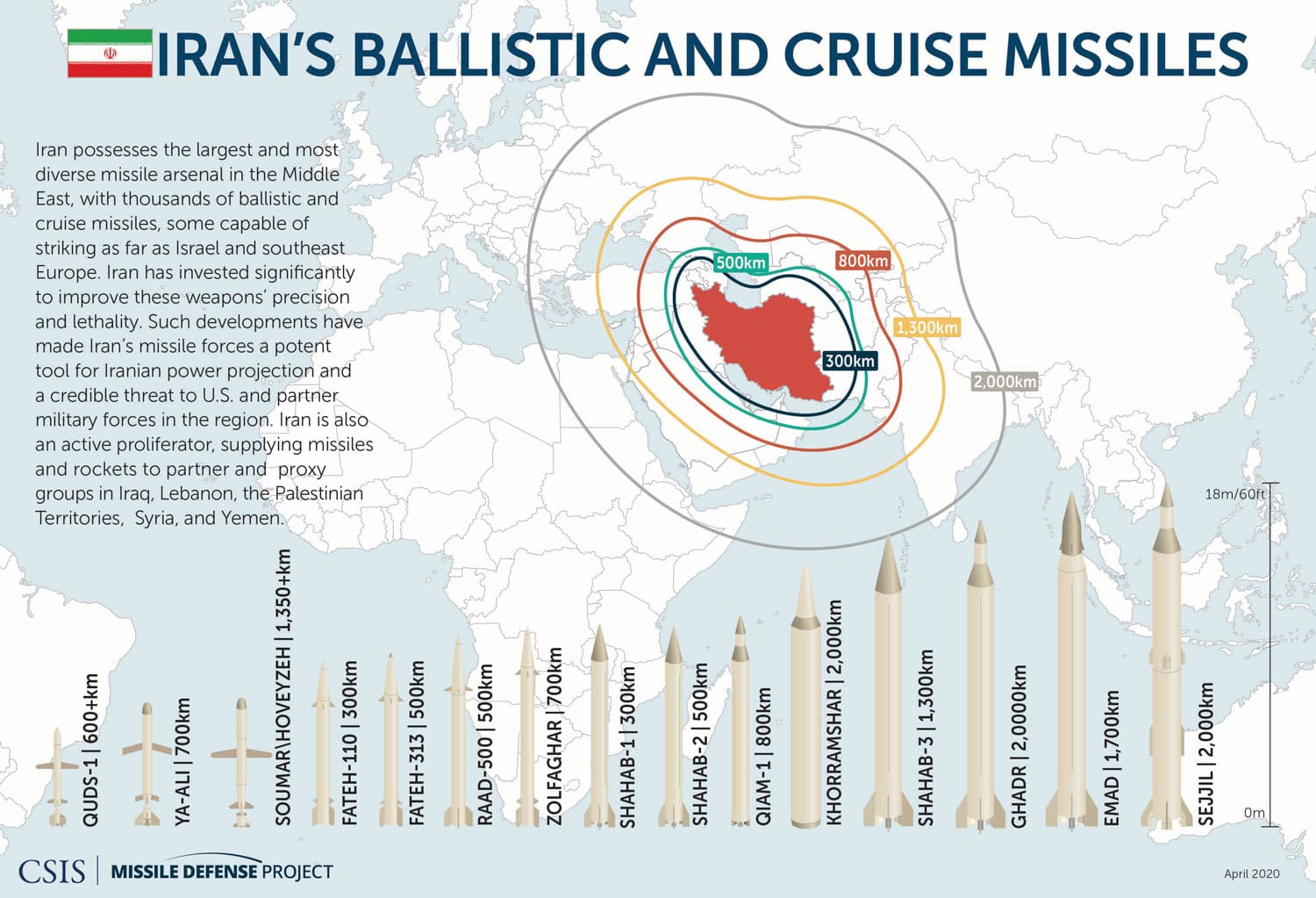
“Iran possesses the largest and most diverse missile arsenal in the Middle East, with thousands of ballistic and cruise missiles, some capable of striking as far as Israel and southeast Europe,” the CSIS explains.
For the past decade, Iran has invested significantly to improve these weapons’ precision and lethality.
Such developments have made Iran’s missile forces a potent tool for Iranian power projection and a credible threat to U.S. and partner military forces in the region.
Iran has not yet tested or deployed a missile capable of striking the United States but continues to hone longer-range missile technologies under the auspices of its space-launch program.
A more complete picture of the diverse missile arsenal fielded by Iran, including a helpful infographic, is available from the Center for Strategic and International Studies.
“If Iran is in fact working on other missiles, such as the Shahab-3B and Ghadr, it may not be able to allocate significant resources toward a 10,000-kilometer-range missile,” or in other words, an ICBM with, under ideal circumstances, sufficient range to strike the eastern edge of the United States from the extreme western edge of Iran.
Operation Days of Repentance
One of the production bottlenecks Iran faces is the production of missile fuel.
Following Israeli strikes as part of the Operation Days of Repentance strikes, Iran’s missile production facilities have been severely curtailed, if not completely destroyed.
During the strikes, around 100 Israeli Air Force planes struck targets throughout Iran, but in particular the country’s missile manufacturing nodes.
Particularly hard-hit were Iran’s planetary mixers, infrastructure, and facilities that combine the ingredients for solid rocket fuel.
Assessments following the Israeli strikes concluded that the operation severely hindered Iran’s ability to build further ballistic missiles.
Much ink had been spilled prior to the current hostilities between Iran, Israel, and the United States. Widespread consensus indicated that while Iran may have had the ability to move toward fielding a credible ICBM, that process would likely take many months, if not years.
“Iran would presumably be able to devote more efforts toward an ICBM only after completing the development of the Shahab-3B and Ghadr missiles, which could take a few years. However, if Iran is not developing a Shahab-3B or Ghadr and is instead allocating most of its missile resources toward an ICBM, then it might be able to test such a missile within a few years,” the Arms Control Association wrote. They conceded that it would be a slow process and one that, without specific steps being met, would see significant delays.
“Iran also would have to perfect many critical technologies for an ICBM, a delay in any one of which would delay the entire ICBM program. First, Iran would have to master stage-separation technology. Iran has developed the single-stage Shahab-3 missile but has yet to test a multiple-stage missile successfully,” the Arms Control Association noted.
“Its only reported test of a multiple-stage rocket, a Shahab-3D with a liquid-fuel first stage and solid-fuel second stage, failed in September 2000. Second, Iran would have to develop a powerful propulsion system for an ICBM. The propulsion systems for Iran’s 1,300-2,000-kilometer-range Shahab-3 and the up to 2,500-4,000-kilometer-range Ghadr and Shahab-3B missiles are not powerful enough for an ICBM, and the option of stacking or clustering many of these systems to build an ICBM quickly is not generally viable for a missile.”
There is also the possibility that North Korea could help Iran build an ICBM. And there is clear evidence that the Kim regime was a key player in ensuring Iran’s missiles became even more potent with each passing year.
ICBM for Iran Anytime Soon?
Iran’s missile arsenal was indeed, at one point, both deep and broad. Groups allied with Tehran, the so-called axis of resistance in Lebanon, Syria, Yemen, and elsewhere at one point posed a credible threat to regional stability thanks in part to the long-range weaponry those groups possessed.
The operative word — regional — was, and is, of crucial importance. Though Iran and Iranian-backed proxies certainly posed a threat to allies of the United States in the region and further afield, it appears that Iran lacked the missile capabilities to transform the country into a Middle Eastern North Korea, one that can reach the United States proper.
That does not mean, however, that the country poses no threat to the United States.
Even though the United States recently struck multiple sites across Iran with the most powerful non-nuclear weapons in existence, reports indicate that the Iranian nuclear threat has not been eliminated, but set back by some months only.
So while the Iranian ICBM threat is, at the moment, moderate at best, the country’s nuclear potential remains high — and that is arguably the more pressing concern.
About the Author: Caleb Larson
Caleb Larson is an American multiformat journalist based in Berlin, Germany. His work covers the intersection of conflict and society, focusing on American foreign policy and European security. He has reported from Germany, Russia, and the United States. Most recently, he covered the war in Ukraine, reporting extensively on the war’s shifting battle lines from Donbas and writing on the war’s civilian and humanitarian toll. Previously, he worked as a Defense Reporter for POLITICO Europe. You can follow his latest work on X.
Iran War
30,000 Pound Bunker-Buster Bombs Might Not Be Able to Destroy Fordow