

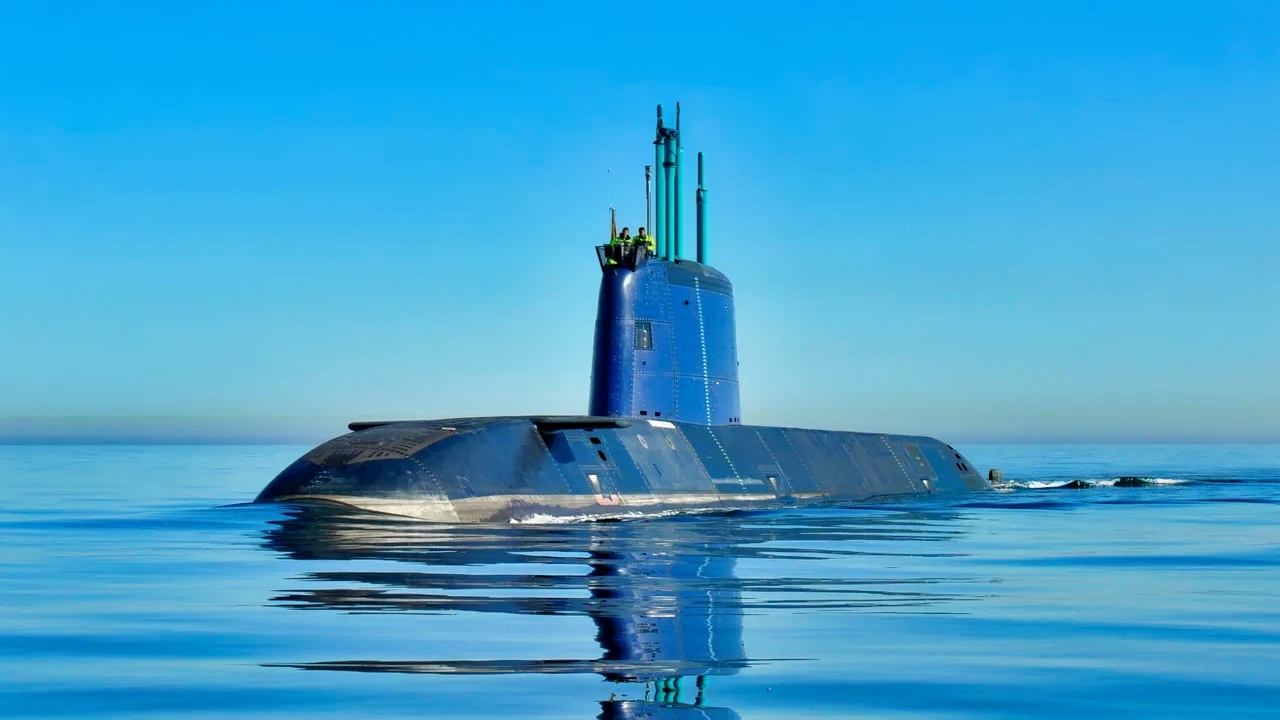
Key Points – Israel’s Dolphin-I and more advanced Dolphin-II class submarines form the backbone of its undersea capabilities and are a crucial component of its strategic deterrence.
-These German-built diesel-electric boats are quiet, versatile, and heavily armed with ten torpedo tubes.
-The newer Dolphin-II class incorporates Air-Independent Propulsion (AIP) for extended submerged endurance.
-While officially unconfirmed due to Israel’s policy of nuclear ambiguity, these submarines are widely believed to be capable of launching nuclear-armed cruise missiles, like the Popeye Turbo, from their larger 650mm torpedo tubes, providing Israel with a survivable, sea-based second-strike capability.
Dolphin-Class Submarine: Israel’s Most Powerful Weapon?
Israel possess a small but potent navy. Likewise, its small submarine force is vital for maintaining a posture of deterrence. The Dolphin-class attack submarines are currently the backbone of Israel’s submarine fleet.
Manufactured by Howaldtswerke-Deutsche Werft in Germany, these diesel-electric submarines may be smaller than larger nuclear attack submarines, but they pack quite the punch, nonetheless, and very well might carry nuclear weapons. Additionally, the Dolphin-class is essential to maintaining Israel’s defense strategy.
Design and Development
The Dolphin I submarines are diesel-electric and feature a displacement of approximately 1,640 tons when surfaced and 1,900 tons when submerged.
They are about 57 meters in length and are equipped with six 533 mm torpedo tubes and four larger 650 mm tubes. These larger tubes are believed to be capable of launching cruise missiles, potentially with nuclear warheads, although Israel maintains a policy of nuclear ambiguity and has never confirmed this capability.
The submarines are also equipped with advanced sonar systems and combat management systems, allowing them to perform a wide range of missions, from anti-ship and anti-submarine warfare to intelligence gathering and special operations support.
Following the success of the first three submarines, Israel commissioned a second batch, known as Dolphin II. These submarines, INS Tanin, INS Rahav, and the most recent, INS Drakon, are larger and more advanced than their predecessors.
One of the most significant upgrades in the Dolphin II class is the inclusion of air-independent propulsion (AIP) systems. These systems allow the submarines to remain submerged for extended periods without surfacing, significantly enhancing their stealth and operational endurance. The Dolphin II submarines displace around 2,050 tons surfaced and 2,400 tons submerged, and they are approximately 68.6 meters long.
They are believed to be capable of speeds exceeding 25 knots and can operate for weeks underwater thanks to their AIP technology.
Role in Israel’s Navy
The Dolphin-class submarines play a vital role in Israel’s defense strategy. They are widely believed to form the sea-based leg of Israel’s nuclear triad, providing a second-strike capability that is crucial for deterrence.
This means that even if Israel were to suffer a devastating first strike, it would retain the ability to retaliate with nuclear force from its submarines. This capability is thought to be enabled by the deployment of long-range cruise missiles, such as the Popeye Turbo, which can be launched from the submarines’ 650 mm tubes. These missiles are believed to have a range of over 1,500 kilometers and can carry nuclear warheads, although, again, this has never been officially confirmed.
In addition to their deterrent role, the Dolphin-class submarines are used for intelligence and surveillance missions. Their stealth and endurance make them ideal platforms for gathering electronic intelligence and monitoring enemy movements. They are also capable of supporting special operations forces, with the ability to deploy swimmer delivery vehicles and other equipment through their larger torpedo tubes. This makes them a versatile tool for covert operations in hostile or contested environments.
a region marked by volatility and the constant threat of conflict, these submarines provide Israel with a powerful tool for deterrence and strategic influence. Their ability to operate far from Israeli shores, including in the Persian Gulf and Indian Ocean, allows Israel to project power and gather intelligence in areas of critical importance. This capability is particularly relevant in the context of Iran’s nuclear program and the broader strategic competition in the Middle East.
Recent Developments and Planned Replacement
The most recent addition to the fleet, INS Drakon, has attracted particular attention due to its unique design features.
It has a noticeably larger sail than its predecessors, which has led to speculation that it may house new sensors or even vertical launch systems for missiles. While the Israeli Navy has not disclosed specific details about Drakon’s capabilities, analysts believe it represents a significant leap forward in terms of both offensive and defensive systems.
It may be equipped with advanced electronic warfare capabilities, improved sonar, and potentially even the ability to launch ballistic missiles, although this remains speculative.
In the future, Israel plans to replace the older Dolphin I submarines with a new class known as the Dakar-class, beginning in 2027. These submarines are expected to incorporate even more advanced technologies, including improved stealth, propulsion, and weapons systems.
The Dakar-class will likely continue the trend of increasing Israel’s undersea endurance and strike capabilities, ensuring that the Israeli Navy remains at the forefront of submarine warfare in the region.
Despite their value to Israel’s Navy, the Dolphin-class submarines have not been without controversy. The procurement process has been the subject of scrutiny in Israel, with allegations of corruption involving senior officials and defense contractors. These allegations have led to public outcry and legal investigations, although they have not affected the operational readiness or effectiveness of the submarine fleet. Additionally, the suspected nuclear capability of the submarines has raised concerns among non-proliferation advocates. Israel’s policy of nuclear ambiguity, combined with its refusal to sign the Nuclear Non-Proliferation Treaty (NPT), complicates efforts to promote arms control and stability in the region.
About the Author:
Isaac Seitz, a Defense Columnist, graduated from Patrick Henry College’s Strategic Intelligence and National Security program. He has also studied Russian at Middlebury Language Schools and has worked as an intelligence Analyst in the private sector
The Best Tanks on Earth
AbramsX: The Tank the US Army Wants


