

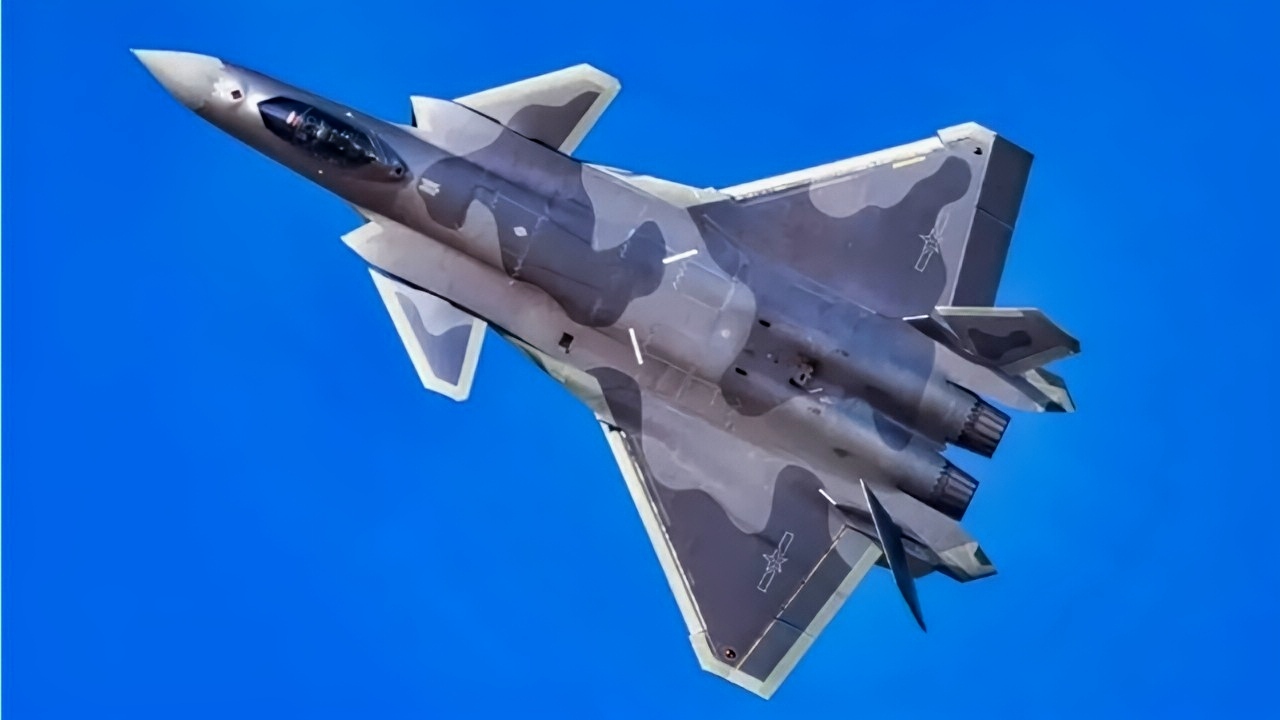
Here’s an interesting fact: China’s all-robot “dark factories” can now churn out Chengdu J-20 “Mighty Dragon” fifth-generation air superiority fighters at a rapid rate. The J-20 is China’s answer to America’s legendary F-22 Raptor fifth-generation air superiority warplane. Whether Washington wants to accept it or not, China is an industrial behemoth–not just in cheap goods, but in high-end weapons systems that can wreak havoc on the US military and the militaries of America’s allies in the Indo-Pacific.
Meet the Mysterious J-36
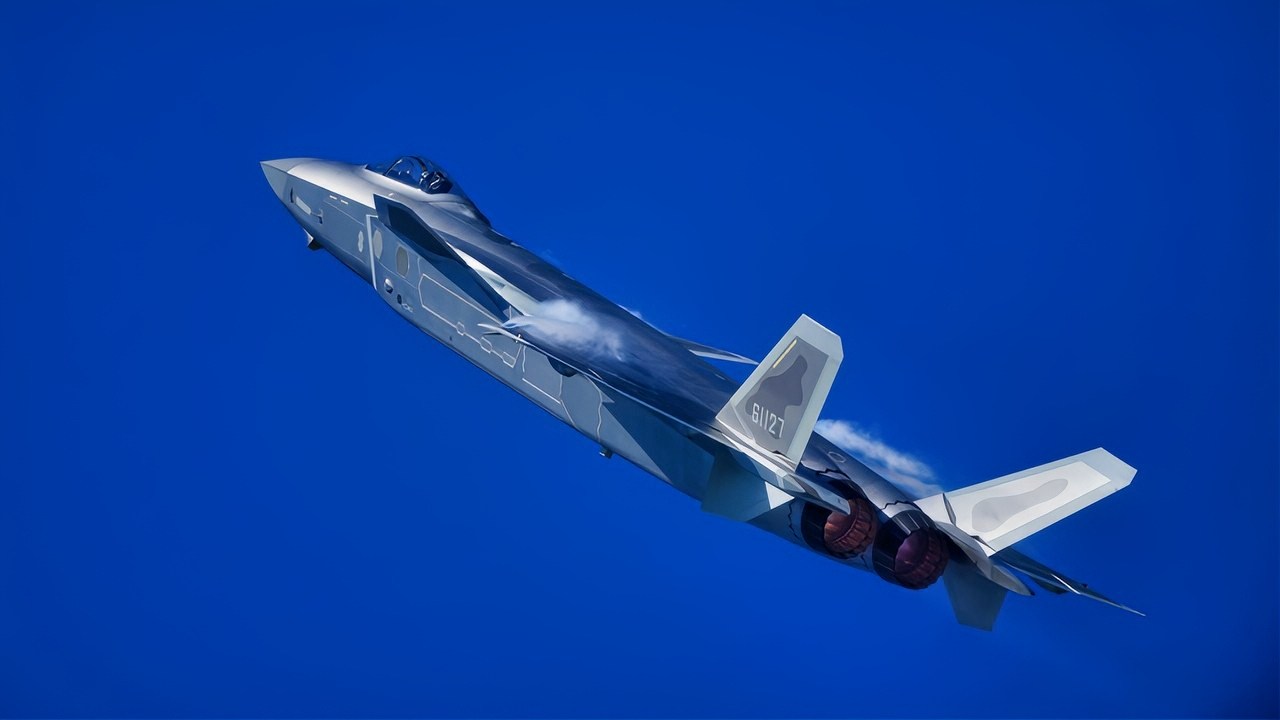
J-20 Stealth Fighter in 2024. Image Credit: Creative Commons.

J-20 Fighter in the Sun. Image Credit: PLAAF.
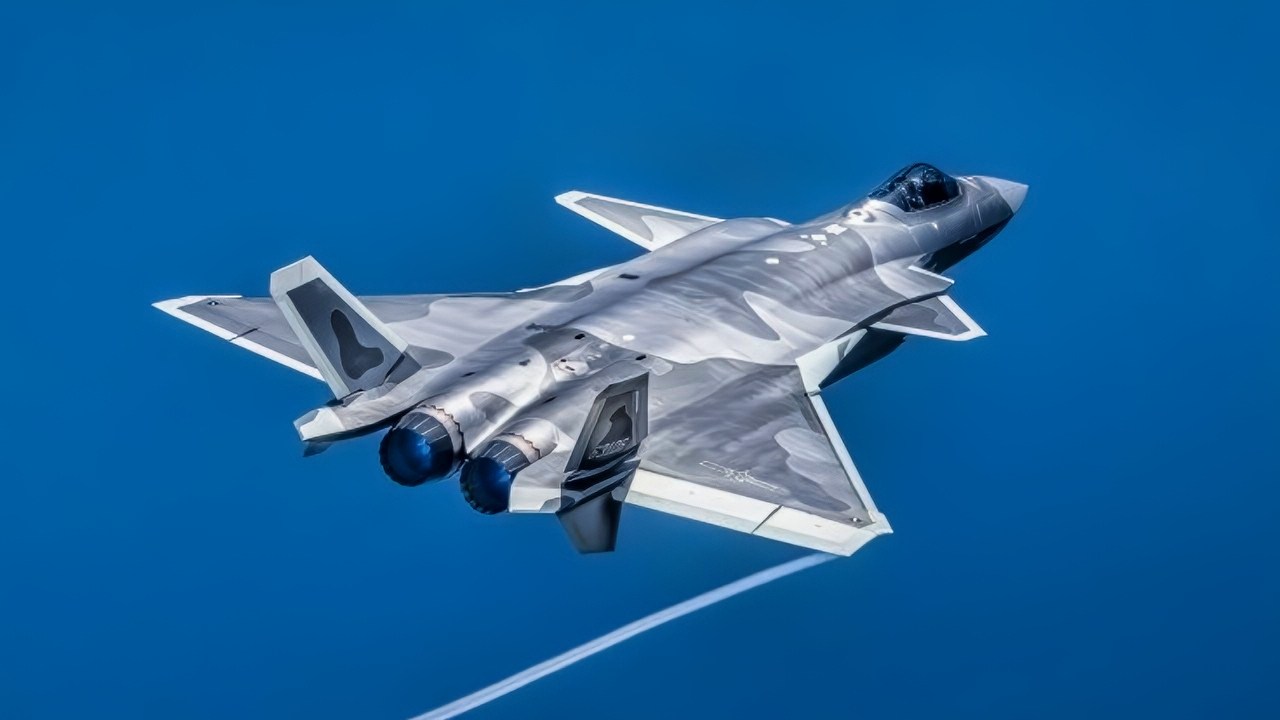
J-20 Fighter from China. Image from PLAAF.

J-20 Fighter Weibo Screenshot.
But the J-20 isn’t the only threat from the skies coming from China. In the last year, stunning images have been propagated across Chinese social media and around the world, depicting strange, alien-looking, tailless, all-black aircraft flying low and conducting what appear to be flight tests. Analysts have identified one of the planes imaged as the “J-36.” The J-36 is one of the most mysterious and potentially disruptive aerospace programs in the world today.
Also known as the JH-XX stealth bomber, the plane appears to fill a gap between China’s heavy strategic bomber program–the Xi’an H-20–and its stealth fighter fleet, led by the aforementioned J-20. The JH-XX appears to be a regional stealth bomber (as opposed to an intercontinental stealth bomber, like the H-20 or America’s B-21 Raider). China optimized the J-36 for warfare in the expansive Western Pacific region.
Multiple Pentagon reports have referenced a JH-XX program in their annual intelligence assessments of China’s military power. There was little acknowledgment, though, from China. That all changed in 2024, when unusual tailless, trijet aircraft prototypes appeared over the Chengdu Aircraft Corporation facilities.
Most reporting on the matter today described the bird as a medium-range stealth bomber or fighter-bomber designed to penetrate regional air defenses. Pentagon analysts assess that the JH-XX will attack Guam, Japan, Taiwan, naval targets, and logistics hubs.

JH-XX Mock Up. This was an early Mock Up. Image Credit: Creative Commons.

JH-XX Bomber Image from X Screenshot. Image Credit: X.
China’s Air War Architecture is Taking Shape
These planes are likely capable of carrying both conventional bombs and nuclear weapons. If the analyses on the J-36 are true–and this author believes they are–then the medium-range regional bomber fits into a brilliant layered structure that is part of a wider Chinese integrated air campaign architecture modeled on America’s highly effective air campaign structure.
Here’s the rub, though. Since the United States and China will fight in territories nearer to Chinese shores, Beijing’s forces have a “homefield” advantage. Their forces have to travel a shorter distance and can mass more effectively than can the long-range expeditionary forces of the United States. This medium-range bomber capability, which the Americans lack, fits perfectly into China’s overarching air war system. And the J-36 is a serious threat to any US or allied forces that get within range of these birds.
In fact, until 2006-2007, the Americans were developing a similar plane.
A variant of the iconic F-22 Raptor, America’s FB-22 was a medium-range fifth-generation fighter-bomber optimized for warfare in the Western Pacific. Ultimately, the Pentagon nixed this plan, preferring to prepare the replacement for the aging B-2 Spirit, the long-range, nuclear-capable stealth bomber (the B-21).
And while many assumed this was a better use of resources, the fact is that it precluded the US from maintaining a mid-range capability that the Chinese clearly assessed they needed.
The “Flying Dorito” Threat
One of the most striking features of the purported J-36 is the cranked-delta shape of the mysterious aircraft. Many observers compare this to the canceled American A-12 Avenger II from the Cold War era. J-36 not only features tailless stealth shaping but also three engines, a broad, blended fuselage, large internal weapons bays, side-by-side cockpit seating, diverterless intakes, and a heavy emphasis on reducing radar signature.
The trijet configuration especially stands out. Most stealth aircraft avoid additional engines because the extra exhaust creates more infrared and radar management challenges. But China is likely sacrificing some stealth to obtain a greater payload and a longer combat radius. The trijet feature would enable higher speeds and greater survivability across the vast maritime distances that define the Indo-Pacific region.
Guam and the First Island Chain are the Real Targets
This next part is the crux of everything China has been doing in the First Island Chain (the territories extending from the Kamchatka Peninsula, down through Japan, Taiwan, and into the Philippines) with their military.
The JH-XX/J-36 will challenge America’s forward operating military infrastructure in the Pacific. Places like Andersen Air Force Base on Guam, US military storage facilities, logistics hubs, missile-defense sites, and the infrastructure that supports US Navy aircraft carriers are all threatened by the J-36.
Beijing is interested in defeating the United States militarily by impeding America’s ability to intervene quickly within the First and even the Second Island Chains.
So, the JH-XX/J-36 is both a stealthy runway-killer and a maritime strike platform. What’s more, this bird is a cruise missile truck as well as a suppression of air defense aircraft. When integrated with China’s anti-access/area-denial (A2/AD) capabilities, the JH-XX/J-36 becomes a long-range A2/AD force multiplier, too.
Indeed, the 19FortyFive national security columnist (and a former member of US Special Forces), Steve Balestrieri, has argued that the JH-XX program is more important for China’s overall strategic doctrine at the operational level than is the H-20. Per Balestrieri’s logic, the H-20 is for strategic deterrence and pre-emptive actions. At the same time, the JH-XX/J-36 is a workhorse for conflicts involving Japan, Taiwan, and the Philippines–the three thorniest local threats Beijing faces today.
Yet in another column at National Security Journal, Balestrieri warned that there were some downsides to the JH-XX’s apparent design. Notably, the national security columnist described the JH-XX as being “frozen in time.” Balestrieri assessed that the plane’s shaping resembled older American concepts (such as the “Flying Dorito” concept of the A-12 Avenger II).
The national security columnist indicated that China was still struggling with advanced flight-control integration and lagging behind the United States in advanced engine design. Also, Balestrieri identified apparent weaknesses in surface-control elements compared with more advanced Western equivalents.
China’s Real Advantage: Iteration at Scale
All this is true, on some level. But the fact of the matter is that China has certain advantages that many Western analysts tend to downplay. One of those is adaptation. Because China is essentially the world’s workshop, with the biggest and most impressive mass-production capability today, and given its robust human capital and the second-largest economy in the world (by GDP), Beijing can rapidly advance its technologies through an iterative design and development process.
That iterative, adaptive process is how, in about a decade, China went from relying on Russian-made engines for its J-20 “Mighty Dragon” to developing a reliable domestic engine to power its impressive J-20 fighter. That same process plays out across China’s industrial sectors.
Dan Collins is the current host of Chaos, Inc., on YouTube, but his professional background is as an engineer who has run multiple high-end factories in China. Currently, Collins runs a firm that provides industrial inputs to computer chip manufacturers in China and Taiwan. When he started working in China in 1998, it was as an engineer with the China branch of General Motors.
In an interview for the podcast National Security Talk on Rumble, Collins described how the Chrysler offices were in the same building as the land vehicle design bureau for the People’s Liberation Army.
Collins explained that China’s defense industry in the 1990s struggled with advanced design concepts for its platforms.
So, they would encourage Western car companies to open shops in China, partner with Chinese firms connected to the PLA, and use the processes they learned from the Americans for creating cars to produce military gear. Within a decade, China was able to produce both civilian cars and impressive military gear indigenously.
Washington Cannot Afford to Get This Wrong
That’s the iterative design and development process that Beijing applies to every product and military platform. Balestrieri was correct to highlight the downsides of the JH-XX. But American policymakers simply cannot afford to assume that the JH-XX will remain “frozen in time” in terms of design.
Washington keeps getting Beijing’s capabilities and intentions wrong. China is not (yet) ready to challenge the United States for global military dominance. That comes later.
First, Beijing must assert control over its own region.
The JH-XX/J-36 is instrumental in that project. American military planners have long assumed that their bases in the Pacific were sanctuaries (in much the same way US planners assumed their bases in the Middle East were safe). Chinese medium-range, regional stealth bombers, like the JH-XX, represent the most significant threat those bases have faced in decades.
If the JH-XX achieves even 70 percent of its rumored performance goals, the US military will be unable to defend its forward bases in the Indo-Pacific, and US offensive strikes from those bases will be rendered impossible.
About the Author: Brandon J. Weichert
Brandon J. Weichert is a Senior National Security Editor. Recently, Weichert became the editor of the “NatSec Guy” section at Emerald. TV. He was previously the senior national security editor at The National Interest. Weichert hosts The National Security Hour on iHeartRadio, where he discusses national security policy every Wednesday at 8 p.m. Eastern. He hosts a companion show on Rumble entitled “National Security Talk.” Weichert consults regularly with various government institutions and private organizations on geopolitical issues. His writings have appeared in numerous publications, among them Popular Mechanics, National Review, MSN, and The American Spectator. And his books include Winning Space: How America Remains a Superpower, Biohacked: China’s Race to Control Life, and The Shadow War: Iran’s Quest for Supremacy. Weichert’s newest book, A Disaster of Our Own Making: How the West Lost Ukraine, is available for purchase at any bookstore. Follow him via Twitter/X @WeTheBrandon.


