
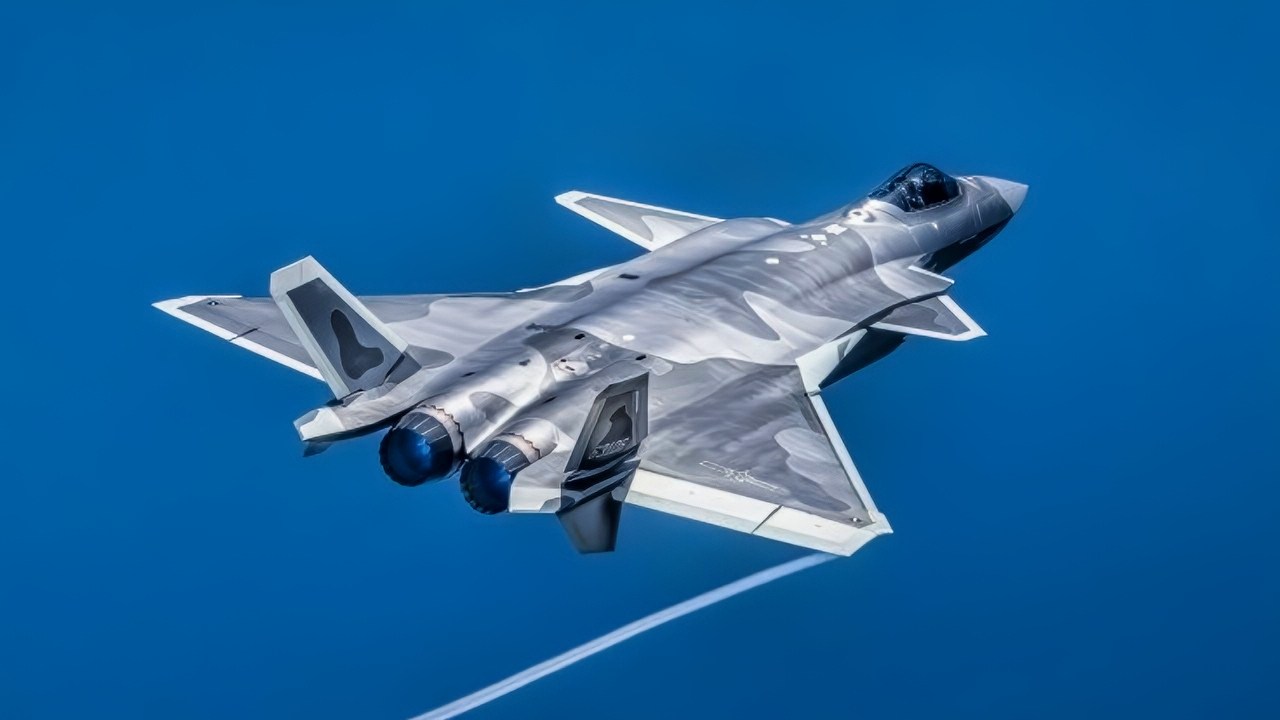
China’s Chengdu J-20 stealth fighter entered service with the People’s Liberation Army Air Force in March 2017, and by 2025 the PLAAF had built more than 300 of them — making China the second country after the United States to field an operational fifth-generation stealth fleet. The aircraft first flew on January 11, 2011 — the same day then-U.S. Defense Secretary Robert Gates was visiting Beijing — a coincidence widely interpreted as deliberate signaling. Most Western assessments estimate the J-20’s radar cross-section to be roughly 100 times greater than the F-22 Raptor’s, the result of a larger airframe optimized for fuel range and weapons payload rather than the F-22’s pure air-dominance design.
The J-20 Is Just the Beginning for Chinese Stealth

J-20 fighter from China. Image Credit: Creative Commons.
China’s Chengdu J-20 stealth fighter officially entered service with the People’s Liberation Army Air Force (PLAAF) in March 2017. It is an operational reality right now, already reshaping air power in the Western Pacific. The aircraft, which first flew in 2011, makes China the second country after the United States to field an operational fifth-generation stealth fighter.
By 2025, more than 300 J-20s had been built, giving the PLAAF a large, operational stealth fleet. And from the beginning, the J-20 has been positioned as China’s answer to the F-22 Raptor and the F-35 Lightning II. That framing is largely correct, but it’s important to note that the aircraft was not necessarily built to mirror American capabilities, but to challenge them.
The J-20 is China’s great leap towards fifth-generation airpower, and while efforts are underway for the country to field a sixth-generation fighter and family of systems, it is a sign that China is rapidly catching up to American capabilities.
China’s Long Road to Fifth-Generation Fighters
The J-20 can trace its origins back to the 1990s, when China began exploring what became known as the J-XX or F-XX program – a long-term effort to develop a fifth-generation fighter capable of closing the gap with the United States.
That effort was shaped heavily by American military performance in the post-Cold War era.
The Gulf War in 1991 and NATO operations in Kosovo in 1999 demonstrated the effectiveness of stealth aircraft capable of precision strike and networked warfare.
Chinese planners were watching, and it was clear that if they were to be competitive, their air force must be able to fight and win future wars. And that meant adapting.

J-20 Fighter. Image Credit: Creative Commons.

J-20 Fighters from China. Image Credit: Creative Commons.

J-20 Stealth Fighter. Image Credit: Creative Commons.

China’s J-20 Stealth Fighter. Image Credit: Chinese Weibo/Screenshot.
Competition between multiple Chinese bureaus followed, with Chengdu Aircraft Corporation ultimately winning the competition to lead development. The first prototype flew on January 11, 2011 – a date that coincided with a visit to Beijing by then-U.S. Defense Secretary Robert Gates. The aircraft was then formally unveiled at the Zhuhai Airshow in 2016 and entered service the following year.
For many years, claims have circulated that the J-20 benefited from cyber espionage targeting American programs like the F-22 and F-35. Those allegations have been widely reported, but the fact remains that intelligence alone cannot design and produce a brand-new fifth-generation fighter.Even if information was obtained to assist the program, China still faced critical obstacles in terms of developing the necessary materials for the aircraft, understanding manufacturing tolerances, and so on.
Ultimately, those challenges were overcome, and China has perfected its production line. Even if the aircraft doesn’t technically come close to the F-35’s capabilities.
How It Stacks Up to the F-22
Beyond the technical differences between the F-22 and the J-20, there’s a doctrinal one. The F-22 was built specifically for air dominance, designed to penetrate contested airspace and destroy enemy fighters.
Since it entered service in 2017, the J-20 has been used in multiple campaigns to establish control of the skies.
The J-20, meanwhile, was designed to compete with that very platform.
As Harrison Kass put it in The National Interest, “the F-22 was designed to penetrate, while the J-20 was designed to prevent penetration.” That makes sense when viewed through the lens of Chinese and American strategy. While the United States builds its forces to project power globally, China builds forces to deny access regionally. At least, that is what it has done historically – and it is a strategy that is slowly advancing into something more wide-ranging today
The J-20, though, fits squarely into China’s anti-access/area denial (A2/AD) strategy. Its role is not to move over enemy territory, but to make it prohibitively difficult for American forces to operate near China – particularly in the event of a Taiwan conflict.
That is why the aircraft is often described as a long-range interceptor rather than a dogfighter. It is designed to target high-value assets such as airborne early warning aircraft and aerial refueling tankers – the platforms that make American airpower effective at range.
What It Can and Can’t Do
Being a fifth-generation stealth fighter, the J-20 has both air superiority and strike capabilities.
The aircraft is larger than both the F-22 and F-35, giving it a larger internal volume for fuel. That gives it greater range – a critical advantage for China, which lacks the same global tanker infrastructure as the United States.
And while the J-20 wasn’t envisioned as a platform that would be sent on missions over great distances over enemy territory, it was designed to operate at a distance and engage targets beyond visual range.
There are, however, some areas in which the J-20 cannot compete – stealth being one of them. Most assessments suggest the platform’s radar cross-section is significantly larger than that of the F-22 – in part because the J-20 can carry a heavy payload. The J-20’s radar cross-section is believed to be around 100 times greater than that of the Raptor.
The aircraft also lacks a built-in cannon; it is generally considered to be inferior to the F-22 in terms of maneuverability and carries fewer air-to-air missiles internally. The J-20, then, is a platform that prioritizes speed and sensor integration, while the F-22 can do all that and more.
The J-20, Today
In the early days of its service life, the J-20 was confined to a handful of elite units or used primarily for signaling.
Today, it is being used far more. It is being distributed across multiple frontline brigades, including those assigned to the People’s Liberation Army Air Force’s Eastern Theater Command, which is responsible for operations around Taiwan.
The U.S. Department of Defense’s China Military Power Report has repeatedly noted that the PLAAF is continuing to expand its fifth-generation fighter force and integrate it across operational units – and all the while, it continues development of its next-generation systems.
Chinese air operations around Taiwan have become more complex in recent years. Western analysts continually point to advanced platforms, including J-20 stealth fighters, now being used in patrols and exercises around Taiwan. Even in 2020, more than half a decade ago, Chinese J-20 stealth fighters were reportedly seen taking part in patrols near Taiwan as part of “real combat” preparations.
The J-20 is now a part of the operational environment the United States must plan around – and, indeed, is planning around. In that sense, the J-20 has achieved something significant for China – it is shaping regional operations and American strategy right now.
And Chinese capabilities are only advancing, with a sixth-generation fighter already underway
Much like the United States’ Next Generation Air Dominance (NGAD) program,
China is believed to be pursuing a “system of systems” approach that will see a next-generation fighter operating alongside a team of unmanned drones. Those “loyal wingman” drones will utilize advanced data fusion and long-range strike integration to make whatever platform comes next far more deadly – and analysts expect it to arrive some time in the 2030s, putting it on a roughly parallel track with the NGAD effort.
China is building that new effort on top of a rapidly expanding J-20 force – much like the U.S. is doing with its large and growing fleet of F-35s – forcing Washington to plan for a peer stealth adversary.
About the Author: Jack Buckby
Jack Buckby is a British researcher and analyst specializing in defense and national security, based in New York. His work focuses on military capability, procurement, and strategic competition, producing and editing analysis for policy and defense audiences. He brings extensive editorial experience, with a career output spanning over 1,000 articles at 19FortyFive and National Security Journal, and has previously authored books and papers on extremism and deradicalization.


James
May 10, 2026 at 4:27 am
The article’s claim that J-20’s radar cross-section is 100 times greater than that of the Raptor is purely based on speculation, or western analysts beliefs, not a factual data, therefore the article is on a shaky ground. Not much can be treated seriously from this article.
Beavis
May 10, 2026 at 7:26 pm
Well. China steal technology, mad products it and sells it to the world. This isn’t surprising.