

On 25 June, Ukrainian President Volodymyr Zelenskiy announced the beginning of a 40-day pressure operation headed by Ukraine’s Security Service (SBU).
The objective of the campaign is to hit enough facilities of the oil industry and other strategic targets that Russia would be forced to sit down at the table to negotiate a peace settlement.
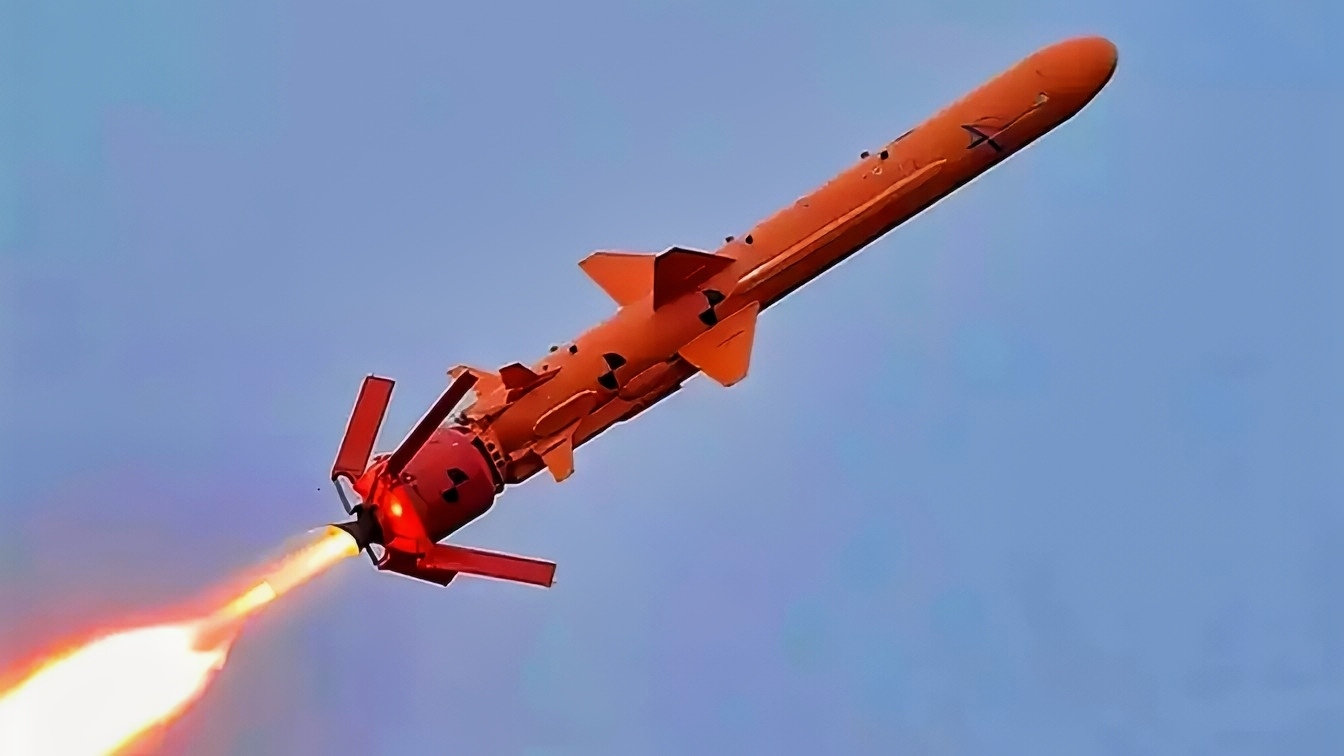
Ukraine Cruise Missile Ministry of Defense Photo
Unfortunately for Ukrainians, the 40 days were up on 4 August, but there are no indications that the Russian side is ready to sit down and agree to a settlement to end the hostilities.
Russian President Vladimir Putin continues to send his soldiers into suicidal attacks on Ukrainian front-line positions.
Meanwhile, he is hitting civilian targets in Ukraine’s cities – rail stations, children’s cancer hospitals, apartment blocks, shopping centers – with what appears to be an endless supply of ballistic missiles.
As Ukrainian news outlets are writing about today, the ultimate objective of what has become an almost daily war on Russian refineries, fuel depots, and pipelines has not been achieved.
But what these 40 days of drone strikes have produced is that they have shown the Ukrainians not the path to a peace settlement, but what looks increasingly like a path to victory.
The campaign has revealed that Ukraine’s real leverage today is not what it can accomplish on the battlefront, where two armies face each other every day.
The leverage lies in Ukraine’s ability to hit the oil industry and any other targets anywhere deep inside Russian territory.
Strategic Depth Isn’t
A ceasefire is nowhere in sight, but the attacks on Russia’s oil-producing and distributing centers and the increasing destruction of the massive warehouses belonging to Russia’s e-commerce giant Wildberries have had a devastating result of another kind.
“We have completely eliminated the very idea of Russia having a strategic rear,” Zelenskyy stated during the early July NATO Summit Defence Industry Forum in Ankara.
He then elaborated on this theme, saying that “for a long time, Russia believed it had a territorial advantage no one else possessed, a deep rear where it could safely keep military production, military equipment, and everything its war depends on, believing no one could reach them. We have reached them.”
The impact of this is twofold. First, it has overturned and invalidated any Russian planning to protect its strategic industrial sites and the critical nodes of its economic system.
Ukraine has proven that there are not enough air defense missiles in the world for Russia to protect even its largest and most populous cities – much less some oil terminal in the middle of Siberia that is hundreds of miles away from the front.
But the even deeper impact is psychological. For centuries, Russian war planners have counted on vast distances of their nation to be one of the lynchpins of its defenses against any adversaries. Ukraine has demonstrated the universal dilemma that the Russians find themselves in: “you can run, but you cannot hide.”
The Economic Cost
In early July, the Ukrainian General Staff’s estimate was that 43% of Russia’s total projected refining capacity had been disabled. Total damage to the oil industry beginning in August 2025 is estimated at $13.5 billion.
In one month alone, Ukraine’s attacks had destroyed or put out of operation more than 60 Russian oil and fuel storage reservoirs.
These sites store refined products and crude oil—58 percent of the former and 42 percent of the latter.
As the author of an assessment in today’s Kyiv Independent points out, these storage sites are “precisely what lets Russia buffer a shock like this instead of passing it straight to consumers.” Without that buffer, there is no way out of the petrol shortage crisis.
To keep sectors of the economy that depend on distribution networks from collapsing, which means keeping petrol pump prices from skyrocketing, Russian oil companies have received some 1.03 trillion roubles (US $13 billion) in government subsidies just in the period April-June. This adds to the federal deficit that exceeded 6 trillion roubles ($75 billion or 2.6 percent of Russia’s GDP in the first five months of this year.
This sum exceeds the entire planned annual deficit, and the state Accounts Chamber now projects a further shortfall of roughly 2.1 trillion roubles (US $26 billion), with over a trillion of this amount represented by oil-and-gas receipts alone.
These levels of deficits and fiscal pressures are simply unsustainable.
About the Author: Reuben F. Johnson
Reuben F. Johnson has thirty-six years of experience analyzing and reporting on foreign weapons systems, defense technologies, and international arms export policy. Johnson is the Director of Research at the Casimir Pulaski Foundation. He is also a survivor of the Russian invasion of Ukraine in February 2022. He worked for years in the American defense industry as a foreign technology analyst and later as a consultant for the U.S. Department of Defense, the Departments of the Navy and Air Force, and the governments of the United Kingdom and Australia. In 2022-2023, he won two awards in a row for his defense reporting. He holds a bachelor’s degree from DePauw University and a master’s degree from Miami University in Ohio, specializing in Soviet and Russian studies. He lives in Warsaw.


