

Oman Might Have Just Ended the Iran War: President Donald Trump vowed to wage a “Military Terror” campaign against the Islamic Republic of Iran. Many assumed that meant he was going to target civilian energy and water infrastructure throughout Iran. The Israelis were supposed to join those airstrikes.
But by Saturday, despite his huffing-and-puffing, it was clear that he’d not blow the Iranian house down.

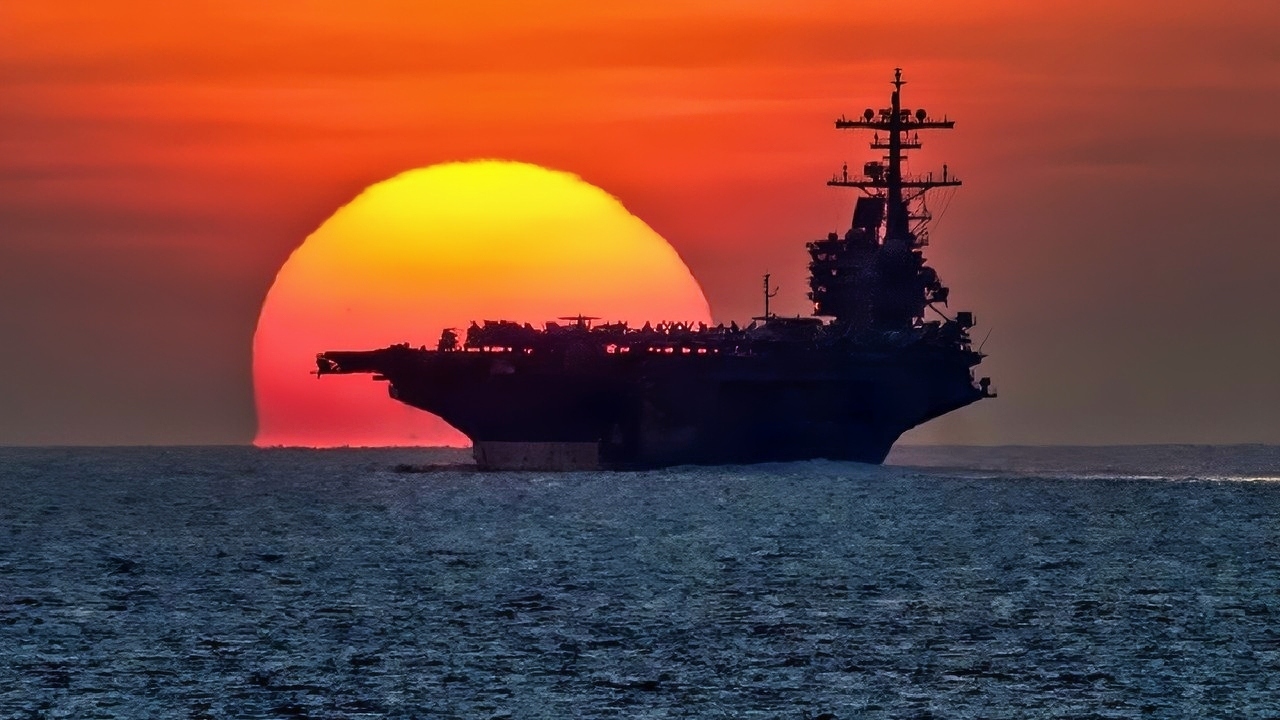
Aircraft Carrier in Hard Turn. Image Credit: Creative Commons.

(April 14, 2018) An MH-60S Sea Hawk helicopter assigned to the “Chargers” of Helicopter Sea Combat Squadron (HSC) 14, prepares to onload cargo during a replenishment-at-sea between the aircraft carrier USS John C. Stennis (CVN 74) and the fleet replenishment oiler USNS Henry J. Kaiser (T-AO 187). John C. Stennis is underway with Carrier Air Wing (CVW) 9 conducting routine, tailored ships training availability and final evaluation problem. (U.S. Navy photo by Mass Communication Specialist 3rd Class William Ford/Released)
Then came another day, and suddenly Trump announced a possible diplomatic breakthrough.
He was standing down.
Or at least that’s what he said he was doing.
Staying His Hand on Iran
For now, though, it seems like the president has stayed his hand.
The Israelis are also apparently cross with the president for essentially leading them on.
Israeli military elements had been preparing to join the attack against the Islamic Republic when Trump basically pulled the proverbial rug out from under them.
The breakthrough involves Oman, the country that shares a long coastline with the contested Strait of Hormuz (SoH) and that sits across from Iran (which also shares a long coastline with the SoH).
You see, the Omanis and Iranians have been quarreling over how the SoH, a once-open waterway that no one tolled and everyone used, has since become a blocked strait due to the war. Iran wants to assert absolute dominance over the SoH while the Omanis prefer to manage the waterway as it was before the war — without tolls.
Tehran insists that the dynamics that once ruled the previous agreement over the SoH be voided, because the Americans and Israelis attacked them in an unprovoked manner on February 28 (while the Americans and Iranians were engaged in diplomacy, no less).
So, Tehran wants compensation for that in the form of dominance over a waterway that cuts through large portions of its territory.
During the 18 days of relative peace last month that the Memorandum of Understanding (MoU) brought to the world, the Iranians granted a 60-day reprieve to global shipping while they endeavored to institute a new Traffic Separation Scheme (TSS) that would be the pretext for an inevitable tolling system after those 60 days.
The Americans steadfastly opposed this (apparently not realizing that they had signed an MoU that literally ceded control over the Strait to Tehran).
A Tale of Two Routes
Using Oman, Washington got the Omanis to open an alternate route in the Strait that cut through their territory.
While the Iranians were busily organizing and implementing a new TSS for ships passing through the SoH on their side of the waterway, the Omanis attempted to maintain their side as a free and open waterway.
This, of course, set Tehran off, prompting the most recent wave of violence between the Americans and Iranians.
Now, Oman has a new paradigm. All ships entering the Strait will be required to utilize the Iranian route, while all outbound ship traffic will employ the Omani route. It’s a fair deal–and the Iranians seem open to it.
Since the SoH has become the center of gravity in the US-Iran conflict, the Omani solution is a practical workaround for a seemingly intractable problem: Iranian dominance over a waterway that is literally in their backyard (and far from the United States).
Shippers will pay a voluntary fee to maintain the SoH rather than pay explicit tolls.
Whatever the reasons for the war at the start of the conflict, the primary reason the Americans have led the charge against Iran since the war began has been over the SoH. Washington cannot abide by the Iranians exerting unilateral control over the Strait. So, they waged war to stop it. Oman has offered an equitable deal that allows both Iran and Oman to have considerable influence over the Strait. Oman is an American partner. That’s a much more acceptable deal to Washington.
Of course, it looks as though the US continues to reposition its forces in the region to more defensible locations while flowing in more troops and platforms. The current negotiations may be but a pause rather than an off-ramp to peace. And we have been down this pathway at least twice before. In January and February, the Omanis worked feverishly on behalf of the Trump administration to get a deal over Iran’s suspected nuclear weapons program.
Instead, the Trump administration went to war. Again, the aforementioned MoU was supposed to bring us to peace after 60 days of negotiations. That never occurred. So, all this might be a pause before Trump and Israel try to do one last, big push against Iran militarily. For now, though, it seems like Iran is interested in the Omani proposal (and the Trump administration seems willing to let this process play out).
Does Trump Want Out?
While Trump has been vowing to annihilate Iran (literally at times), the fact is that the Iranians have steadily eroded America’s fighting capacity in the region. The Islamic Republic has enacted a strategy that can only be described as the debasing of the US Armed Forces throughout the Middle East.
Forward bases, such as those in Kuwait, that would have been key for expanded strikes against Iran, have been decimated. Twitchy Gulf Arab allies, such as Saudi Arabia, have also limited the use of US military bases in their territory, fearing robust Iranian reprisals.
There are also serious economic consequences for the United States due to the war. If the conflict continues, there will be more economic damage to the United States.
And, as the Midterm elections approach in a few months, if that economic fallout is significant enough, then the Republican Party will be made to pay at the ballot box. Trump really doesn’t want to lose his congressional majorities.
Thus, all the inputs for Trump are that the war must stop. Hopefully, this time it’s more than just a pause.
About the Author: Brandon J. Weichert
Brandon J. Weichert is Senior National Security Editor. He also manages The Weichert Brief on Substack. Weichert also hosts “National Security Talk” on Rumble. He is the author of four bestselling national security books, the most recent of which is A Disaster of Our Own Making: How the West Lost Ukraine (Encounter Books). Follow him via Twitter/X @WeTheBrandon.


