

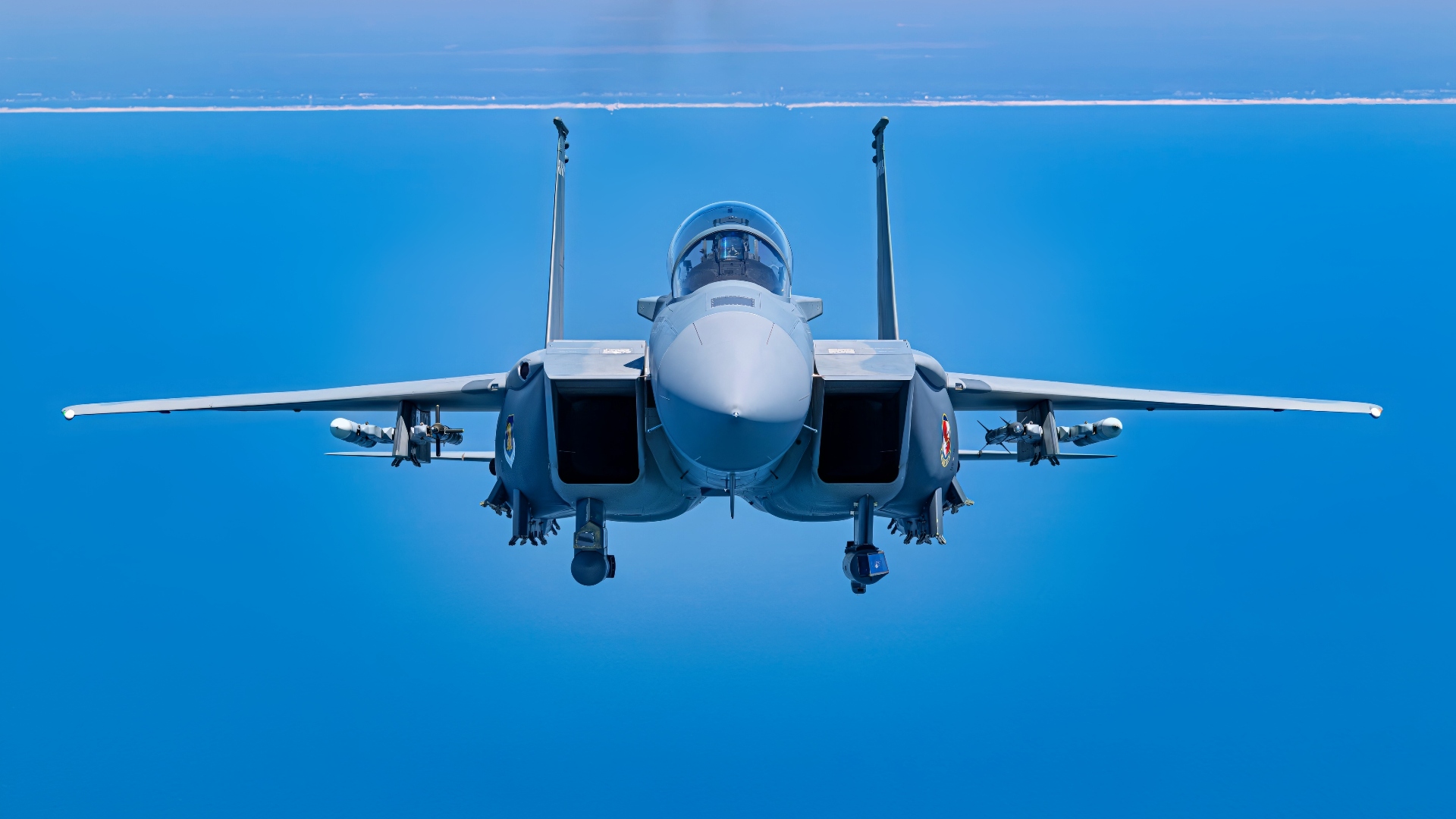
Key Points and Summary – The F-15EX Eagle II and Dassault Rafale take different paths to air dominance.
-The F-15EX brings huge payload, range, and a powerful APG-82 AESA paired with EPAWSS—ideal for BVR salvos of AMRAAMs and mixed strike loads. Rafale is smaller, more agile, and optimized by canard-delta aerodynamics, SPECTRA EW, and Meteor missiles with a larger no-escape zone.

Dassault Rafale Fighter in India. Image Credit: Creative Commons.
-The Eagle is faster overall and carries more missiles; Rafale can supercruise and is marginally lower-signature. One-on-one, the F-15EX likely gains first detect and massed shots, but Rafale’s SPECTRA/Meteor can neutralize and counter. Within visual range, Rafale’s agility and MICA IR give it the edge.
F-15EX Eagle II vs. Rafale: Who Wins?
The F-15EX Eagle II and the Dassault Rafale are both highly advanced fourth-generation fighters.
Both possess state-of-the-art avionics and highly lethal weapons systems.
Both boast impressive capabilities and have proven themselves to be highly reliable.
While they may appear similar in some areas, both aircraft were built with different and distinct philosophies, making them well-suited for their intended roles.
However, of the two fighters, which one would win in a hypothetical combat engagement?
The F-15EX Eagle II Takes on Europe’s Best
The F-15EX is a large, twin-engine aircraft with a powerful radar and the ability to carry more weapons than any other fighter in the U.S. inventory.
It is not stealthy in the traditional sense, but it compensates with speed, altitude, and electronic warfare capabilities.
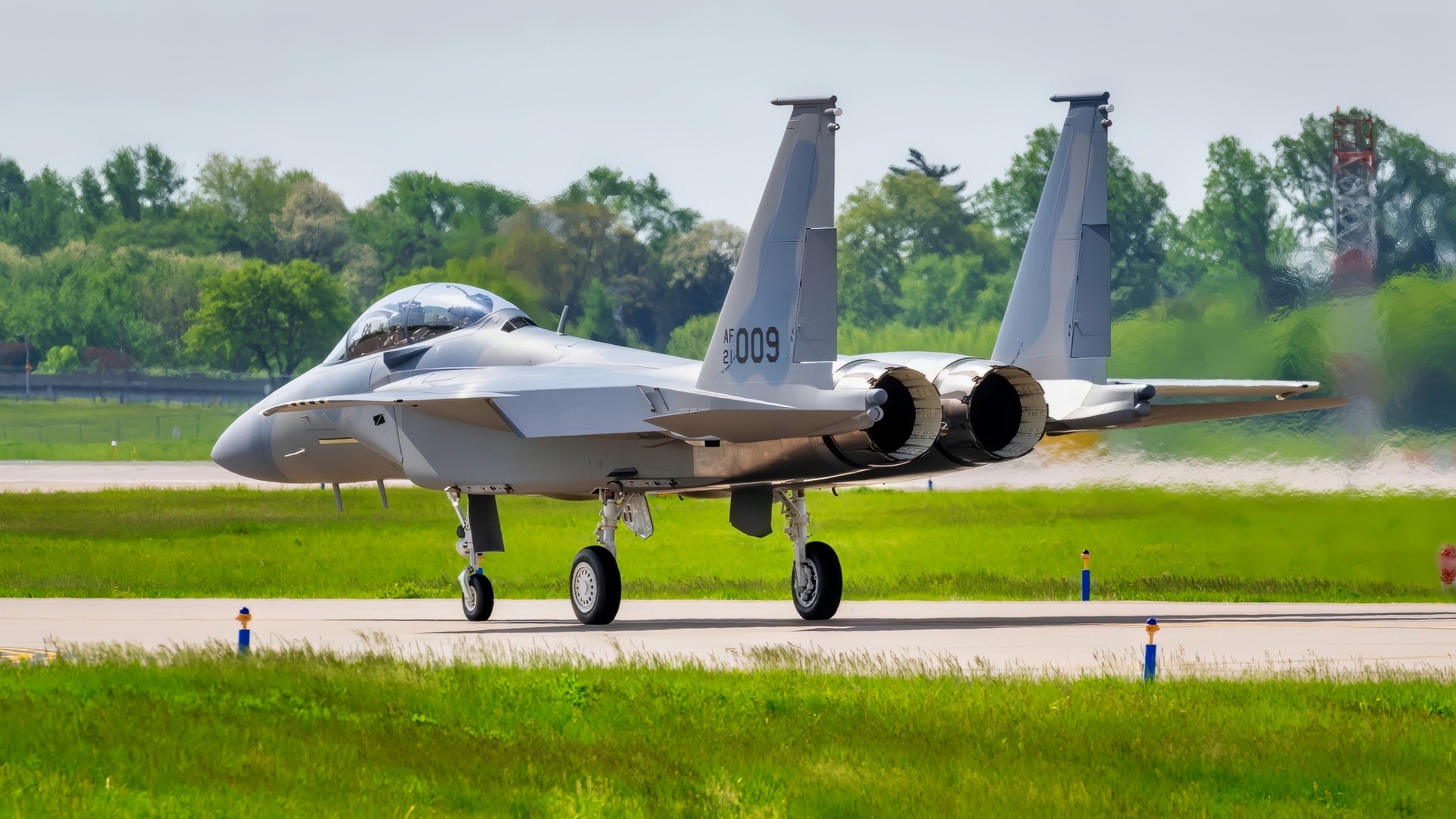
F-15EX-9 in St. Louis Missouri, shortly before delivery to Portland Air National Guard Base, Ore. (Boeing/Eric Shindelbower)
Its open mission systems architecture allows for rapid upgrades, and its EPAWSS suite provides advanced threat detection and jamming capabilities.
The cockpit features a large area display and helmet-mounted cueing, giving pilots superior situational awareness.
The Rafale, on the other hand, is smaller and more agile. Its canard-delta wing configuration gives it excellent maneuverability, and its airframe incorporates radar-absorbing materials to reduce its signature.
The SPECTRA electronic warfare suite is widely regarded as one of the most advanced in the world, offering active jamming, threat detection, and decoy deployment. Rafale’s cockpit is ergonomically designed with voice control, touchscreen interfaces, and optional helmet-mounted sights.
Avionics and Weaponry
In terms of sensors, the F-15EX is equipped with the AN/APG-82(V)1 AESA radar, which offers long-range detection and tracking capabilities.
It is explicitly designed for beyond visual range (BVR) combat, especially when paired with the AIM-120D AMRAAM missiles.
The Rafale uses the RBE2-AA AESA radar, which is slightly smaller but still highly capable. Where Rafale truly shines is in its integration of the Meteor missile, a European long-range air-to-air weapon with a larger no-escape zone than the AMRAAM.
This gives Rafale a qualitative edge in BVR engagements, even if the F-15EX can carry more missiles overall.

An F-15EX Eagle II, assigned to the 142nd Wing, taxis on the flightline before take-off during the official Unveiling Ceremony for the new fighter jet at the Portland Air National Guard Base, Oregon on July 12, 2024. The 142nd Wing will be replacing the F-15 C/D model Eagles with the new F-15EX Eagle II models. (National Guard photo by John Hughel, Oregon Military Department Public Affairs)
The F-15EX can carry up to 12 AMRAAMs, a staggering number that allows it to saturate the battlespace with firepower. It also supports a wide range of air-to-ground munitions, including the AGM-158 JASSM and future hypersonic weapons. Rafale, while not matching the F-15EX in payload volume, is highly versatile.
It can carry MICA IR and RF missiles, SCALP EG cruise missiles, Exocet anti-ship weapons, and even the ASMP-A nuclear missile. Its weapons flexibility is a key part of its omnirole identity.
Engine Performance and Stealth Features
When comparing flight performance, the F-15EX is faster overall, with a top speed exceeding Mach 2.5 thanks to its powerful twin F110-GE-129 engines. It has a longer combat radius and can quickly reach high altitudes.
However, its engines are not optimized for supercruise, giving it a lower average cruise speed. The Rafale, with its Snecma M88 engines, can supercruise under certain conditions at Mach 1.4, giving it an edge in fuel efficiency during high-speed engagements.
It has a top speed of around 1.8 and a combat range of around 1,850 km. Its agility in close combat is superior due to its aerodynamic design and lighter weight.
Neither aircraft possesses any comprehensive stealth technology.
The F-15EX incorporates EW suites and radar warning receivers to detect incoming threats and protect itself, but these systems do not provide the survivability of a true stealth aircraft.
The Rafale, on the other hand, does possess some technology that slightly reduces its radar cross-section. This includes the use of composite materials and serrated patterns to help absorb radio waves.
In addition, the aircraft also possesses its own EW suites to make it harder to detect on certain spectrums. Overall, the Rafale is less detectable than the F-15EX, but only by a slight margin.
While cost considerations do not determine which fighter wins in a fight, they are important factors in considering which fighter to procure.
The F-15EX is an insanely expensive fighter. In its most recent production lot, the F-15EX costs approximately $94 million per unit, which is comparable to the price of an F-35A.
The Raffle is even more expensive, with an estimated cost of around $115-130 million per aircraft. However, its price varies depending on the contract.
In 4 Words: The F-15EX Might Lose
Now, considering a hypothetical one-on-one engagement between the two aircraft in neutral airspace, both are well-equipped, resulting in an incredibly close match.
In a beyond visual range scenario, the F-15EX would likely detect the Rafale first due to its superior radar. It could launch multiple AMRAAMs, potentially overwhelming the Rafale’s defenses. However, Rafale’s SPECTRA suite and the Meteor missile could allow it to evade incoming threats and strike from a longer distance. The outcome would depend heavily on tactics and the effectiveness of electronic warfare.
In a within visual range dogfight, Rafale would have the upper hand. Its agility, smaller size, and advanced infrared missiles, such as the MICA IR, make it a formidable opponent in close quarters.
The F-15EX, while powerful, is less maneuverable and presents a larger target. Its AIM-9X missiles and helmet-mounted cueing system would help, but Rafale’s aerodynamic advantage would likely prevail.
About the Author: Isaac Seitz
Isaac Seitz, a Defense Columnist, graduated from Patrick Henry College’s Strategic Intelligence and National Security program. He has also studied Russian at Middlebury Language Schools and has worked as an intelligence Analyst in the private sector.
More Military
China Claims New J-35 Stealth Fighter Has Radar Cross-Section ‘Smaller Than a Human Palm’
The SR-71 Blackbird Mach 3 Bomber?
5 Reasons A U.S.-China War Could Start


Tg
October 4, 2025 at 6:18 pm
Yeah right. Eagle EX will smoke that micro machine. Is the author of this simping for the Rafael lol?