

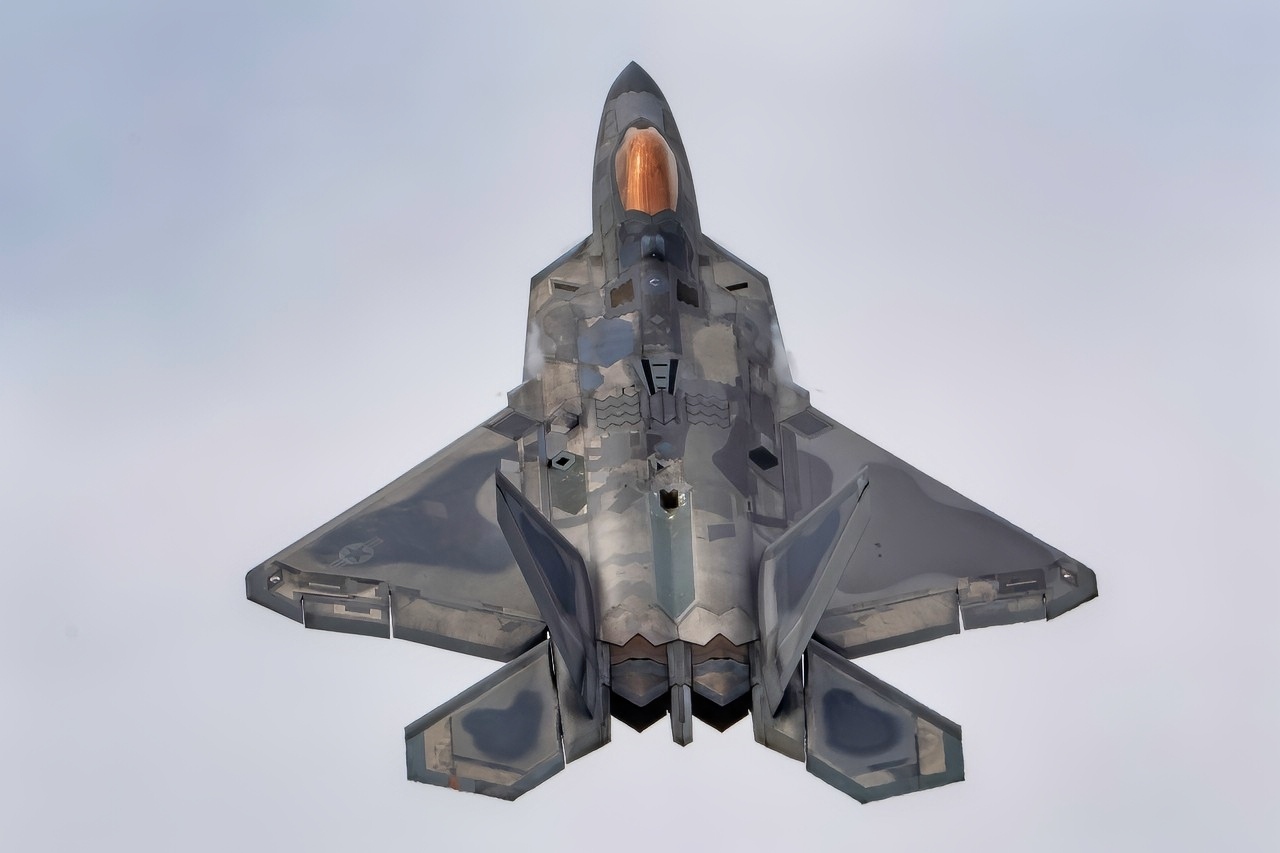
PUBLISHED on August 8, 2025, 1:03 PM EDT – Key Points and Summary – In a hypothetical one-on-one dogfight, the fifth-generation F-22 Raptor would overwhelmingly defeat China’s fourth-generation J-10C “Vigorous Dragon.”
-The F-22’s decisive advantages in stealth, supercruise, and advanced sensor fusion create an insurmountable gap.

F-22 Raptor at USAF Museum. Image Credit: National Security Journal.
-It would detect, track, and engage the J-10C from beyond visual range, long before the Chinese pilot would even be aware of a threat.
-While the J-10C is a capable and modern multirole fighter, it simply cannot compete with the F-22’s purpose-built air superiority and low-observability, making the outcome of any direct confrontation almost certain.
F-22 vs. J-10: A Fighter Jet Battle
The F-22 Raptor is often regarded as one of the most advanced fighter jets in service, alongside the F-35. Its sophisticated stealth technology, advanced avionics, and high-performance engines make it a terrifying presence on the battlefield.
Meanwhile, the J-10 Vigorous Dragon has long been a staple in the PLAAF’s fleet. As one of China’s most widely produced modern fighters, the J-10 is both fast and deadly.
Compared to the F-22, however, it falls short in several areas.
But who would win if they went head to head?
The Raptor Faces the Vigorous Dragon
The F-22 Raptor is a fifth-generation air superiority fighter developed by the United States. It was designed with stealth, supercruise, and advanced sensor fusion as its core attributes. Its primary mission is to dominate the skies by engaging and defeating enemy aircraft before they even know it’s there.
The Chengdu J-10, on the other hand, is a fourth-generation multirole fighter developed by China.

J-10. Image Credit: Creative Commons.

J-10 Fighter From China. Image Credit: Creative Commons.

J-10CE Fighter. Image Credit: Creative Commons.
The latest variant, the J-10C, incorporates modern avionics and limited stealth features, but it is not a stealth aircraft in the same sense as the F-22. The J-10C is intended to be a versatile platform capable of both air-to-air and air-to-ground missions, optimized for regional conflicts and cost-effective deployment.
In terms of physical performance, the F-22 is larger and more powerful. It is equipped with two Pratt & Whitney F119-PW-100 engines, which enable it to supercruise at speeds exceeding Mach 1.5. Its top speed exceeds Mach 2.25, and it can operate at altitudes up to 65,000 feet.
The J-10C, powered by a single WS-10B or AL-31FN engine, can reach speeds around Mach 2.2 and has a service ceiling of approximately 59,000 feet. While the J-10C is agile due to its canard-delta wing configuration and thrust vectoring capabilities, it lacks the raw power and altitude performance of the F-22.
Stealth and Avionics
Stealth is one of the most decisive factors in modern air combat, and here the F-22 has a clear advantage. Its airframe is designed from the ground up to minimize radar cross-section, with internal weapons bays, radar-absorbent materials, and carefully shaped surfaces. This allows it to operate in contested environments with a high degree of survivability.
The J-10C incorporates some stealth features, such as radar-absorbent coatings and diverterless supersonic inlets, but it is not a true stealth aircraft. In a combat scenario, the F-22 would likely detect and engage the J-10C long before the latter could respond.
Avionics and sensors further widen the gap between the two aircraft. The F-22 is equipped with the AN/APG-77 AESA radar, which offers long-range tracking, low probability of intercept, and advanced electronic warfare capabilities. It also features sensor fusion, integrating data from radar, infrared, and electronic sources into a single, coherent picture for the pilot. This gives the F-22 unmatched situational awareness. The J-10C also has a modern AESA radar and includes infrared search and track (IRST), radar warning receivers, and data link capabilities. However, its sensor fusion and electronic warfare systems are not as advanced or integrated as those of the F-22.
Weapons and Armaments
When it comes to weapons, both aircraft are formidable. The F-22 typically carries six AIM-120 AMRAAMs for beyond-visual-range (BVR) engagements and two AIM-9 Sidewinders for close combat, all housed internally to preserve stealth. It also has a 20mm M61A2 cannon for dogfighting.
The J-10C has 11 hardpoints and is equipped with PL-15 BVR missiles, which reportedly have a longer range than the AIM-120D, and PL-10 short-range missiles with high off-boresight capability. It also carries a 23mm cannon.
While the PL-15’s range is impressive, missile effectiveness depends heavily on sensor capability and engagement geometry. The F-22’s stealth and superior radar likely allow it to “shoot first” in most scenarios, neutralizing the J-10C before it can launch its own missiles.
In a beyond-visual-range engagement, the F-22’s stealth and sensor superiority would almost certainly give it the upper hand. It could detect, track, and engage the J-10C without being seen, using its AMRAAMs to destroy the target before the J-10C even knows it’s under attack. In a within-visual-range dogfight, both aircraft are highly maneuverable, but the F-22’s thrust vectoring, higher thrust-to-weight ratio, and post-stall agility give it a decisive edge.
The J-10C’s PL-10 missile and helmet-mounted sight system are excellent, but they are not enough to overcome the F-22’s aerodynamic and sensor advantages.
Unsurprisingly, the F-22 Raptor Fighter Wins
Operationally, the F-22 is a more exclusive and expensive platform. Only 187 were built, and it is operated solely by the United States Air Force. Its unit cost exceeds $140 million, and it is not available for export.
The J-10C, by contrast, is more affordable, with a unit cost around $40–50 million, and has been exported to countries like Pakistan. Over 600 J-10s have been produced, making it a more widely deployed aircraft. This makes the J-10C a practical choice for regional powers, especially when supported by ground-based radar, surface-to-air missiles, and other assets.
To the surprise of no one, in a one-on-one fight, the F-22 would almost certainly win due to its stealth, superior avionics, better maneuverability, and more advanced weapons systems. It was designed to dominate air-to-air combat and has the tools to do so against any current fourth-generation fighter.
The J-10C, while highly capable and modern, falls short in terms of stealth and sensor integration compared to its peers. However, in a larger conflict involving multiple aircraft, ground support, and electronic warfare assets, the outcome could be more complex.
The J-10C’s affordability and versatility make it a valuable asset in regional conflicts, especially when deployed in large numbers or as part of a networked force.
About the Author: Isaac Seitz
Isaac Seitz, a Defense Columnist, graduated from Patrick Henry College’s Strategic Intelligence and National Security program. He has also studied Russian at Middlebury Language Schools and has worked as an intelligence Analyst in the private sector.
Defense Watch
F/A-XX Is the YF-23 on a Carrier?


MT
August 10, 2025 at 12:33 am
That seems a nonsensical comparison.
You need to compare apple to apple. A more appropriate comparison would be between 2 direct rivals such as China’s J20 and the F22.
Why would anyone need a comparison between a gun and a knife? They are not in the same category.
DPS
August 10, 2025 at 2:00 pm
It would be better to compare the J20 to the old F22. The are, closer, with the J20 even holding an advantage in range. The overall result would still be the same though. Even given the F22’s age, it’s still superior to the J20 in nearly every other respect.