


Key Points and Summary – The F-35 just took a major step toward becoming Europe’s premier air-to-air killer. A U.S. Marine Corps F-35B has flown for the first time with the MBDA Meteor beyond-visual-range missile, proving the weapon fits cleanly inside the jet’s weapons bay without compromising stealth.
-The UK-led integration effort, backed by Italy and other European F-35 users, aims to give both F-35A and F-35B variants access to Meteor’s 200-kilometer reach, high “no-escape zone,” and two-way data link.

A Norwegian F-35A Lightning II fighter jet assigned to the 62nd Fighter Squadron (FS), Luke Air Force Base, Arizona, takes-off for a mission during Red Flag 21-2, at Nellis AFB, Nevada, March 8, 2021. The 62nd FS conducts F-35 pilot training for U.S. and allied aircrews. (U.S. Air Force photo by William R. Lewis)

A crew chief from the 158th Fighter Wing taxis an F-35 II Lightning in for rapid refueling and rearming, July 24, 2025, at Westover Air Reserve Base, Chicopee, Mass.
During the D-ICT exercise, F-15’s from the 104th Fighter Wing and F35’s from the 158th Fighter Wing received simultaneous rapid rearming and refueling from the 103AW C-130H Hercules with all engines running. Performing these D-ICT exercises helps aircraft quickly return to their mission and highlights our ability to distribute and operate from anywhere. (U.S. Air National Guard Photo by Jay Hewitt)
-Full integration has slipped into the 2030s, but once complete, it will dramatically boost NATO’s air combat reach against Russian and Chinese threats.
Meteor Missile Makes Europe’s F-35 a True Air-to-Air Killer
According to official reports from the UK Royal Air Force, a U.S. Marine F-35B conducted its first flight armed with a Meteor AAM missile.
This brings the aircraft one step closer to full integration with the advanced anti-air missile, significantly improving the anti-air capabilities of Europe’s fifth-generation stealth fighters.
This achievement has been made possible by close collaboration between the U.S. and the UK, which seek to upgrade all of Europe’s F-35s to field the missile.
The project is expected to be completed sometime around the 2030s, after which the Meteor is expected to be fully compatible with the F-35.
The F-35 is Getting the Meteor
The Royal Air Force first announced in February 2025, when an American aircraft completed a successful test flight armed with the Meteor AAM.
The weapon was used in the test to gather environmental data as part of a campaign to fully integrate the missile into the F-35 fully.
It is unknown whether the F-35 has been able to fire the missile successfully. Still, for the time being, it has been proven to fit inside the F-35’s weapon bays, allowing the aircraft to carry the rocket while maintaining a stealthy profile.
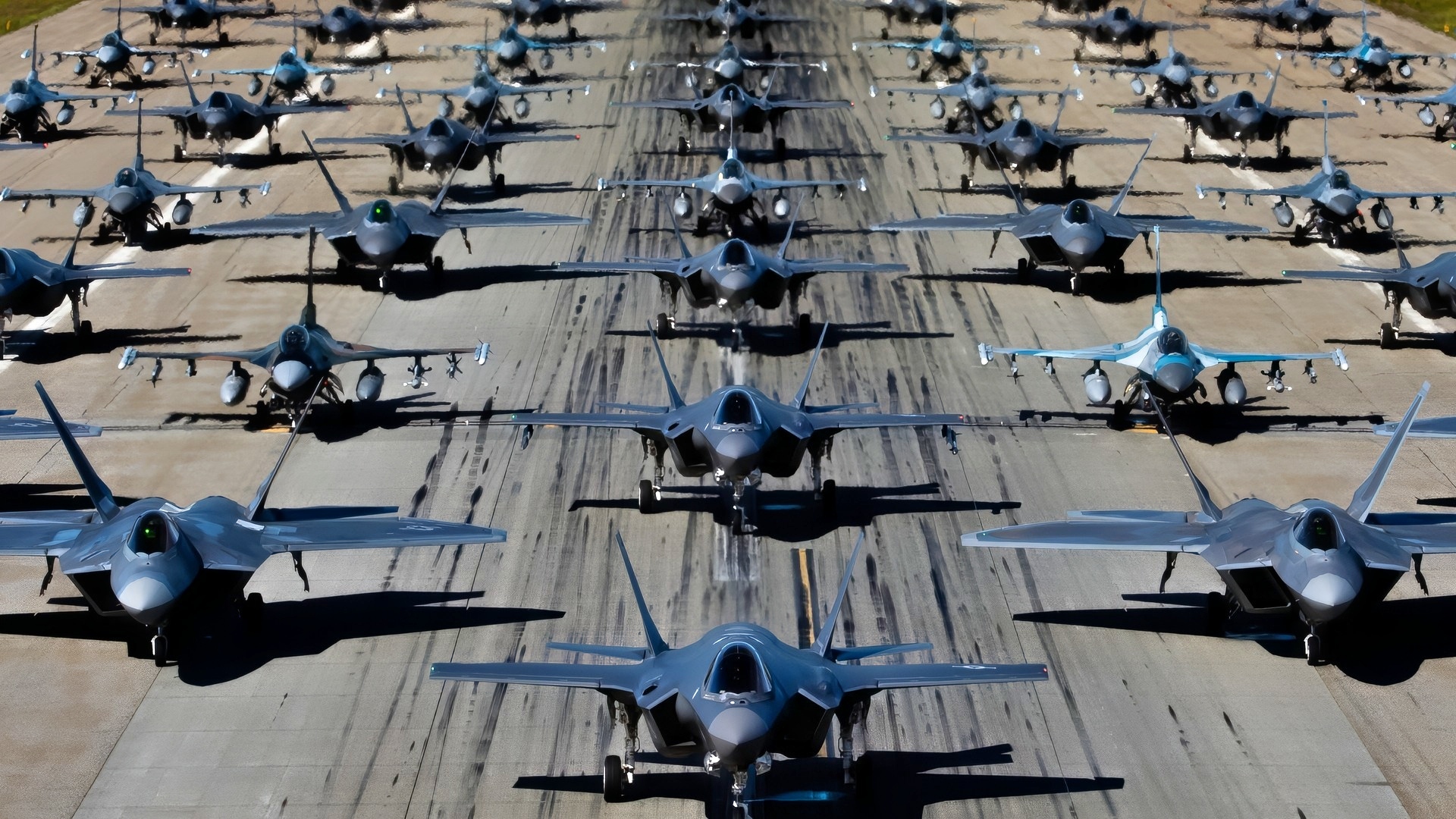
The 354th Fighter Wing conducts a 75-fighter jet formation at Eielson Air Force Base, Alaska, Aug. 12, 2022, in honor of the U.S. Air Force’s 75th Anniversary. This capabilities demonstration included F-35A Lightning II, F-16 Fighting Falcon and F-22 Raptor aircraft from across Pacific Air Forces. (U.S. Air Force photo by Senior Airman Gary Hilton)
The British Air Force was immensely pleased with these early trials. As Air Commodore Al Roberts, the RAF’s Head of Air-to-Air Missiles, commented, “This milestone is a testament to the effective collaboration between the multinational governmental and industrial partnerships that we have in place.
Inclusion of Meteor onto the Lightning II will bring this formidable air combat capability to the UK and to the burgeoning F-35 community, significantly enhancing security among allies.” Despite worries that the U.S. might break ties with Europe, developments like this signify continued collaboration between the U.S. and its NATO allies in defense technology.
Integration Timeline
Plans to integrate the Meteor into the F-35 were first discussed as early as 2019, when Lockheed Martin received initial funding to begin work on the project. MBDA and BAE Systems received additional funding in 2021 for the project from the British and Italian governments.
The plan was to have the Meteor fitted on VSTOL F-35Bs used by Italy and the UK, as well as the conventional F-35A, which is used by many other European nation-states.
In 2024, MBDA, the primary manufacturer of the Meteor, announced plans to tweak the missile to accommodate the F-35’s interior storage. Finally, this year, the F-35 made its first flight with the missile.

An F-35 Lightning II connects to a KC-10 Extender fuel injection arm to refuel during an aerial training mission, during Operation Astral Knight 19 over the Adriatic Sea, June 3, 2019. Astral Knight is a joint, multinational exercise taking place throughout various locations in Europe, with more than 900 Airmen participating in the exercise. (U.S. Air Force photo by Staff Sgt. Joshua R. M. Dewberry)
Initially, the timeline toward full integration was planned to be fulfilled by the “middle of the decade.” These plans later changed to sometime in 2027.
However, in June 2025, the UK announced that full Meteor integration is unlikely to be completed until the 2030s, citing 2027 as no longer a realistic date.
Integrating a missile like the Meteor, which was intended for European platforms, into an American fifth-generation platform was always expected to encounter significant technological hurdles. However, with the most recent developments, progress is at least visible.
Why the Meteor Missile?
The Meteor is often described as one of the most advanced missiles in the world, and for good reason. The missile uses an active radar-homing seeker with a two-way data link to ensure accuracy. What sets the missile apart from many others is its propulsion.
The Meteor uses a solid-fueled ramjet engine with thrust controls. When the missile reaches a certain range, its throttle is significantly increased, ensuring a direct, powerful hit.
This gives the Meteor a high “no-escape zone” and an overall range of around 200 km.
The missile’s data link ensures communication between the aircraft and the rocket, providing instantaneous guidance instructions and further improving accuracy.
Overall, the Meteor AAM is a massive upgrade to the F-35’s anti-air capabilities. It is by far the most advanced BVR missile in Europe and surpasses many of its international counterparts in several ways.
The integration into the F-35 is a significant boost to European arms manufacturers like MBDA and BAE Systems, which have previously been limited to using American weapons on the F-35. The Meteor not only expands the F-35’s arsenal but also enhances interoperability among NATO users.
The AIM-120 AMRAAM is the closest counterpart that the U.S. currently has to the Meteor. Like the Meteor, the AMRAAM uses an active radar seeker and a two-way data link for accuracy; however, it has only half the range of the Meteor, with a top range of 90 km.
China’s PL-15 BVR missile is one of the closest counterparts to the Meteor.
It uses a miniature AESA radar for guidance and a solid rocket fuel motor capable of speeds greater than Mach 5. The PL-15 has already been successfully integrated into China’s fifth-generation stealth fighters, such as the J-20 and J-35.
The Russians currently field the R-37M missile, which offers a maximum range of around 300 km and uses both active and passive guidance.
About the Author: Isaac Seitz
Isaac Seitz, a Defense Columnist, graduated from Patrick Henry College’s Strategic Intelligence and National Security program. He has also studied Russian at Middlebury Language Schools and has worked as an intelligence Analyst in the private sector.


