


Key Points and Summary – The Sukhoi Su-27 “Flanker” is one of the fastest and most maneuverable fighter jets ever built, capable of reaching Mach 2.35 and performing incredible aerial feats like the “Pugachev Cobra.”
-Designed during the Cold War to beat the American F-15 Eagle, the Su-27 is a formidable air superiority fighter used by numerous air forces.
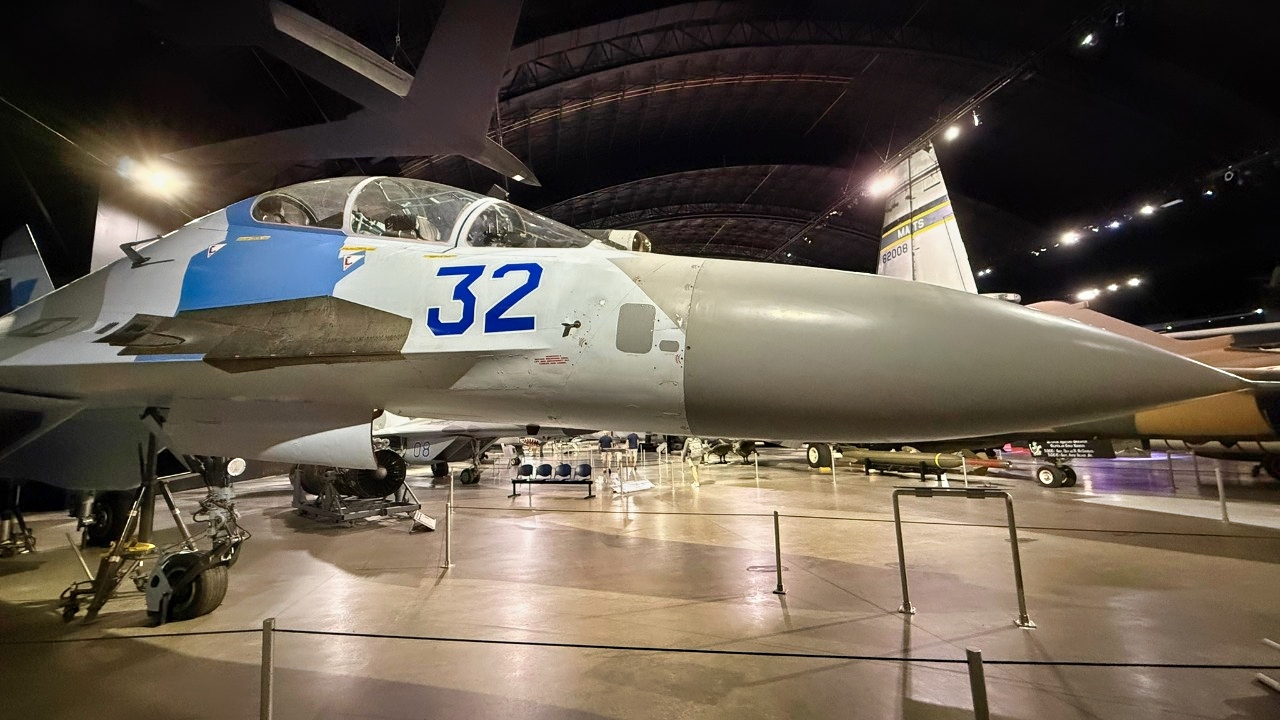
Su-27 Flanker Fighter from Russia. Image Credit: National Security Journal.
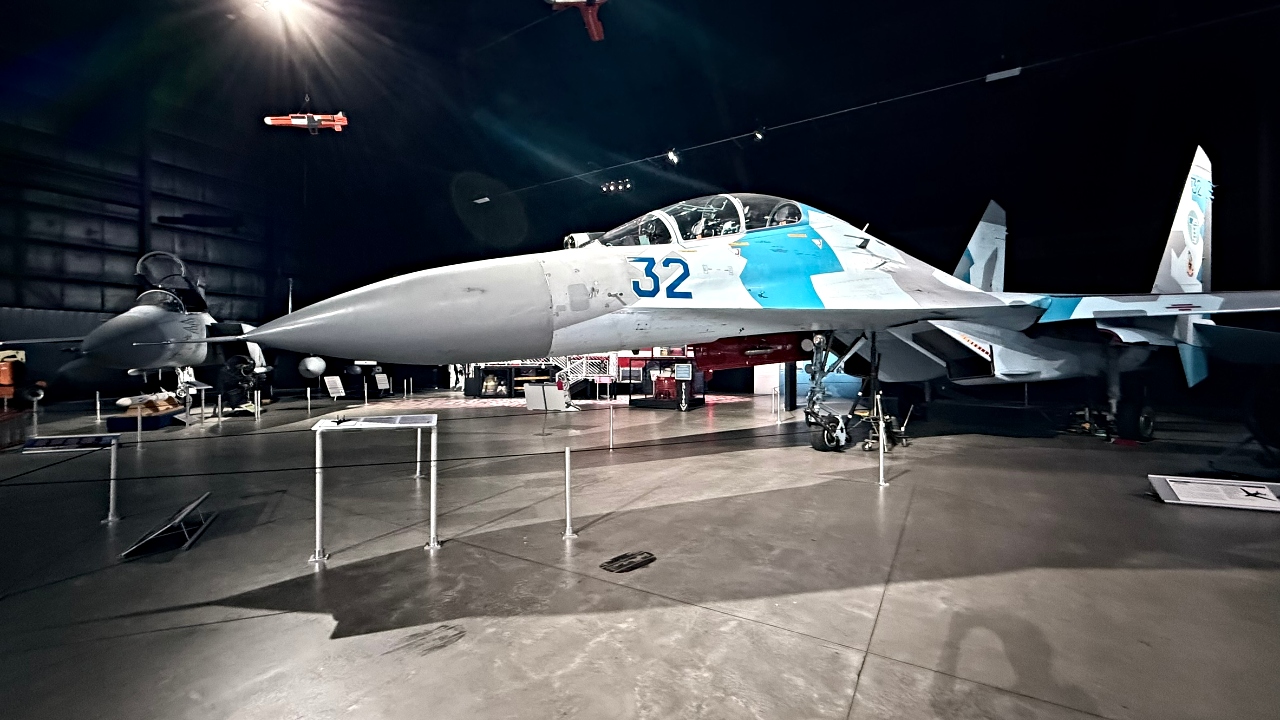
Su-27 Flanker from U.S. Air Force Museum. Image Credit: National Security Journal.
-However, its performance in the Ukraine war has been disappointing.
-Unable to establish air dominance against Ukraine’s robust air defenses, Russia has relegated the once-feared Flanker to launching long-range missiles from within its own airspace, a significant failure for a premier dogfighter.
How Fast Is the Su-27 Flanker?
Russia’s Su-27 Flanker is one of the fastest airplanes ever built.
Clocking in at MACH 2.35 or 1,553 miles per hour, it ranks as the tenth fastest warplane in the world, according to a list compiled by FlyJetify.com.
The F-111 Aardvark and the F-15 Eagle are a shade quicker at MACH 2.5 or 1,650 miles per hour. The MiG-31 Foxhound could hit MACH 2.83 or 1,864 miles per hour.
The Su-27 was designed during the 1980s, when the Soviets wanted a fighter jet with higher velocity to outfly the F-14 Tomcat and the F-15 Eagle. The Flanker reached a blistering speed as the Russians intended.
The Flanker is a highly maneuverable warbird that serves as an air superiority fighter.
What Does the Powerplant Look Like?
The Su-27 is a gifted jet. It boasts high speed, along with excellent acceleration due to its high engine thrust-to-weight ratio.
The Flanker is equipped with two powerful Sukhoi Saturn/Lyulka AL-31F turbofans, each with nearly 28,000 pounds of thrust, and features afterburners.
The high speed of the Su-27 makes it a great air policeman with the ability to respond to adversarial aircraft encroaching on a country’s Air Defense Identification Zone. Many countries use it as an interceptor in this manner.
Excellent Altitude and Range
To accomplish this mission, the Su-27 has a high ceiling of nearly 60,000 feet. This gives it an advantage in potential dogfights, too, with the ability to swoop down quickly and engage the enemy.
The Flanker also has an impressive operational range of 2,193 miles.
The Su-27 utilizes its excellent speed and acceleration to good effect when outmaneuvering adversarial pilots. The Russians and other allied air forces have developed various methods to achieve kills.
How Does the Flanker Perform?
“The Su-27 is also renowned for its ability to perform advanced aerial maneuvers. One of the most famous is the ‘Pugachev Cobra’ maneuver. This maneuver, named after Russian test pilot Viktor Pugachev, involves the aircraft pulling its nose vertically upwards before dropping back into a normal flying position.
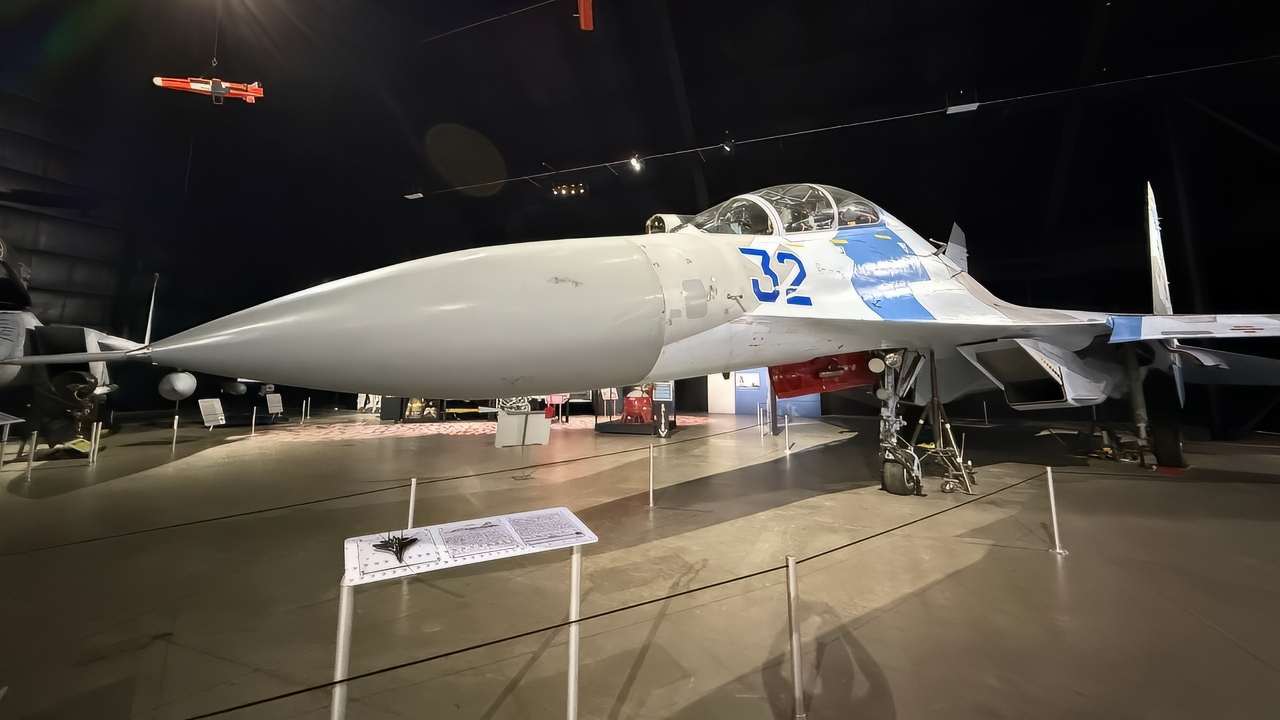
Su-27 Flanker Up Close. Image Credit: National Security Journal Taken on July 19, 2025.
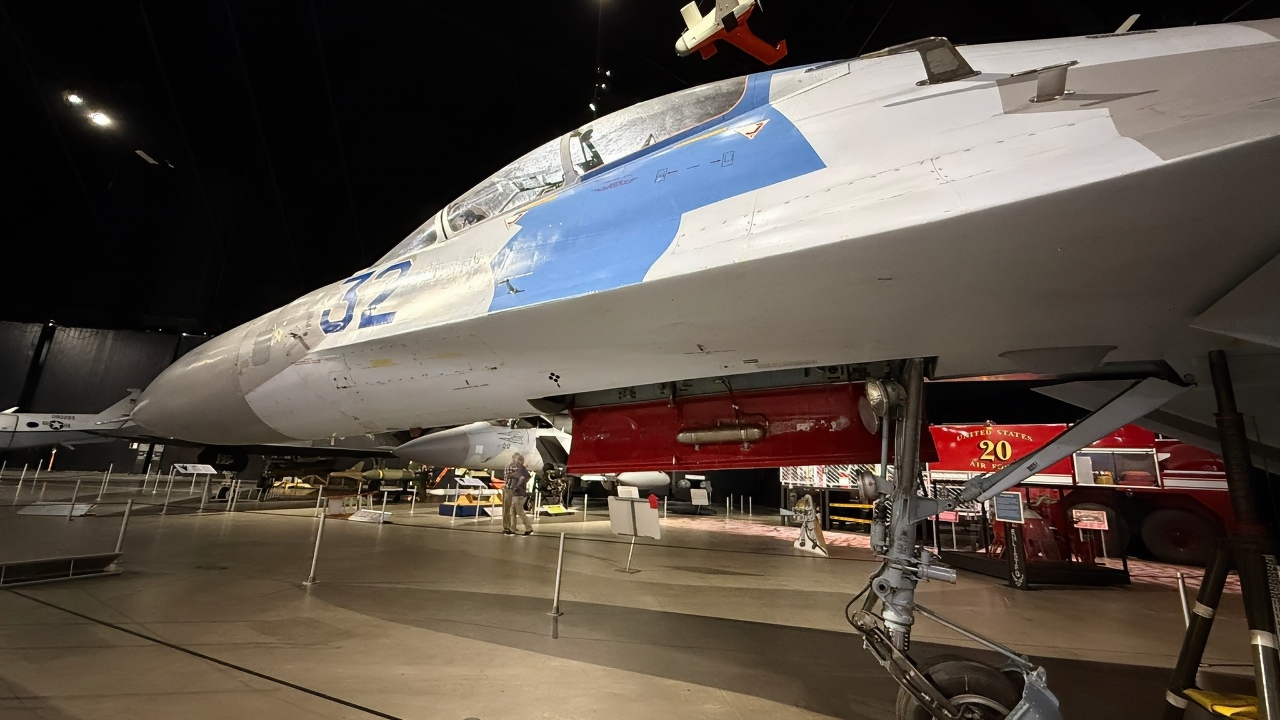
Russian Su-27 Flanker from USAF Museum. Image Credit: National Security Journal.
This can be used to foil an infrared-guided missile by causing the rocket to lose its thermal ‘target.’ Another impressive maneuver the Su-27 can perform is the ‘Kulbit,’ also known as the ‘Frolov Chakra.’ This complex maneuver sees the aircraft perform a 360-degree flip on itself while continuing to fly forward,” according to FlyaFighter.com.
The Flanker is a single-seat aircraft that measures 72 feet in length and 48 feet in width. Empty weight is 36,000 pounds.
While the Su-27 is meant for dogfighting, it can also conduct a ground strike. Weapons are carried on 10 hardpoints. For air-to-surface missions, the Su-27 is equipped with precision-guided bombs, conventional bombs, cluster bombs, anti-radar missiles, and anti-ship missiles. This gives the airplane much versatility in the diverse range of missions it can carry out.
Numerous Variants Have Proliferated
The Su-27 has undergone significant updates over the years, and there are numerous variants. Approximately 700 Flankers were produced in total.
Most notable is the Su-27BM Super Flanker with improved avionics, radar, and sensors. The Super Flanker has even better maneuverability than the base model Su-27. There is also an aircraft carrier version. The Su-27SKM is the export variant. At least twelve different air forces fly this model. The United States even bought two in 2009 to serve as “red team” aggressors in aerial combat drills.
Performance During the Russia-Ukraine War
Ukraine also flies the Su-27. The Ukrainian air force started the war with 32 Su-27s. The Russians have downed at least 15 Ukrainian Flankers.
Meanwhile, the Russian air force has also flown Su-27 to a mixed record. Su-27s have often remained over Russian airspace and fired cruise missiles and the effective glide bombs at Ukrainian cities and military targets, plus these weapons have destroyed energy infrastructure.
The Su-27 was intended to establish air dominance in the war against Ukraine, but this did not occur.
The origins of the Su-27 date back to the 1970s, when the Soviets sought to enhance their air power capabilities. The United States had its share of air superiority fighters, and the USSR didn’t want to fall behind. Instead of creating a separate air interceptor and a medium-sized bomber, the Soviets thought they could combine these characteristics in one airplane, and the Su-27 was born. The designers decided on a wing-body blending shape and twin vertical tail fins, as MiiltaryFactory.com described. The speedy aircraft was versatile and pilot-friendly with a diverse range of weapons.
The Flanker is one of the fastest aircraft in the world and can execute numerous defensive and offensive maneuvers. It was meant to challenge the F-14 and F-15 and achieve air superiority in a significant conflict.
However, its performance has been disappointing during the war in Ukraine. This can be attributed to the strength of air defenses on both sides. Vladimir Putin’s air force has responded by keeping the Su-27 in Russian airspace for ground strikes.
These tactics have been mostly effective, but they have been a disappointment in force-on-force battles.
About the Author: Dr. Brent M. Eastwood
Brent M. Eastwood, PhD is the author of Don’t Turn Your Back On the World: a Conservative Foreign Policy and Humans, Machines, and Data: Future Trends in Warfare plus two other books. Brent was the founder and CEO of a tech firm that predicted world events using artificial intelligence. He served as a legislative fellow for U.S. Senator Tim Scott and advised the senator on defense and foreign policy issues. He has taught at American University, George Washington University, and George Mason University. Brent is a former U.S. Army Infantry officer. He can be followed on X @BMEastwood.
Hypersonic Weapons In-Depth
Russia’s Hypersonic Missiles Summed Up in 4 Words


