Key Points and Summary: Iran’s army, while large in personnel with approximately 960,000 active and reserve troops, is a mix of strengths and critical weaknesses.
-Its conventional forces are technologically inferior, relying on an aging air force and recently degraded air defenses.
-The real power lies with the Islamic Revolutionary Guard Corps (IRGC), which oversees Iran’s most potent assets: its vast and diverse arsenal of ballistic missiles and its asymmetric tactics using regional proxy forces.
-However, recent Israeli strikes during “Operation Rising Lion” have decimated Iran’s air defenses, killed senior IRGC commanders, and are now targeting its missile launchers, exposing severe vulnerabilities.
How Strong Is Iran’s Army?
In the current conflict between Israel and Iran, exchanges mainly take place in the air.
Israel has been conducting airstrikes during Operation Rising Lion with virtual impunity over Tehran, as they have air dominance over Iran. The Iranians have been launching hundreds of ballistic missiles toward Tel Aviv and other Israeli cities.
Israel’s Iron Dome has neutralized the vast majority of the missiles and drones from Iran, but between 10 and 15 percent get through. It has taken a toll on the civilian population, which was the target of the Iranian missiles.
Israel has targeted Iran’s nuclear facilities, military targets, and conducted selected strikes against top military and scientific leaders, eliminating several. Now, each side is hoping to bludgeon the other. Iran has thousands of missiles, but the Israelis are targeting the launchers, which they have destroyed about 30 percent of. The mobile launchers are tough to track, however.
The US has deployed a large force of naval and air forces to the region but, thus far, has only acted defensively, protecting US bases in the region and shooting down missiles headed for Israel. But that may soon change.
If the war does escalate, a common question is, “How strong is Iran’s Army?”
A Look At Iran’s Military Strengths And Weaknesses
Iran possesses a large military, particularly in terms of active personnel, making it the largest in the Middle East. However, its military capabilities are a mix of strengths and weaknesses.
While Iran has a significant number of troops and is developing advanced weapons like drones and missiles, its conventional forces are considered to be technologically inferior to some of its adversaries.
Iran has a large standing military, comprising both active-duty personnel and reserves, with a total of approximately 960,000 personnel. While their conventional forces are weak, the IRGC—Iran’s Islamic Revolutionary Guard Corps—was built to provide extra protection to the Islamic regime in 1979 and is the dominant branch of the Iranian Armed Forces.
The Revolutionary Guard, which had several senior leaders killed in Israel’s strikes, oversees Iran’s ballistic missile program.
The IRGC, which answers only to Iran’s supreme leader, has an estimated 125,000-strong military with Army, Navy, and air units. This force includes the Quds Forces. The United States and other world powers classify the IRGC and Quds Forces as terrorist organizations.
Iran has invested heavily in its missile and drone programs, developing a wide range of systems with the ability to strike targets across the Middle East and into Europe or even China.
Their military doctrine emphasizes asymmetric tactics, including the use of drones, missiles, and proxy forces, to offset its technological disadvantages against stronger conventional militaries. Hamas, Hezbollah, Houthi rebels, Islamic Jihad, and others have done Iran’s bidding for years in the region.
But the Israelis have decimated their proxies since the October 7 attack on Israel. Hamas and Islamic Jihad have been decapitated as the senior leadership of both groups has been eliminated. The same happened to Hezbollah. But Israel and the US have been hammering the Houthis.
The most significant weaknesses of Iran’s military are its air defenses, which Israeli airstrikes have nearly wiped out, and its lack of an air force. Their fighter aircraft consist of ancient F-14s, F-5s, and other 1970s-era aircraft. Israel took out most of the remaining F-14s with a drone strike.
The US Has Been Obsessed With Diplomacy
Since 1979, with the overthrow of the Shah, the US has treated Iran as a great military power, reluctant to do anything to anger the ayatollahs. The US was close to Iran during the Shah years, and so was Israel.
There were once daily flights between Tel Aviv and Tehran, and Iran had a significant Jewish population. No longer.
The ayatollah played on Carter’s almost religious faith in the possibility of diplomacy. Following the Carter administration, Ronald Reagan’s Secretary of Defense, Caspar Weinberger, blunted retaliation for the 1983 Marine Barracks bombing for fear of angering Saudi Arabia.
From George H.W. Bush onward, both Republican and Democratic administrations hoped to engage the Islamic Republic. They believed holding Iran accountable for its actions or those of its proxies might undercut the possibility of diplomacy.
That changed in the two Trump administrations. He targeted and eliminated Quds Force General Qassem Soleimani in January 2020.
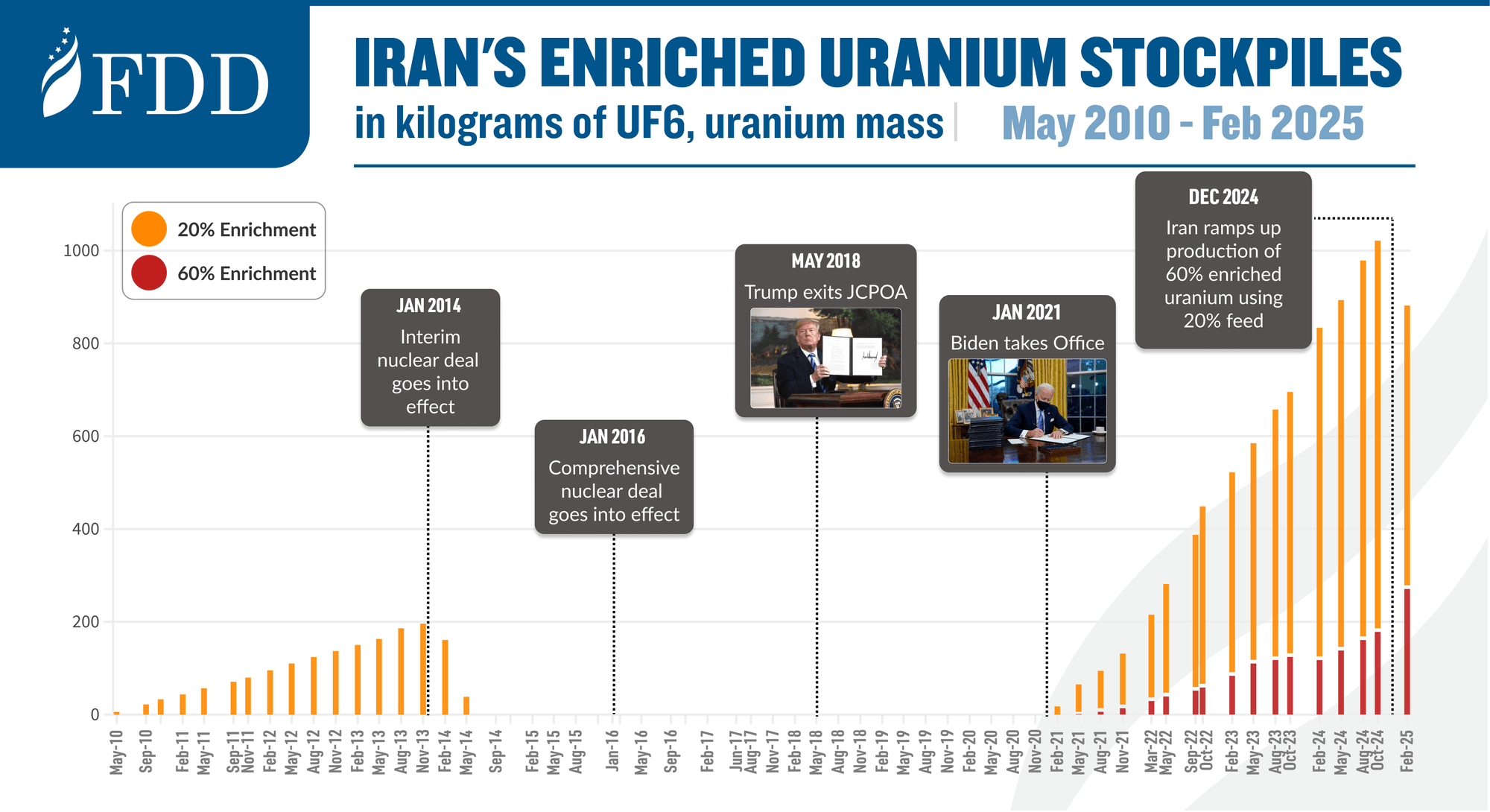
Iran’s nuclear progress is now undeniable. Proponents of the 2015 Joint Comprehensive Plan of Action can scream about Trump’s withdrawal from the agreement for Iran’s enrichment surge, but they ignore two significant facts:
Iran’s enrichment occurred not after Trump withdrew but rather when the Biden administration scrapped “Maximum Pressure” sanctions, and the 2015 nuclear deal did not relieve Iran of its Nuclear Non-Proliferation Treaty obligations.
Iran’s conventional military is weak, its air defenses are largely destroyed, and its air force is decades behind its adversaries. Their navy is no match for a modern navy. They put all of their efforts into missiles and building proxy forces. But their proxies have been neutralized for now, and while they have thousands of missiles and rockets, their launchers are being hunted against an air force that flies with impunity over their capital.
That is why, a week after snubbing President Trump, they are suddenly requesting more negotiations in a desperate attempt to buy time in the hope they can build a nuclear weapon.
About the Author:
Steve Balestrieri is a National Security Columnist. He served as a US Army Special Forces NCO and Warrant Officer. In addition to writing on defense, he covers the NFL for PatsFans.com and is a member of the Pro Football Writers of America (PFWA). His work was regularly featured in many military publications.
Iran War
B-2 Bomber: How America Would Strike Iran