

Iran Is Finding New Ways to Disrupt Middle East Oil – Iran’s attempts to choke off Middle Eastern oil exports aren’t working as well as they once did, but that doesn’t mean Tehran is out of options or that the region’s energy crisis is ending.
In fact, signs suggest the battle over Middle Eastern oil exports may simply be changing, with even bigger, longer-term problems emerging.
New shipping data published on October 5 shows that Middle Eastern crude exports exceeded pre-war levels on September 24 and between September 27 and 29, reaching 19.5 to 22.5 million barrels per day.
The seven-day moving average also rose to 18.5 million barrels per day on October 1, slightly above the 18 million barrels per day average recorded during the year before the U.S. and Israel launched the first strikes.

U.S. Air Force F-22 Raptors assigned to the 27th Expeditionary Fighter Squadron and Philippine Air Force FA-50PH light jet fighters conduct joint combined exchange training, above Basa Air Force Base, Phillipines, on Aug. 9, 2024. Joint combined exchange training is critical to enhancing U.S. and Philippine Air Force interoperability in a free and open Indo-Pacific. (U.S. Air Force photo by Senior Airman Mitchell Corley)

U.S. Air Force Gen. Kevin B. Schneider, Pacific Air Forces commander, pilots the lead F-22 Raptor rendezvousing with a C-17 Globemaster III, both from Joint Base Pearl Harbor-Hickam, during a mission off the coast of O‘ahu, April 8, 2025. PACAF provides ready and lethal forces to ensure stability and security in the Indo-Pacific. (U.S. Air Force photo by Tech. Sgt. Emerson Nuñez)
Iran is still striking ships in the Strait of Hormuz, but it is also adapting and finding new ways to disrupt exports, including those facilitated by alternative pipeline routes.
Rather than simply attacking tankers that move through the Strait of Hormuz, Iran and its proxies are targeting pipelines and pumping stations, refineries themselves, and the terminals that have allowed Gulf producers to work around the bottlenecks created by Iran in the wake of the war.
The Gulf’s New Oil Network
The recovery of Middle Eastern oil shipments is partly due to Gulf states changing how they export oil and partly to expanded U.S. naval operations intended to protect convoys moving through the Strait of Hormuz day and night.
According to Kpler, Gulf countries other than Iran exported at least 16.5 million barrels per day of crude in September, matching their pre-war average. Around 40% of that crude now leaves without passing through Hormuz, compared with just 17% before the war.
Saudi Arabia quickly began using its East-West pipeline to divert crude to Yanbu on the Red Sea.
The United Arab Emirates, meanwhile, is exporting its crude from Fujairah outside of the Strait of Hormuz, and tankers are moving crude through the strait before transferring it to other vessels near Fujairah and Sohar.
Over 70% of the crude that passed through the Strait of Hormuz in August later changed tankers offshore.
The Strait of Hormuz is still vulnerable to Iranian strikes, but the U.S. is proving that oil can in fact move through the waterway – albeit at a higher price and greater risk. The alternative routes also have their own vulnerabilities.
Now the Pipelines Are Being Hit
On Sunday, October 4, Yemen’s Houthis – a proxy group for Iran – took responsibility for ballistic missile and drone strikes against Saudi Aramco facilities in Riyadh and Khurais in retaliation for Saudi strikes against Yemen. Reports showed the sites engulfed in flames, and the Houthis themselves said that the attacks caused major fires.
A day later, an unnamed source from Saudi Arabia’s energy sector told Agence France-Presse that the attack caused substantial damage to a pumping station in Khurais, east of Riyadh, on the East-West pipeline. According to the source, the damage forced operators to shut down the pipeline again.
However, a separate source told Reuters on October 5 that the pipeline’s oil flow was not interrupted, as claimed. Other reports from major Western outlets say the pipeline is operating normally.
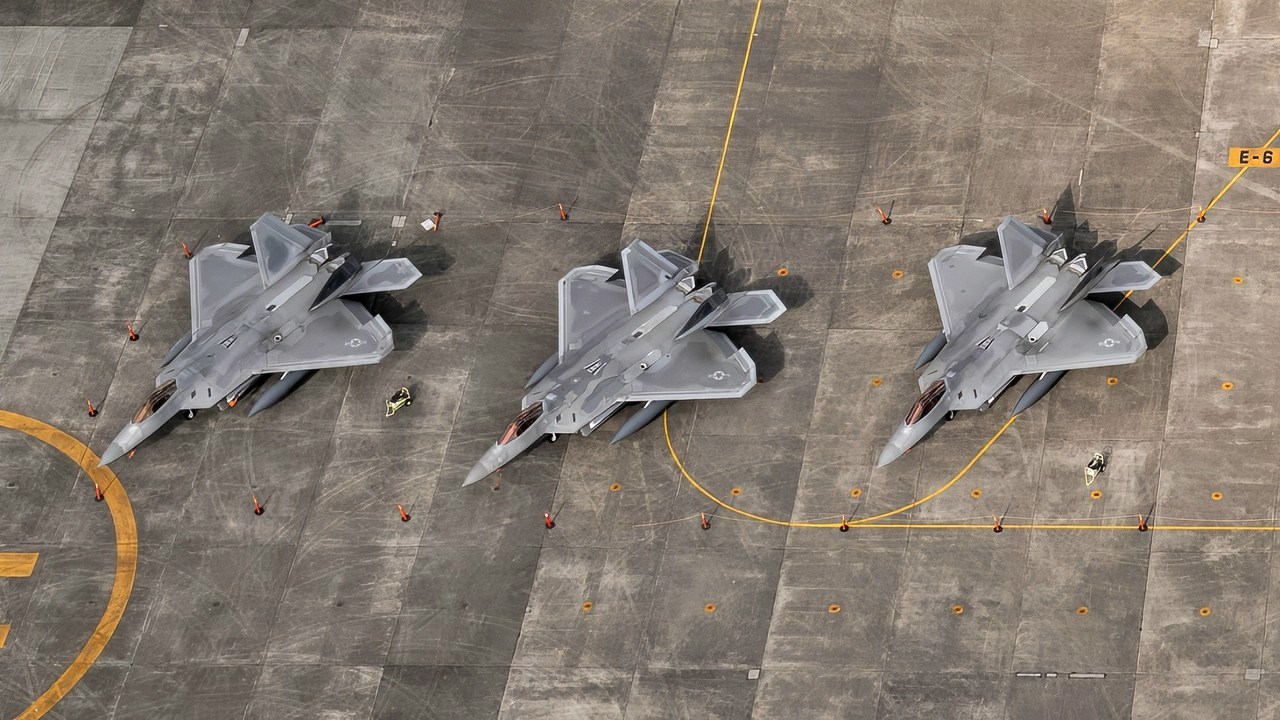
Eight U.S. Air Force F-22 Raptors from Joint Base Elmendorf-Richardson, Alaska, sit on the flightline, July 9, 2018, at Yokota Air Base, Japan. Eight F-22s evacuated from Kadena Air Base, Japan due to Typhoon Maria. The F-22 are deployed under U.S. PACOM’s theater security package (TSP) program, which has been in operation since 2004. (U.S. Air Force photo by Yasuo Osakabe)
Neither Saudi Aramco nor the Saudi Energy Ministry has confirmed whether the pipeline is in operation.
But an attack on the pipeline itself would be significant because it is one of the primary reasons Saudi Arabia has been able to circumvent Iran’s restrictions in the Strait of Hormuz, although the Houthis’ aggressive targeting of vessels in the Bab el-Mandeb Strait is also putting that strategy under pressure.
The roughly 1,200-kilometer pipeline carries crude from Saudi Arabia’s eastern oil-producing regions to Yanbu on the Red Sea, allowing up to seven million barrels per day to flow to the ports.
However, on September 10, drones launched from Iraq struck three pumping stations that serve the pipeline, forcing Saudi Arabia to shut the system down. The pipeline was offline until September 22, when Saudi Arabia restarted operations at a reduced rate.
Before the attack, the pipeline moved roughly four million barrels per day, about 4% of global oil supply. The pipeline was moving that oil specifically to bypass the Strait of Hormuz.
The threat is expanding, too, with Aramco CEO Amin Nasser warning on October 5 that attackers are now weaponizing satellite imagery and ship-tracking data to identify and strike oil infrastructure and tankers.
About the Author: Jack Buckby
Jack Buckby is a British researcher and analyst specializing in defense and national security, based in New York. His work focuses on military capability, procurement, and strategic competition, and he produces and edits analysis for policy and defense audiences. He brings extensive editorial experience, with a career output spanning over 1,000 articles at National Security Journal, and has previously authored books and papers on extremism and deradicalization.


