

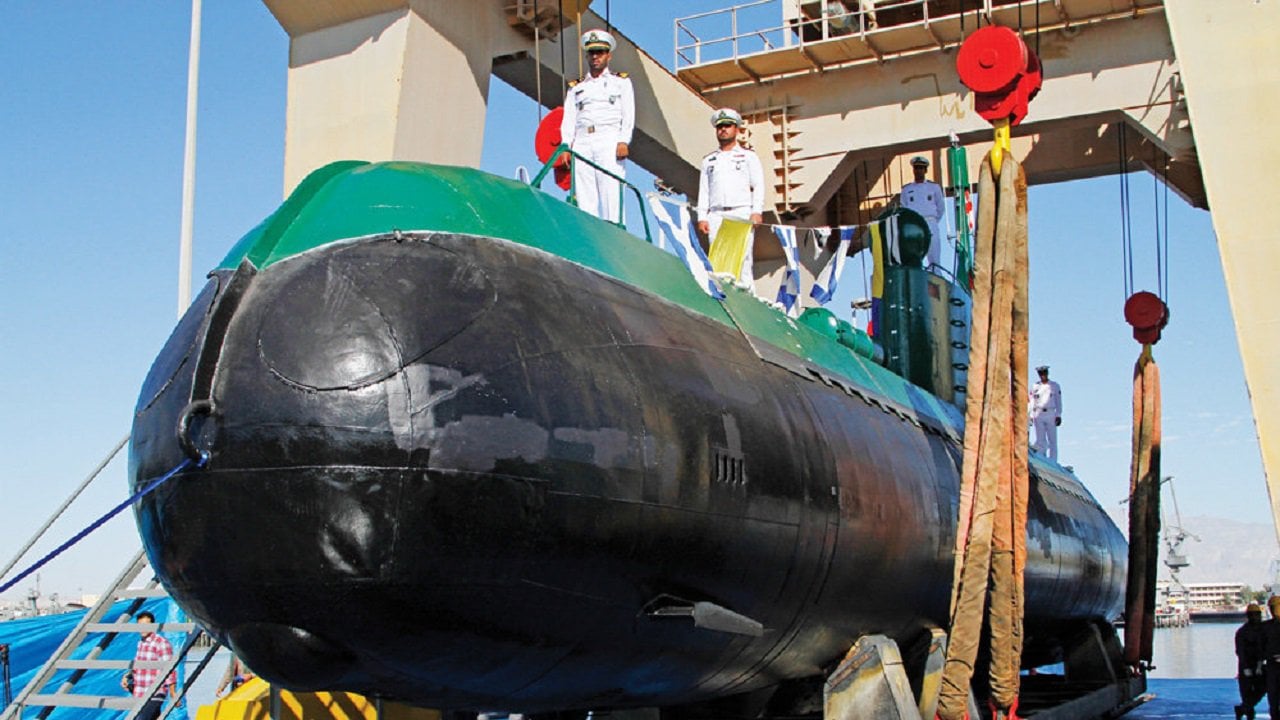
Key Points – Iran’s Ghadir-class midget submarines, numbering around 20, are a key component of its asymmetric naval strategy, specifically designed for the shallow waters of the Persian Gulf.
-While Iran claims the Ghadir is an indigenous design, it is widely believed to be based on North Korean technology, likely the Yono-class, continuing a long history of military cooperation between the two nations.
-These small, stealthy diesel-electric submarines are armed with two 533mm torpedo tubes and are ideal for ambushes, mine-laying, and special operations in strategic chokepoints like the Strait of Hormuz, posing a significant threat to larger naval vessels.
Ghadir-Class: Iran’s Midget Submarines
The Ghadir-class submarine is the most widely produced class of submarine currently in service in the Iranian Navy. These midget submarines may be small but still represent a significant threat to the United States and allied navies. These submarines are a key component of Iran’s asymmetric naval warfare strategy, particularly suited for operations in the shallow waters of the Persian Gulf. Despite being advertised as an entirely domestic project, North Korean midget submarine designers likely had a significant influence on its development.
North Korea’s Involvement in Iran’s Submarine Force
Iran’s interest in small, agile submarines dates back to the 1980s during the Iran-Iraq War. At that time, the need for stealthy and cost-effective naval assets became evident. Iran initially relied on imported designs, particularly from North Korea, including the Yugo and Sang-O classes. These early experiences laid the groundwork for Iran’s indigenous submarine program. By the early 2000s, Iran had made significant strides in domestic military production, culminating in the unveiling of the Ghadir-class submarine in 2004. The first unit was launched in 2005, and Iran soon announced the commencement of mass production.
As of 2025, Iran is believed to have constructed around 20 Ghadir-class submarines, all of which are operational within its Southern Fleet.
According to reports, North Korea handed over at least one of its submarines to Iran, which was then used as inspiration for the Ghadir-Class. North Korea has been a strategic partner with Iran for several decades now and has supplied Iran with various naval systems, including torpedo boats and other attack craft. More worryingly, Iran and the DPRK have been closely cooperating in the field of missiles. This, combined with the provided submarines, has experts worried that Iran and North Korea may one day be able to create nuclear submarines of their own with ballistic missile capabilities.
There has been considerable debate among defense analysts regarding the design origins of Iran’s Ghadir-class. While some argue that it is based on the North Korean Yugo-class, others suggest it more closely resembles the Sang-O class, being about 1.5 times larger than the Yugo. The Office of Naval Intelligence reported that Iran received a Yono-class submarine, which more closely resembles the Ghadir class. Regardless, Iran claims that the Ghadir-class is an entirely domestic product that is expressly made for the needs of the Iranian Navy.
The Iranian/Korean “Midget Sub”
The Ghadir-class is a midget submarine designed primarily for coastal defense, reconnaissance, mine-laying, and special operations. Despite its harmless-sounding name, these midget submarines are a lethal force to be reckoned with. Its small size and diesel-electric propulsion system make it particularly well-suited for stealth missions in the Persian Gulf, where the average depth is only about 50 meters. The submarine has a surfaced displacement of approximately 117 tons and a submerged displacement of around 125 tons. It measures about 29 meters in length, with a beam of 9 meters and a draught of 8.2 meters. It is powered by a diesel-electric engine that allows it to travel at speeds of up to 10 knots on the surface and 8 knots when submerged. The crew complement is typically around seven personnel.
In terms of armament, the Ghadir-class is equipped with two 533 mm torpedo tubes. These can be used to launch torpedoes and possibly lay naval mines. There have also been unconfirmed reports suggesting that the submarine might be capable of launching anti-ship cruise missiles, although this capability has not been independently verified. Despite its limited offensive payload, the Ghadir-class is considered a potent threat in the confined maritime environment of the Persian Gulf, where its stealth and maneuverability can be leveraged to maximum effect.
Why Midget Subs are a Big Deal
The Ghadir-class plays a central role in Iran’s doctrine of asymmetric warfare. This doctrine emphasizes the use of unconventional tactics and platforms to counter technologically superior adversaries, such as the United States Navy. The Ghadir-class is particularly effective in this context due to its ability to operate undetected in shallow waters, lie in ambush near strategic chokepoints like the Strait of Hormuz, and deploy naval commandos for sabotage or reconnaissance missions. Its capability to lay mines covertly adds another layer of threat, potentially disrupting commercial shipping and naval operations in the region.
Despite its advantages, the Ghadir-class is not without its downsides. Its small size restricts its operational range and endurance, making it unsuitable for extended missions far from home waters. The limited number of torpedo tubes also constrains its offensive capabilities. Furthermore, the submarine is likely to lack the advanced sonar and electronic warfare systems found on more modern Western submarines. However, these limitations are offset by the submarine’s low cost, ease of production, and strategic utility in Iran’s naval doctrine.
Iran’s Developing Naval Power
Iran appears committed to enhancing its undersea warfare capabilities. Reports suggest that upgrades to the Ghadir-class are underway, including improvements to sonar and navigation systems, enhanced stealth features, and potential integration with unmanned underwater vehicles.
Iran has also introduced newer submarine classes, such as the Fateh-class, which are larger and more capable, indicating a broader strategy to diversify and modernize its submarine fleet.
Overall, the presence of Ghadir-class submarines in the Persian Gulf poses a significant threat. Their ability to operate undetected in shallow waters poses a serious challenge to regional and international naval forces. In particular, their potential to disrupt traffic through the Strait of Hormuz (a vital chokepoint for global oil shipments) gives Iran a powerful tool for strategic leverage. While hardly a match for the US submarines, Iran’s midget subs have the potential to complicate naval operations for the US and its allies massively.
About the Author:
Isaac Seitz, a Defense Columnist, graduated from Patrick Henry College’s Strategic Intelligence and National Security program. He has also studied Russian at Middlebury Language Schools and has worked as an intelligence Analyst in the private sector.
Russia’s Bomber Forces
Tu-22M3: The Bomber Ukraine Hit With Drones


Pingback: North Korea Is Sending Another 6,000 People to Kursk, After 6,000 Troops were Casualties - National Security Journal
Pingback: Iran 'Sleepwalked' Into a War with Israel It Can't Win - National Security Journal
Pingback: Iran's Submarine Force Summed Up in 4 Words - National Security Journal