


“Project Freedom” lasted 48 hours. The U.S. military launched escort operations through the Strait of Hormuz on May 5, sank six Iranian small boats, and guided two American-flagged merchant ships through the corridor. By Tuesday evening, President Trump had suspended the operation — citing diplomatic progress, deferring to Pakistan, announcing a pause to let negotiations breathe.
Secretary Rubio declared the combat operation against Iran over on Tuesday — the same day Project Freedom launched. Trump suspended the escort mission that evening. Two ships transited in forty-eight hours. Washington called that diplomatic progress. The operational record frames it differently.
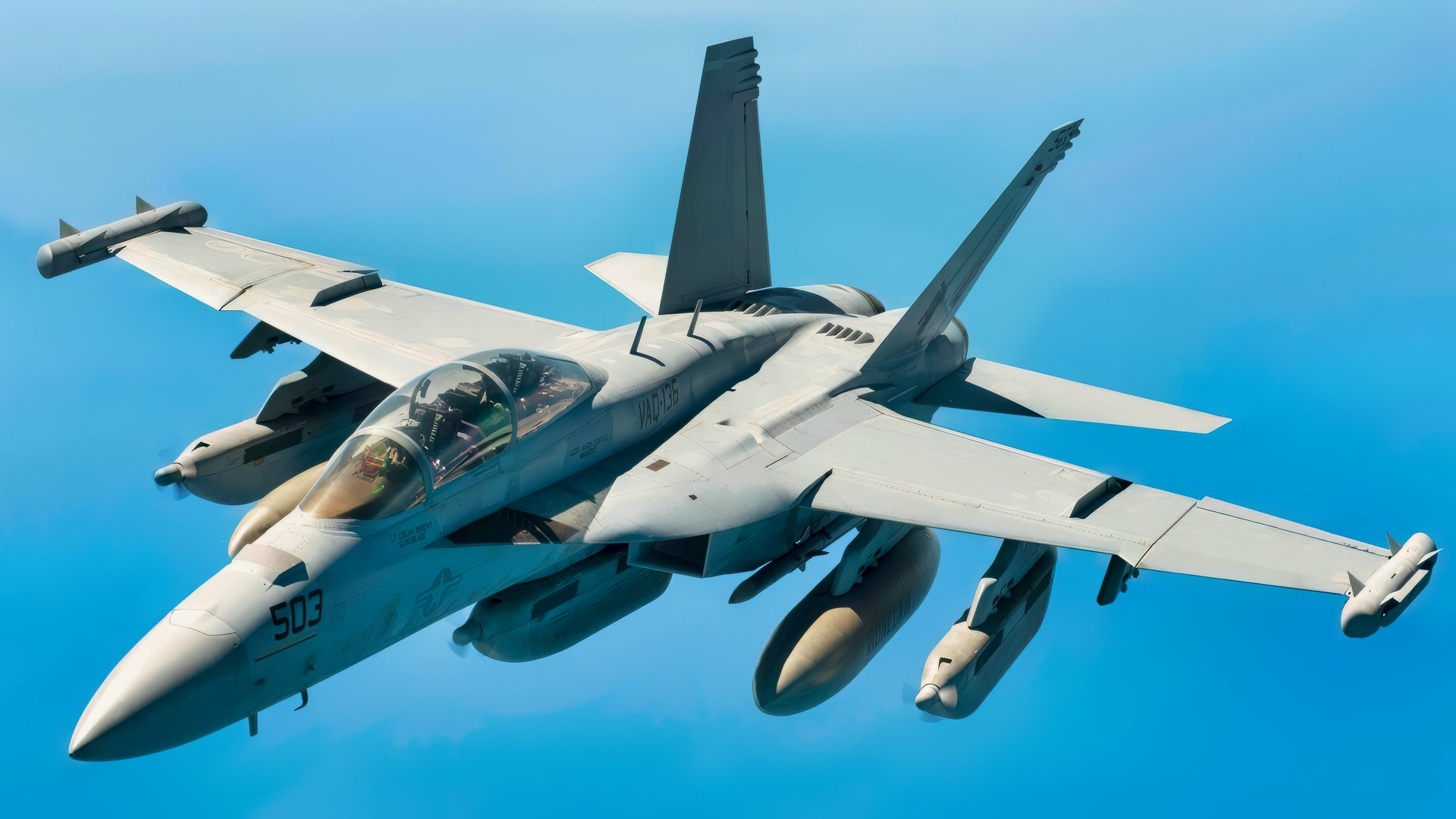
A U.S. Navy EA-18G Growler assigned to the USS Carl Vinson breaks away from a U.S. Air Force KC-135 Stratotanker from the 909th Air Refueling Squadron after conducting in-air refueling May 3, 2017, over the Western Pacific Ocean. The 909th ARS is an essential component to the mid-air refueling of a multitude of aircraft ranging from fighter jets to cargo planes from different services and nations in the region. (U.S. Air Force photo by Senior Airman John Linzmeier)
The Strait of Hormuz Is Closed
The Strait of Hormuz has effectively ceased to function as a reliable transit corridor since February 28 — reduced to roughly five percent of normal traffic volume since the United States and Israel launched Operation Epic Fury, with roughly 1,500 commercial vessels bottled up and most major carriers suspended.
A significant share of global oil and LNG supply is not moving.
This is not an elevated-risk transit environment. It is a closed waterway, now blockaded in both directions — the U.S. Navy interdicting ships bound for Iranian ports since April 13, Iran running its own vetting and toll system on the northern corridor at over a million dollars per ship.
Washington spent weeks describing this as a problem of uncertain passage. It is a problem of closed passage. That distinction matters for everything that follows.
What the Operation Actually Tested
Project Freedom’s architects framed it as a defensive humanitarian mission — Rubio described crews from 87 nations as stranded ducks. That framing was politically useful and strategically incomplete.
What the operation actually tested was whether the United States could impose transit through a contested waterway over Iranian opposition — under conditions where Iran retains mines, fast boats, drones, and ballistic missiles, and where the UAE was struck by Iranian missiles on back-to-back days during the operation itself.

An F/A-18 Super Hornet from Naval Air Station Oceana, Virginia, performs an aerial demonstration over Rickenbacker International Airport, Ohio, June 16, 2024, as part of the Columbus Air Show. This year’s event featured more than 20 military and civilian planes, including a KC-135 Stratotanker from the 121st Air Refueling Wing, which served as the base of operations for military aircraft participating in the show. (U.S. Air National Guard photo by Senior Airman Ivy Thomas)
The answer, as of May 6: two ships got through, and the operation is suspended.
That is not necessarily a strategic failure — a pause for diplomacy is defensible if talks produce results. But Iran read the sequence as a test, and the test’s results are now on the negotiating table. Foreign Minister Araqchi was in Beijing on Wednesday, meeting Wang Yi, demanding “a fair and comprehensive agreement,” and pointedly declining to acknowledge the escort pause as a concession. Tehran’s position is that the strait remains an Iranian card to play, not an American one to force.
The Kill Chain Problem Washington Keeps Avoiding
Every escort operation makes the same structural concession: passage depends on conditions that can change. The U.S. can push ships through. Escorting them does not strip the corridor of danger on American terms — not durably, not without widening the fight considerably.
The productive approach runs earlier in the sequence. Disruption requires three things: finding targets, tracking them, and delivering a strike. Break that chain before the shot is cued and the operational calculus shifts. Leave it intact, and Washington is reacting within a corridor constantly watched and held at risk cheaply.

Iran’s missile capabilities. Image Credit: Creative Commons.
That means sustained pressure on the ISR architecture that enables Iranian strikes — the targeting networks, the fast-boat and drone staging areas along the Iranian littoral, the communications that cue the IRGC shot. Degrading those systems imposes costs earlier in the kill chain than any convoy operation can reach. It does not eliminate risk. It makes disruption harder to execute and less reliable when attempted. In this environment, that is the ceiling—and it is worth being honest about it.
Concentrating more ships inside the strait does not improve those odds. A tighter formation is easier to track, time, and stress. The geometry works against the escorting force.
What Iran Is Actually After
Iran does not need to keep the strait closed indefinitely. It needs closure to generate leverage—and it already has.
Araqchi’s Beijing statement is the clearest signal. A “comprehensive agreement” means Iran is not negotiating for a ceasefire. It is negotiating for something structurally larger: recognition of its rights, relief from the sustained pressure campaign, and — not stated but clearly implied — the right to retain a future capacity for exactly this kind of disruption. The strait is the card. The comprehensive agreement is the pot.
“Forcing the strait open” is not a counter to that strategy. Inserting escorts into the corridor addresses the symptom. The coercive leverage model Tehran just demonstrated still goes untouched.
The Honest Standard
Two ships transited before Trump suspended the operation. Iran struck the UAE on back-to-back days and signaled victory from Beijing before Project Freedom reached day three.
The question is not whether to maintain a credible presence in the Gulf — Washington should. The question is what standard of success is honest and achievable. Routine, low-risk transit is not on offer. A contested strait that Iran cannot convert into durable coercive leverage — that is achievable, and it is the ceiling, not the floor.
Iran is negotiating for the permanent right to threaten Hormuz. Washington should negotiate to ensure that the threat produces diminishing returns. Conflating the two objectives is how you end up suspending a two-day-old operation and calling it diplomatic progress.
About the Author: Dr. Andrew Latham
Andrew Latham is a professor of international relations and political theory at Macalester College in Saint Paul, MN. You can follow him on X: @aakatham.


SurfBird
May 7, 2026 at 9:23 am
What the government of Iran really wants is power. The power to launch nuclear armed missiles at anyone who isn’t a Shia Muslim; starting with Israel. The power to influence (force) others to bend to their will. That’s why they fund Hezbollah, Hamas, Houthis and others. The power to squeeze the world’s economic artery by closing the Strait of Hormuz.
That lust for power makes them very similar to many other nations throughout history. So far only the United States and a small number of neighboring nations seem to realize the danger.