

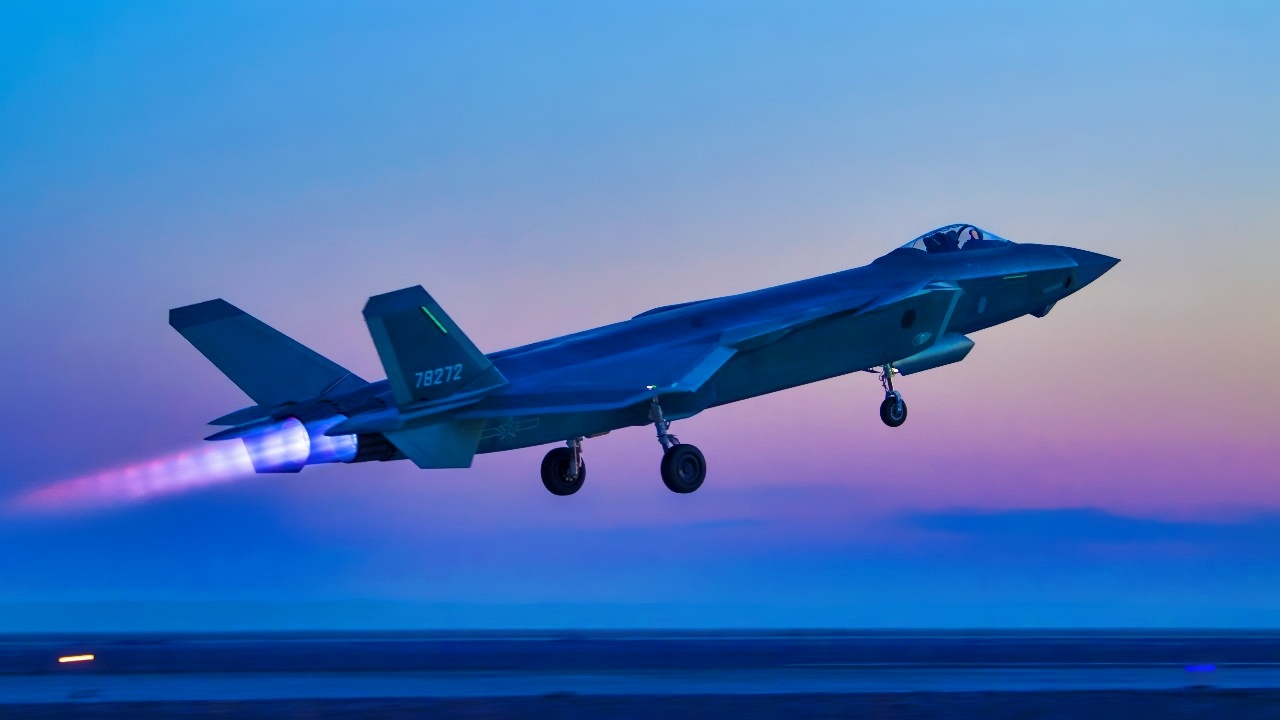
Key Points and Summary – In a hypothetical matchup between the fourth-generation F-16V Viper and China’s fifth-generation J-20 “Mighty Dragon,” the deciding factor is stealth.
-While the combat-proven F-16 is more maneuverable and excels at ground strike missions, the J-20’s ability to evade radar gives it a decisive advantage in initial air-to-air combat.

J-20. Image Credit: Creative Commons.
-In a potential conflict over Taiwan, the J-20 would likely be used to establish air superiority on “Day One.”
-The F-16, however, would remain critical for its ability to defend against a surface invasion, highlighting a classic clash between stealth and proven multi-role capability.
The F-16 vs. China’s Stealth J-20: How Do They Match Up?
The F-16 Fighting Falcon has served the U.S. Air Force well over the decades. It has been a mighty workhorse and active with many different militaries around the world. Combat-proven as a close air support warbird over the skies of Iraq and Afghanistan, plus seeing warfare with Israel and Ukraine, this airplane has always exceeded expectations.
But the F-16 is a fourth-generation airplane, although variants like the F-16V Viper could be seen as the fourth-generation “+.” It may have to fly someday in Day Two or Day Three of warfare against China’s fifth-generation J-20 Mighty Dragon fighter.
The J-20 comes with stealth capabilities, although the F-16 may have better maneuverability in a dogfight, as the American pilots have combat experience and the Chinese do not.
The F-16 Is Much Older Than the J-20
The F-16 is a much older aircraft – it is over 50 years old, having first flown in 1974. The advent of the J-20 was in 2017. While the F-16V is a modernized warplane, the overall systems on the J-20 are newer. However, the F-16 has much more combat experience and is considered an air superiority and multi-role fighter.
It excels at ground strike capabilities and its bombing runs with precision-guided munitions dropped danger close to friendly forces have saved numerous soldiers and marines since 9/11.
You Can’t Beat Stealth
The J-20 is more of a long-range air superiority fighter without the ground strike experience of the F-16. The J-20 would still be quite a challenge for the F-16. The J-20’s ability to evade radar could keep the Mighty Dragon from getting shot down in aerial combat by the F-16.

U.S. Air Force F-16 Fighting Falcons assigned to the 14th Fighter Squadron fly in formation waiting to refuel during an off-station training near Misawa Air Base, Japan, June 2, 2025. The F-16s were refueled by a KC-46A Pegasus assigned to the 60th Air Mobility Wing as part of an exercise to demonstrate its capability to traverse the Pacific Ocean and deliver fuel to fighters in the region. (U.S. Air Force photo by Senior Airman Robert Nichols)
Size Match-up and Sensors
Both fighters can hit a top speed of MACH 2. The F-16 has better maneuverability and agility due to its smaller size and weight. Both the J-20 and F-16V have advanced AESA radar. The F-16V features the Northrop Grumman AN/APG-83 Scalable Agile Beam Radar.
The Taiwan Versus China Scenario
The two airplanes are likely to engage in a battle with Taiwan. The Taiwanese began receiving 66 F-16V Block 70 Vipers in March. Chinese pilots are more experienced flying the J-20 Mighty Dragon, and the Taiwanese aviators may have a learning curve to operate the updated F-16V. Taiwan’s pilots slated to fly the F-16V will be trained in the United States.
The Chinese are ready to enter into combat against Taiwan at any time.
However, Taiwan already has 139 base model F-16s in the fleet, and the air force is experienced in flying the older fourth-generation jets. The F-16V has newer cockpit features that will challenge inexperienced pilots. Not so for the Americans who have been flying F-16 variants for decades.
The F-16 Excels at Surface Strike
Taiwan needs the F-16 not only for dogfighting, but also for ground strike in the event of a Chinese invasion. The F-16 can drop 2,000-pound bombs, small diameter bombs, and JDAMs, plus laser-guided and GPS-guided precision munitions. Taiwanese pilots would need to be able to support their ground troops and hit back against Chinese amphibious craft during an invasion.
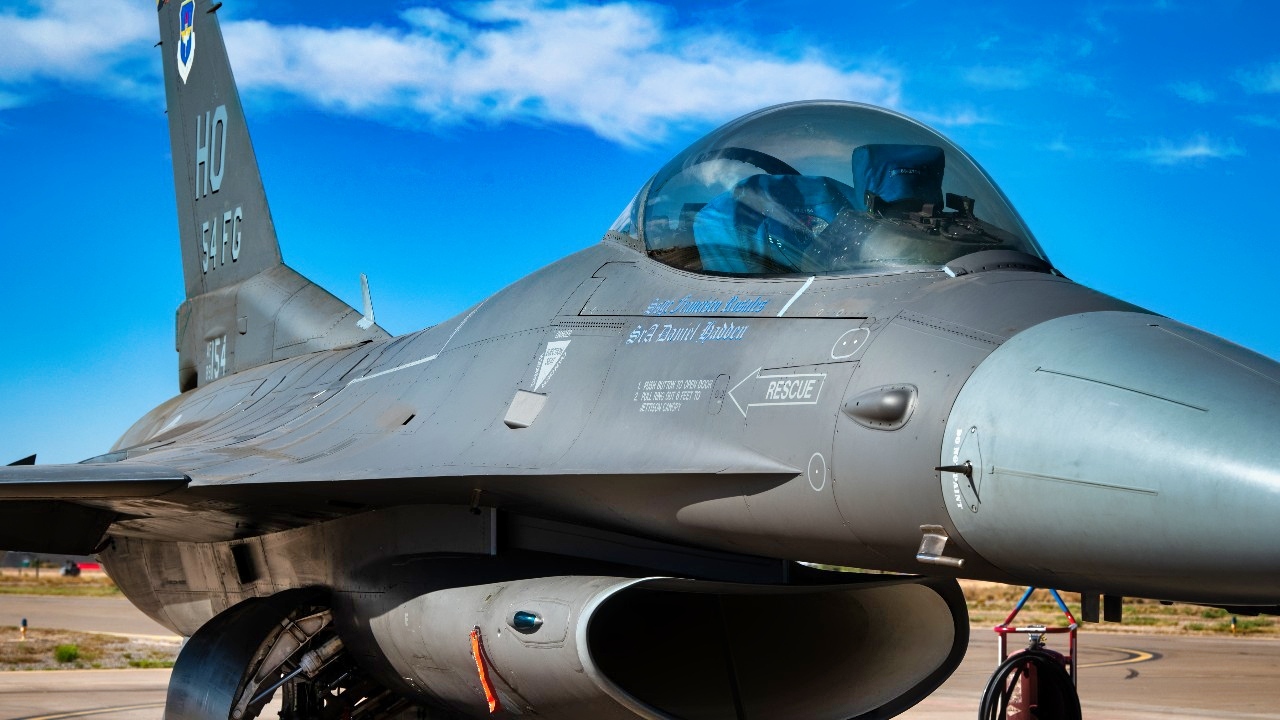
An F-16 Fighting Falcon assigned to the 54th Fighter Group sits on the flightline at Holloman Air Force Base, May 1, 2025. The F-16 was the first production aircraft with a fly-by-wire flight control system, meaning it’s controlled electronically instead of with direct mechanical linkages, allowing for more precise and safer maneuvers. (U.S. Air Force photo by Staff Sgt. Gaspar A. Cortez)
This mission is old hat for the Americans. F-16s are always ready for air-to-surface roles. However, the J-20’s stealth capabilities put the Taiwanese at a disadvantage. The Mighty Dragon could escort Chinese bombers during an attack on Taiwan and make sure Xi Jinping’s air force controls the skies for days, if not weeks.
For aerial combat, the F-16V “can be armed with a range of air-to-air missiles (AAMs), including AIM-9 Sidewinder, Magic II and ASRAAM short-range AAMs, as well as AIM-7, Sky Flash and AIM-120 medium-range AAMs,” according to AirForce-Technology.com.
J-20’s Missiles, Engines, and Size
The J-20 can carry four PL-15 long-range missiles in its central bay and two PL-10 short-range missiles in its side bays. There are also the PL-21 very long-range missiles in development.
The J-20 uses Shenyang WS-10C turbofan engines with 33,000 pounds of thrust. The J-20 has a JLJ-5 AESA radar for better survivability and situational awareness. The stealth fighter is 69 feet long with a wingspan of 43 feet. Its combat range is 1,200 miles, and the ceiling is 52,000 feet.
The F-16 has a length of 50 feet, a wingspan of 33 feet, and a height of 17 feet. The F-16 has a range of 2,002 miles and a ceiling of 50,000 feet.
The key difference between the two airplanes is stealth. The J-20’s ability to evade radar would give the F-16 a disadvantage in combat. In a conflict between Taiwan and China, the F-16s, due to a surprise attack, may not be able to scramble fast enough due to the stealthiness of the J-20. The F-16 pilots would have to remain confident and steadfast when going up against the Mighty Dragon.
Thus, the J-20 has an edge in aerial combat, but the F-16 is better at ground strike missions. This would mean that the J-20 has the advantage on Day One of the conflict, while the F-16 could come to help friendly forces waging combat on the ground early on during the invasion.

An F-16 Fighting Falcon aircraft assigned to the 113th Wing hooks onto the BAK-12 aircraft arresting system at Joint Base Andrews, Md., Aug. 13, 2024. The 316th Civil Engineer Squadron tested the overhauled arresting aircraft system to validate the stability of the emergency brake system. (U.S. Air Force photo by Senior Airman Bridgitte Taylor)
The F-16V is still an excellent choice for the Taiwanese. This is a highly agile and fast modernized fourth-generation “+” fighter. Pilots will need to adjust to its features, but the Taiwanese are experienced flying the less modernized F-16 base model.
In 4 Words: F-16 is Too Old
China is fine with this match-up and is confident that the J-20 can outfly the F-16 in the early days of combat. The Mighty Dragon’s stealthiness will help face down the Taiwanese if there is an amphibious attack. Plus, it can rehearse an aerial incursion repeatedly.
The F-16 is more maneuverable, though its experience with ground strike will help defend Taiwan. The Taiwanese pilots have their work cut out for them during an invasion and will have to perform at their utmost ability to challenge the Chinese aviators in their J-20s. Let’s hope the Chinese never attack Taiwan, but if it happens, the F-16s and F-16Vs will have to display the right stuff when dogfighting and engaging in ground strikes.
About the Author: Dr. Brent M. Eastwood
Brent M. Eastwood, PhD is the author of Don’t Turn Your Back On the World: a Conservative Foreign Policy and Humans, Machines, and Data: Future Trends in Warfare plus two other books. Brent was the founder and CEO of a tech firm that predicted world events using artificial intelligence. He served as a legislative fellow for U.S. Senator Tim Scott and advised the senator on defense and foreign policy issues. He has taught at American University, George Washington University, and George Mason University. Brent is a former U.S. Army Infantry officer. He can be followed on X @BMEastwood.
More Military
Su-57 vs. J-20 Fighter: Who Wins?


