

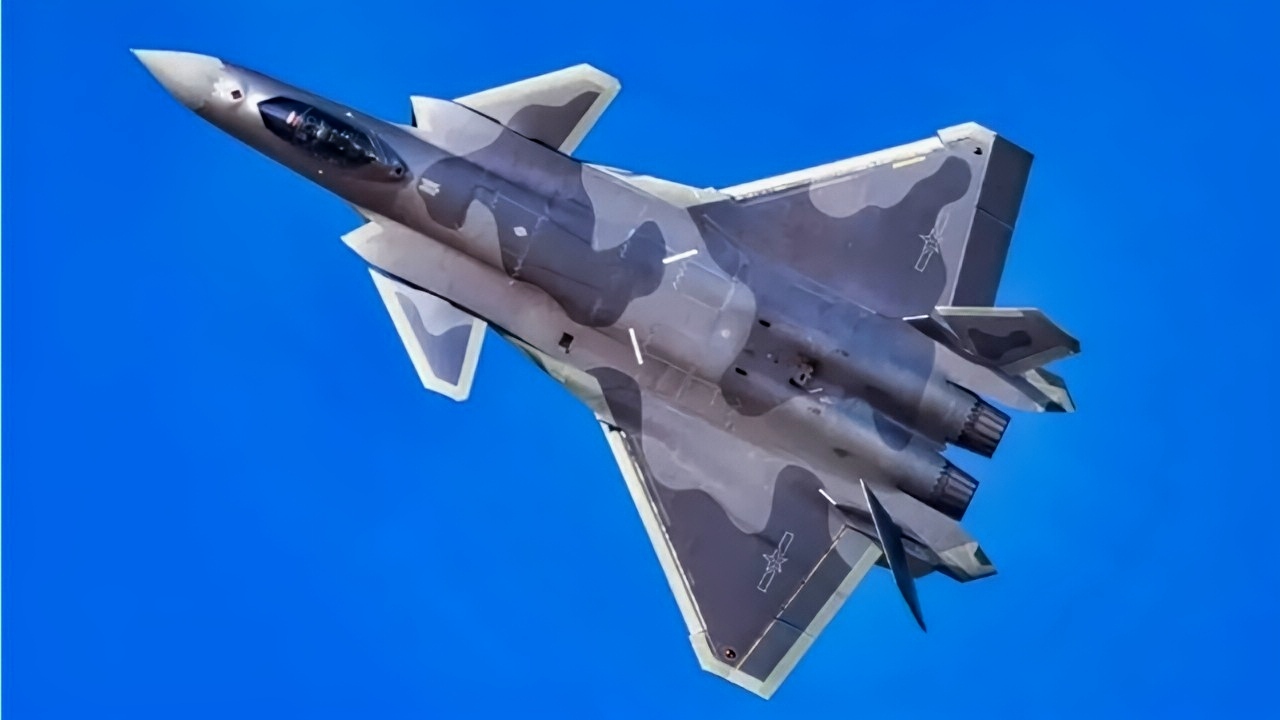
Key Points and Summary – China’s aerospace industry now holds a distinct advantage over Russia’s, a shift illustrated by comparing their premier stealth fighters.
-China’s J-20 appears to be a more sophisticated and genuinely stealthy platform that is being mass-produced, with an estimated fleet of 800 aircraft.
-In contrast, Russia’s Su-57 suffers from significant stealth deficiencies—to the point of being called a “fraud” by one think tank—and is plagued by severe production issues, with only a few dozen delivered to its air force.
-China’s massive and active defense industrial capacity gives it this decisive edge.
J-20 Fighter vs. Su-57 Felon: Who Wins?
In recent years, China has unveiled several stealthy aircraft that appear to be of greater sophistication. The country’s naval aviation wing is growing too. It has been working on a stealth bomber for at least several years. Russia, too, has one somewhat stealthy fighter on the books, the Su-57. But China’s stealthy aircraft appear to be farther along in their development — and the country can build hundreds of them, whereas Russia’s Su-57 fleet numbers in the dozens.
China’s J-20
China’s J-20 is one of the country’s seemingly steadily growing handful of stealth fighters. And while that fighter’s qualities and capabilities are wrapped in secrecy, some estimates of that jet can be guessed at. Particular attention seems to have been paid to minimizing the jet’s radar cross-section, a measure of detectability by adversary radar.
One area potentially ripe for growth is the J-20’s powerplants. Historically, the Chinese aerospace industry has been heavily reliant on Soviet and later Russian technology transfers, outright reverse engineering, and industrial espionage for its combat aircraft.
The J-20 is no exception.
Initially, the Saturn AL-31 jet engine was the power plant of choice for the J-20. China’s ability to build capable jet engines domestically has accelerated in recent years. The WS-10C engine was a domestic attempt to provide Chinese planes with their indigenous engines. The WS-15, a higher-output jet engine, follows that foray.
The jet’s design emphasizes long-range interception and the penetration of adversary airspace, with careful attention paid to the jet’s internal volume both for fuel and weapon storage. The tradeoff, however, is sacrificing some agility to facilitate range and payload qualities.
Recent images circulating online also show the plane’s recent development: the addition of another seat in the cockpit, presumably a Weapon Station Officer position. Typically tasked with operating the jet’s weapons, in the future, the person in that second seat will likely be responsible for controlling Loyal Wingmen-type aircraft: unmanned and attritable planes that can enter combat in place of manned aircraft.
Sukhoi Su-57
Although Russian state-owned media seem to enjoy touting the capabilities of the Su-57, that jet’s rollout domestically — and interest abroad — has been markedly more tepid.
Although the jet benefits from a pair of high-output engines, the multi-role platform’s features are significantly less stealthy than those of its Western counterparts, notably the F-22 Raptor and F-35, both of which are stealthy, fifth-generation platforms.
The Su-57’s stealth coatings, in particular, are likely less technically sophisticated than the coatings of either the F-22 or the F-35. Some of China’s other stealth fighters seemingly possess stealthier characteristics than the Su-57.
From the rear, especially, the Su-57 is broadly very similar to a previous fourth-generation stealth platform. Compare the Su-57’s engine nozzles with those of the F-35. The latter’s engine nacelles are saw-toothed, a design consideration that diffuses adversary radar directed at the rear of the plane out and away from radar receivers.
Or consider the F-22. The air superiority fighter’s engine nozzles are very angular, capable of 3D thrust vectoring, and provide the jet with extreme airborne agility. The Su-57’s engine nozzles, in contrast, are virtually indistinguishable from those of other fourth-generation aircraft, and lack 3D thrust vectoring or stealth considerations.
“Effective stealth design reduces an aircraft’s radar cross-section (RCS), allowing it to avoid detection and gain the upper hand in longer-range engagements. However, the Felon reportedly has a radar profile similar to that of fourth-generation non-stealth aircraft,” the Center for European Policy Analysis explained, going so far as to call the Russian jet a “fraud.”
Earlier this year, following the Aero India 2025 air show, a single T-50, a prototype designation for the Su-57, landed in Iran at the country’s 9th Tactical Air Force Base, located in Bandar Abbas, due to engine trouble.
Pictures of that jet fighter raised the prospect of Tehran’s beleaguered air forces getting a new fighter for the first time in decades. That image ended up a pipe dream, however, and Iran still lacks a credible air force.
Individual features aside, a serious obstacle to the Su-57’s future is production issues. United Aircraft Corporation, the Russian aerospace conglomerate, did open new production facilities last year. But this has not prevented Russia from ordering a paltry 76 of the jets, with outside estimates placing the number that have been delivered to the Ministry of Defense at approximately one-third of that number.
Which Fighter Comes Out on Top?
A comparison of the two jets on a one-for-one basis is not a realistic comparison. Not only are Russia and China nominally allies, but the two countries’ leaders have pledged their “no limits” partnership, recently reaffirming themselves as “friends of steel.”
That relationship devolving into a shooting war appears exceedingly unlikely shortly.
However, there is one aspect of the Chinese aerospace program that holds a significant advantage over that of the Su-57 and the Russian aerospace industry as a whole: a defense industrial capacity that is both broad and deep.
The J-20 production line is a hot one. That is, it is active and actively producing aircraft. Although estimates among experts vary, by some counts, China’s J-20 fleet is already 800-strong.
China can likely build around 100 new airframes per year, a number that would almost certainly expand during a wartime scenario.
About the Author: Caleb Larson
Caleb Larson is an American multiformat journalist based in Berlin, Germany. His work covers the intersection of conflict and society, focusing on American foreign policy and European security. He has reported from Germany, Russia, and the United States. Most recently, he covered the war in Ukraine, reporting extensively on the war’s shifting battle lines from Donbas and writing on the war’s civilian and humanitarian toll. Previously, he worked as a Defense Reporter for POLITICO Europe. You can follow his latest work on X.
More Military
Su-57 vs. J-20 Fighter: Who Wins?


