


The F-15J is a variant of the McDonnell Douglas F-15 Eagle licensed to Japan.
Though most of the fighters were identical to the base F-15, the U.S. withheld the engines and some avionics from the licensing agreement due to security concerns, allowing the Japanese to tailor the aircraft to their specific needs.
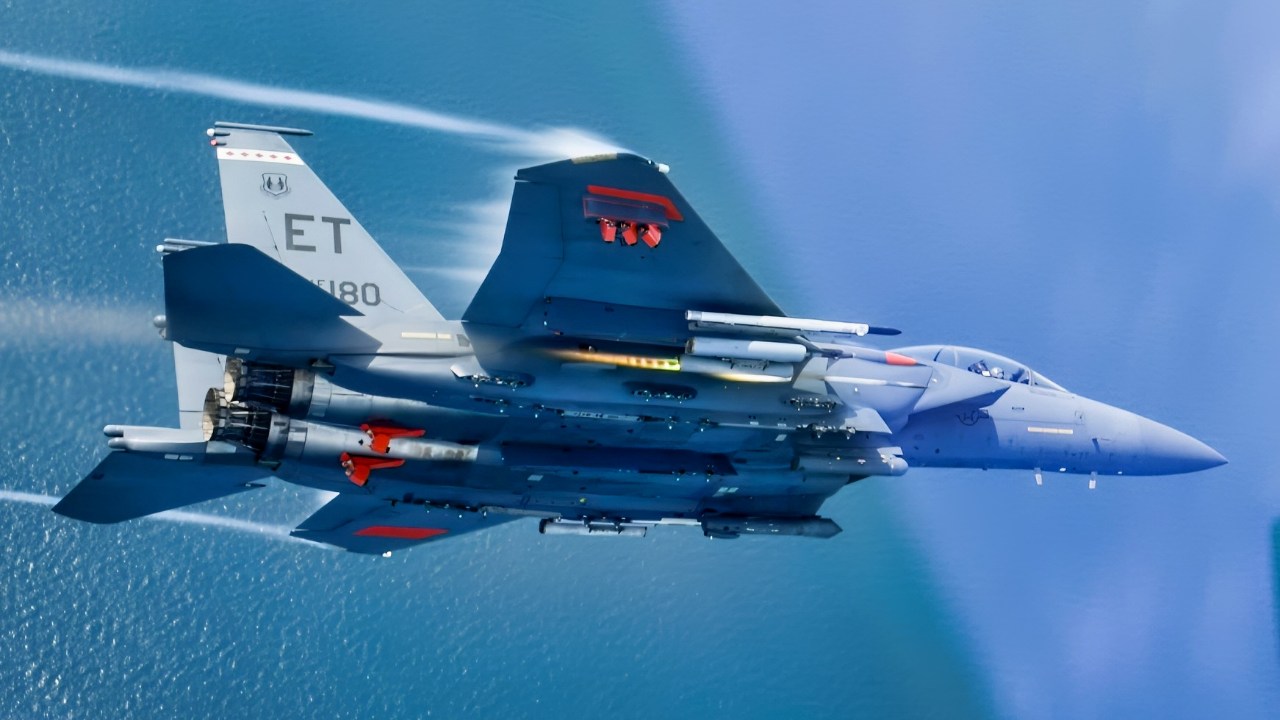
A 96th Test Wing F-15E Strike Eagle flies during a test mission May 22, 2025 over Eglin Air Force Base, Florida. The 96 TW and the 53rd Wing teamed up to test AGR-20F Advanced Precision Kill Weapon System II laser-guided rockets on the F-15E in May in an effort to get the capability to the warfighter as quickly as possible. (U.S. Air Force photo by Staff Sgt. Thomas Barley)
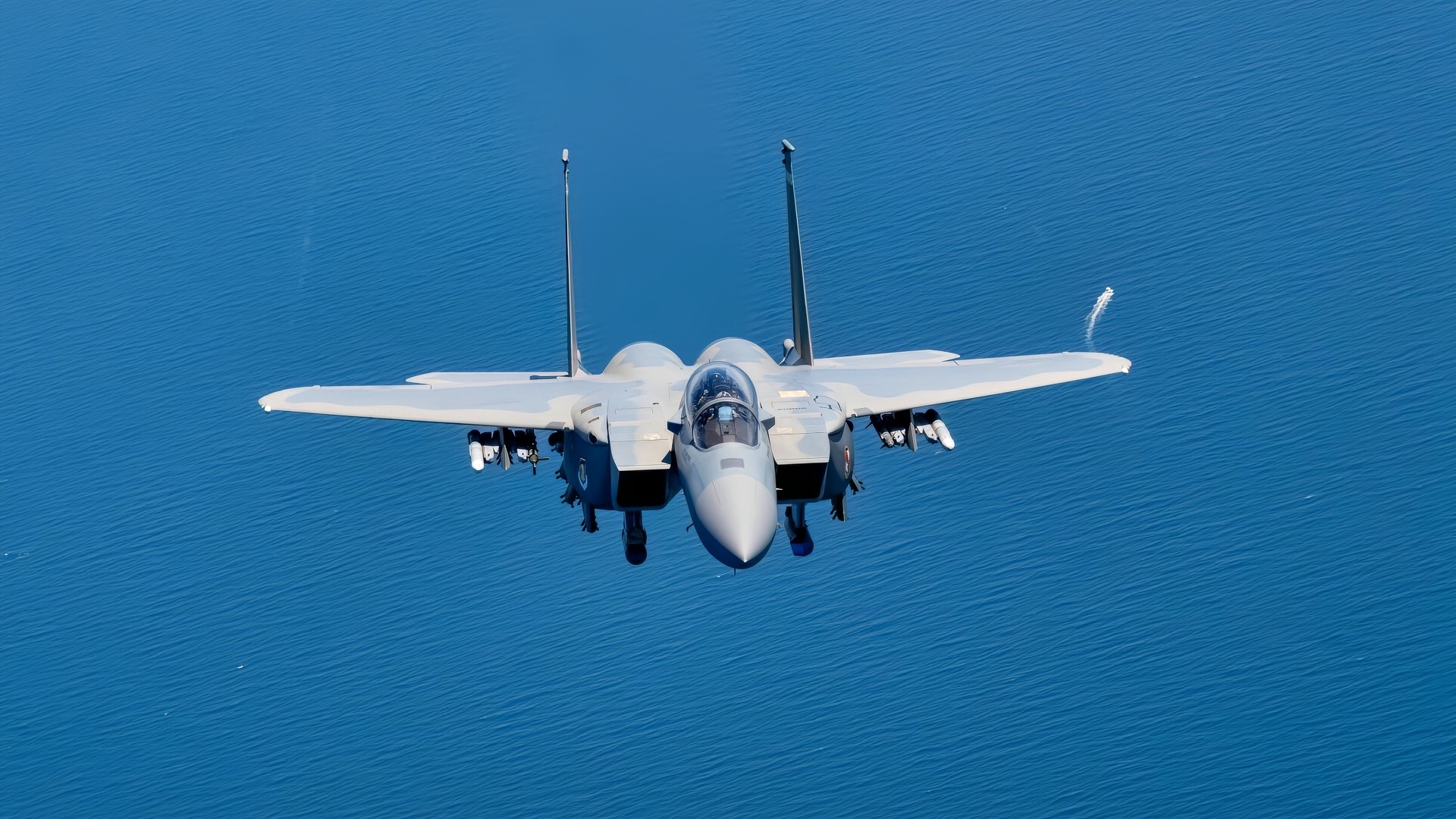
A U.S. Air Force F-15EX Eagle II flies over the Gulf of America, September 16, 2025. The F-15EX, from the 40th Flight Test Squadron at Eglin Air Force Base, Florida, is one of the first F-15EXs in the Air Force, and is going through developmental and operational test series at Eglin to confirm its operational capabilities before it is delivered to the combat Air Force. (U.S. Air Force photo by Staff Sgt. Blake Wiles)
The result was a modified F-15 that retained the base characteristics while also meeting Japan’s strategic requirements.
Design and Development
In the 1970s, Japan maintained an air force consisting mainly of F-104 Starfighters and F-4WJ Phantom IIs. While the aircraft served well, they were growing old, and it became apparent that Japan needed a new fighter jet for its air force.
After evaluating numerous candidates, the Japan Defense Agency selected the F-15C/D Eagle for its unmatched performance in air superiority missions.
In 1978, Mitsubishi Heavy Industries was chosen as the prime contractor, and by 1981, the first F-15J entered service.
Initially, production involved a mix of U.S.-built and Japanese-assembled aircraft, with McDonnell Douglas manufacturing the first few units in St. Louis before Mitsubishi assumed full-scale licensed production.
By the end of the program, Japan had acquired 203 single-seat F-15Js and 20 two-seat F-15DJs, making it the largest operator of the Eagle outside the United States.

Lt. COl. Stephen ‘Steagle’ Mindek, 104th Fighter Wing pilot, takes off in an F-15C Eagle for Maj. John “Space’ Stout’s fini-flight, January 10, 2025, at Barnes Air National Guard Base, Westfield, Massachusetts. Following the fini-flight, Maj. Stout was greeted with cheers from his fellow Airmen, friends, and family. Maj. Stout’s final ride in the F-15C Eagle resulted in over 1100 hours flown in the legendary aircraft. (U.S. Air National Guard photo by Jay Hewitt)
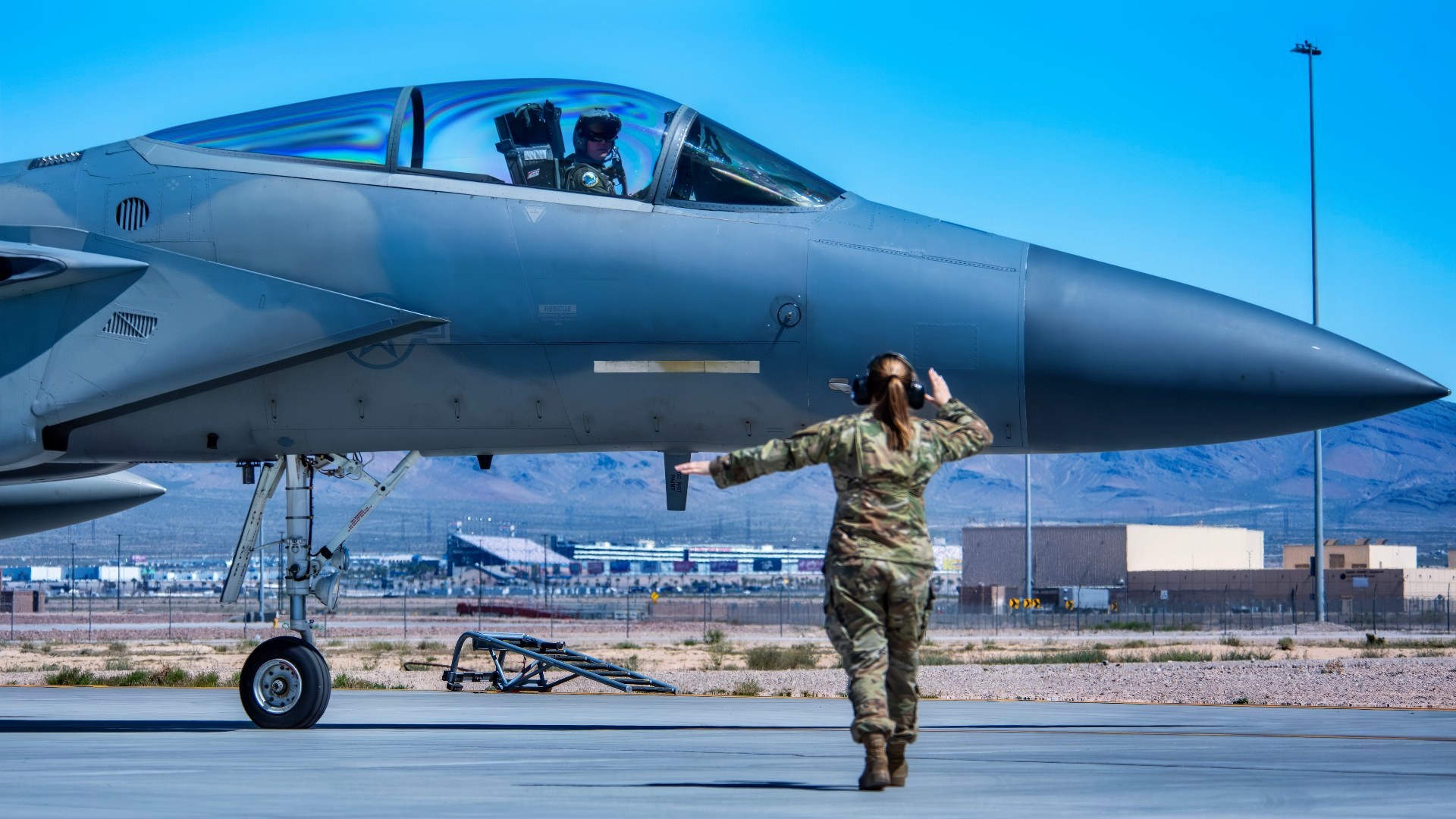
U.S. Air Force Senior Airman Marydith Stidham, a 125th Aircraft Maintenance Squadron crew chief, marshals Capt. Steven Fleming, a 125th Fighter Squadron F-15C Eagle pilot, while taxiing on the flightline at Nellis Air Force Base, Nevada, April 16, 2024. Units assigned to the 125th Fighter Wing participated a two-week exercise in support of the USAF Weapons School. During the exercise, the wing operated in both daytime and nighttime vulnerability periods in a contested degraded environment, preparing students for real-world conditions. (U.S. Air Force photo by Senior Airman Jose Miguel T. Tamondong)
The F-15J retains the aerodynamic and structural features of the F-15C, including its twin-engine configuration, swept wings, and side-mounted air intakes. It measures 19.4 meters in length, has a wingspan of 13.1 meters, and stands 5.6 meters tall.
Its empty weight is approximately 12,700 kilograms, and its maximum takeoff weight approaches 30,800 kilograms. Power comes from two Pratt & Whitney F100-PW-220E turbofan engines, built under license by IHI, each producing 17,450 pounds of thrust dry and 25,000 pounds with afterburner.
This gives the aircraft a maximum speed of Mach 2.5, a service ceiling of 19,000 meters, and a range of roughly 4,600 kilometers.
Armament includes a single M61A1 20 mm Vulcan cannon and up to ten hardpoints for air-to-air missiles such as the AIM-7 Sparrow, AIM-9 Sidewinder, and later AIM-120 AMRAAM.
Avionics were initially similar to those of the U.S. F-15C, though sensitive systems such as advanced ECM suites and nuclear delivery capability were omitted.
Japan’s Dedicated Air Superiority Fighter
Since its induction in 1981, the F-15J has been the JASDF’s primary air superiority fighter.
Its main mission is airspace defense, including rapid interception of foreign aircraft approaching or violating Japanese airspace. In 2016 alone, F-15Js were dispatched over 1,100 times, primarily in response to Chinese and Russian incursions.
The aircraft operates from key bases such as Naha, Komatsu, and Chitose, covering Japan’s extensive air defense identification zone.
It also participates in joint exercises with U.S. forces and allied nations, reinforcing Japan’s security partnerships. In 2025, F-15Js made a historic deployment to Europe under the “Atlantic Eagles” mission, signaling Japan’s growing expeditionary capability and strategic alignment with NATO.
Several variants of the F-15J exist. The standard F-15J is a single-seat air superiority fighter, while the F-15DJ serves as a two-seat trainer that is also combat-capable. Modernization efforts have produced upgraded versions such as the F-15J Kai and the F-15J MSIP (Multi-Stage Improvement Program), which introduced improved avionics and radar systems.
The latest upgrade standard, known as the F-15JSI or Japan Super Interceptor, incorporates advanced radar, electronic warfare systems, and long-range strike capability.
Upgrades and Future Prospects
Over the years, the F-15J has undergone several modernization efforts to keep it relevant to modern warfare. The J-MSIP program, initiated in the late 1980s, upgraded avionics, radar, and ECM systems to keep pace with evolving threats. More recently, Japan launched the F-15JSI program in 2020, investing approximately $4.5 billion to upgrade 68 F-15Js.
These enhancements include the AN/APG-82(V)1 AESA radar for superior detection and tracking, the EPAWSS (Eagle Passive Warning Survivability System) for advanced electronic warfare, and an advanced mission computer (ADCP II) for faster data processing.
The integration of AGM-158B JASSM-ER cruise missiles gives the F-15J a long-range strike capability previously absent from Japan’s air defense doctrine. These upgrades align the F-15JSI with the capabilities of the U.S. Air Force’s F-15EX Eagle II, ensuring interoperability and extending service life until at least 2040.

A U.S. Air Force F-15EX Eagle II, assigned to 85th Test and Evaluation Squadron, Eglin Air Force Base, Florida, lands at Kadena Air Base, Japan, July 16, 2025.This short-term visit marked a key milestone in the Department of Defense’s ongoing effort to modernize U.S. airpower in the Indo-Pacific. (U.S. Air Force photo by Airman Nathaniel Jackson)

A U.S. Air Force F-15EX Eagle II, assigned to 85th Test and Evaluation Squadron, Eglin Air Force Base, Florida, lands at Kadena Air Base, Japan, July 16, 2025. During the transition to the F-15EX, the U.S. Air Force will sustain a steady-state presence at Kadena through a combination of 4th and 5th generation aircraft. (U.S. Air Force photo by Airman Nathaniel Jackson)
The F-15J remains indispensable for Japan’s defense strategy, even as fifth-generation fighters like the F-35A/B Lightning II enter service.
While stealth aircraft excel at penetrating enemy defenses, the F-15J offers unmatched payload capacity and endurance, making it ideal for air dominance and missile-carrier roles in conjunction with stealth platforms.
Japan’s decision to modernize rather than retire the F-15J reflects both fiscal prudence and strategic necessity. Upgraded F-15Js will complement F-35s and Japan’s future sixth-generation fighter, currently under development, forming a layered defense network capable of countering threats from China, North Korea, and Russia.
In the future, Japan aims to complete the F-15JSI upgrades by 2030, transforming these aircraft into formidable multi-role platforms.
Their integration with advanced sensors, electronic warfare suites, and standoff weapons will enable Japan to project power beyond its immediate borders, reinforcing deterrence in the Indo-Pacific.
Additionally, Japan’s participation in multinational exercises and deployments signals a shift toward a more proactive security posture.
About the Author: Isaac Seitz
Isaac Seitz, a Defense Columnist, graduated from Patrick Henry College’s Strategic Intelligence and National Security program. He has also studied Russian at Middlebury Language Schools and has worked as an intelligence Analyst in the private sector.


