

Despite having shown tremendous skill in using the US-made Patriot (PAC-3) Air and Missile Defense (AMD) system, Ukraine’s Air Defense Forces (PPO) were unable to take out any of the 23 Russian ballistic missiles fired at targets in Kyiv on Monday, 6 July. At least 12 people were killed and around 50 wounded.
So, why did Ukraine’s ability to intercept incoming Russian missile attacks suddenly drop to zero kills?
The reason is simple. There are no missiles left to shoot with.

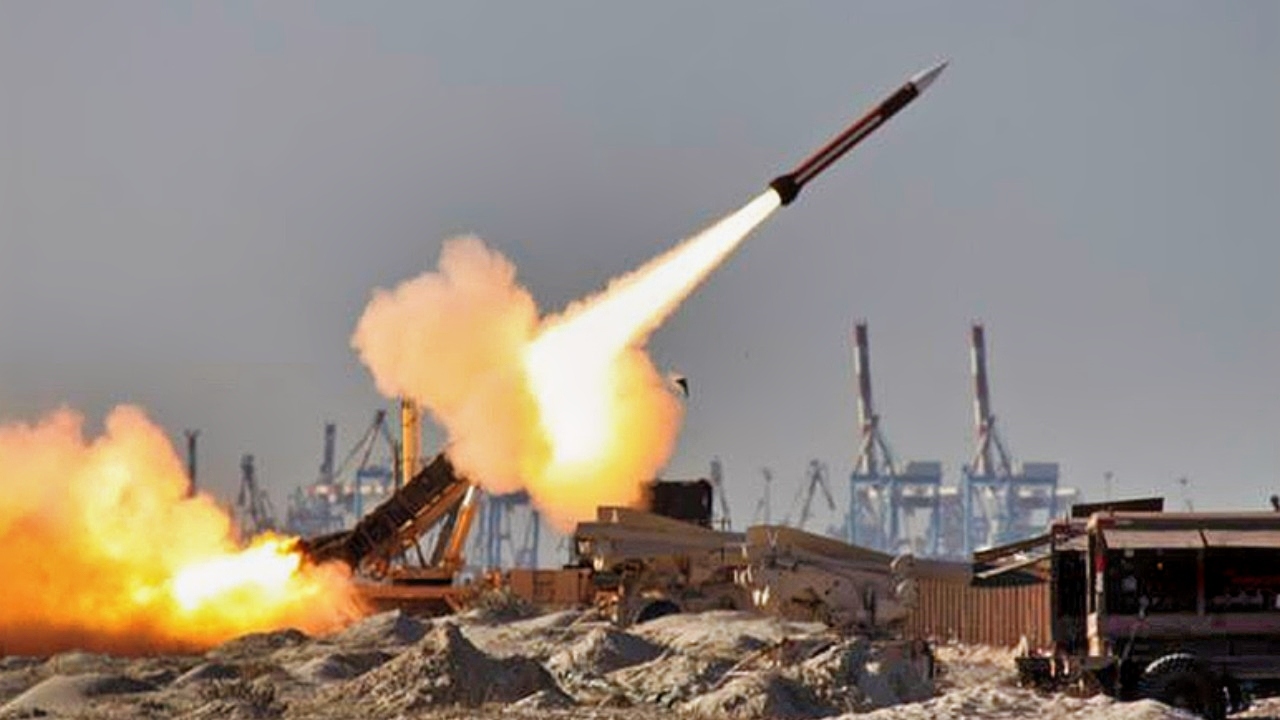
Exercise Artemis Strike is a German-led tactical live fire exercise with live Patriot and Stinger missiles at the NATO Missile Firing Installation in Chania, Greece from Oct. 31-Nov. 09. Over 200 U.S. soldiers and approximately 650 German airmen will be participating in the realistic training within a combined construct, exercise the rigors associated with force projection and educate operators on their air missile defense systems. The 10th Army Air Missile Defense Command will deploy, operate and fire live missiles within a tactical scenario, under Supreme Headquarters Allied Powers Europe operational readiness evaluation criteria.
The country has almost entirely expended its arsenal of Patriot PAC-3 missile interceptors.
Russian missiles crashing into one building after another in the Ukrainian capital are a result of a situation that Ukrainian President Volodymyr Zelenskyy has been warning of for months.
Simply put, there is a worldwide shortage of the MSE (Missile Segment Enhancement) interceptor missiles for the Patriot.
The MSE is the most capable of the three missiles fired by the Patriot system. It also does not rely on a blast-fragmentation warhead detonating within the lethal range of an incoming Russian ballistic missile, but rather on a more modern missile defense doctrine.

Su-57 Felon Fighter from Russia
Single v. Double
Instead, the MSE relies on a hit-to-kill (HTK) intercept, using the kinetic energy of “hitting a bullet with a bullet” to destroy incoming warheads through direct impact. Ukraine has also perfected techniques for employing this weapon, further increasing its lethality.
Simply put, the Ukrainian Patriot crews have increased the missile’s effectiveness to the point where they are firing only one MSE interceptor per Russian ballistic missile. This is a monumental step, as it extends the number of MSE missiles remaining as far as possible.
Under standard US Army doctrine, intercepting a ballistic missile calls for two MSE interceptors to be fired per incoming missile. In some more complex scenarios, the doctrine calls for up to four MSEs to be fired – this on the chance that the first salvo of two missiles might miss.
Ukraine’s reduction of the number of MSEs needed for an intercept down to one has been driven by necessity. The shortage of these missiles is becoming an increasingly serious problem – a supply crisis exacerbated by the war with Iran that began in February 2026. During the first few days of this conflict, the US expended 18 months’ worth of production of the MSE.
Brother, Can You Spare an Interceptor?
Zelensky is now begging for these MSE interceptors, as they are the only weapons capable of shooting down ballistic missiles like the Russian-made Iskander and Tsirkon. It is “simply nonsensical that, in the modern world, production has still not been scaled up to the level actually required to protect people from ballistic terror,” said the Ukrainian president.
Ukraine’s Air Force (PSU) reports that Russia fired 351 drones and 68 missiles overnight on 6 July, with the majority of these missiles targeting Kyiv. None of the 29 ballistic missiles could be intercepted as Ukraine had nothing to shoot back with.
“Russians are certainly using the fact that there is a serious deficit of interceptor missiles now in Ukraine and the world,” said PSU spokesperson Yurii Ihnat. The Ukrainian defense minister, Mykhailo Fedorov, also warned that Russia is now ramping up ballistic missile attacks – firing in quantities not seen before – opportunistically taking advantage of Ukraine’s shortage of Patriot interceptors.
At this week’s NATO summit in Ankara, Zelensky is expected to ask Western countries to send more of their own dwindling supplies of interceptors. The Ukrainian president has also called on the US to give the highest priority to answering Ukraine’s urgent missile-defense requirements.
“Missiles for Patriots are a priority, and, of course, we understand that the political will of the United States would certainly be enough to make up for the Patriot shortage, but so far, there is not enough of that support,” he said on Sunday evening, just hours before this latest Russian missile attack.
Ukraine is one of around 20 countries that are waiting in a queue for Patriot interceptors to be delivered. Stockpiles are low, and the production tempo is such that it can take more than two years to manufacture.
Ukrainian civilians are dying, as the US still has not substantially increased the production rate of this weapon. This is despite the war being in its 5th year. Zelenskiy – as well as the Ukrainian population at large – has every right to be angry and disdainful of US defense industrial planning that appears to have never adequately planned for a real-world wartime scenario.
About the Author: Reuben F. Johnson
Reuben F. Johnson has thirty-six years of experience analyzing and reporting on foreign weapons systems, defense technologies, and international arms export policy. Johnson is the Director of Research at the Casimir Pulaski Foundation. He is also a survivor of the Russian invasion of Ukraine in February 2022. He worked for years in the American defense industry as a foreign technology analyst and later as a consultant for the U.S. Department of Defense, the Departments of the Navy and Air Force, and the governments of the United Kingdom and Australia. In 2022-2023, he won two awards in a row for his defense reporting. He holds a bachelor’s degree from DePauw University and a master’s degree from Miami University in Ohio, with a specialization in Soviet and Russian studies. He lives in Warsaw.


1KoolKat
July 7, 2026 at 9:15 am
This isn’t a failure of the Patriot system’s technology; it is a failure of industrial scale. It exposes the absolute ceiling of modern ballistic missile defense (BMD): it is an asymmetric math problem where the defender loses the economic and industrial war of attrition.
Ultimately, this confirms the hard reality that “exquisite” defense systems are entirely dependent on the unglamorous, foundational capacity of the Defense Industrial Base. If you don’t have the factories to match the threat’s production rate, any defense shield can, and will, be systematically emptied and overwhelmed.
Steve
July 8, 2026 at 11:13 am
Point made but WHO sat on their arse and did nothing to increase the DIB? LM, US Gov’t, et.al.
Swamplaw Yankee
July 8, 2026 at 8:20 pm
The USA knew in 2012-13 that the POTUS Obama Democrat Cabal would facilitate the 2014 Balkanization of Independent Ukraine.
So, 13 years later, the original or licensed sites of manufacture of Patriot missile interceptors will not expand. The ( potential ) granting of a license this week to Ukraine seems nebulous, but far off in any option.
So, what EU country is capable of a potential counterfeit missile interceptor in the near term? France, Ukraine, Germany? Naming names in detail seems timely!