


Key Points and Summary – The SR-72 “Darkstar,” the hypersonic successor to the legendary SR-71 Blackbird, is being developed to revolutionize aerial warfare with its projected Mach 6 speed.
-The central question: is this velocity enough to evade the most advanced Russian and Chinese air defense systems?
SR-72 Darkstar or Son of Blackbird. Image Credit: Lockheed Martin.

SR-72 Darkstar Plane. Image Credit: Lockheed Martin Handout.
-The SR-72’s combination of extreme speed, high altitude, and advanced stealth makes it effectively “too fast to hit.”
-It compresses an enemy’s reaction time to mere seconds, rendering current interceptor missiles obsolete and promising a massive strategic advantage for the United States.
SR-72 Darkstar: What We Know and Think We Know
One of the most ambitious projects currently underway is the SR-72 hypersonic aircraft. Often called the “Darkstar” based on its appearance in the film Top Gun Maverick, the SR-72 is the spiritual successor to the SR-71 Blackbird.
Still currently in the development phase, the SR-72 promises to be a quantum leap in stealth technology and speed, with estimated flights speeds at around Mach 6. However, the question arises whether this is enough to evade the ever-growing air defense capabilities of the U.S.’ adversaries.
The First Manned Hypersonic Aircraft
The SR-72 is being developed by Lockheed Martin’s Skunk Works division, the same advanced development team responsible for the SR-71 Blackbird. Unlike its predecessor, which was purely a reconnaissance platform, the SR-72 is intended to serve both reconnaissance and strike roles.
It is expected to be optionally manned, meaning it could operate either autonomously or with a pilot, depending on the mission requirements.
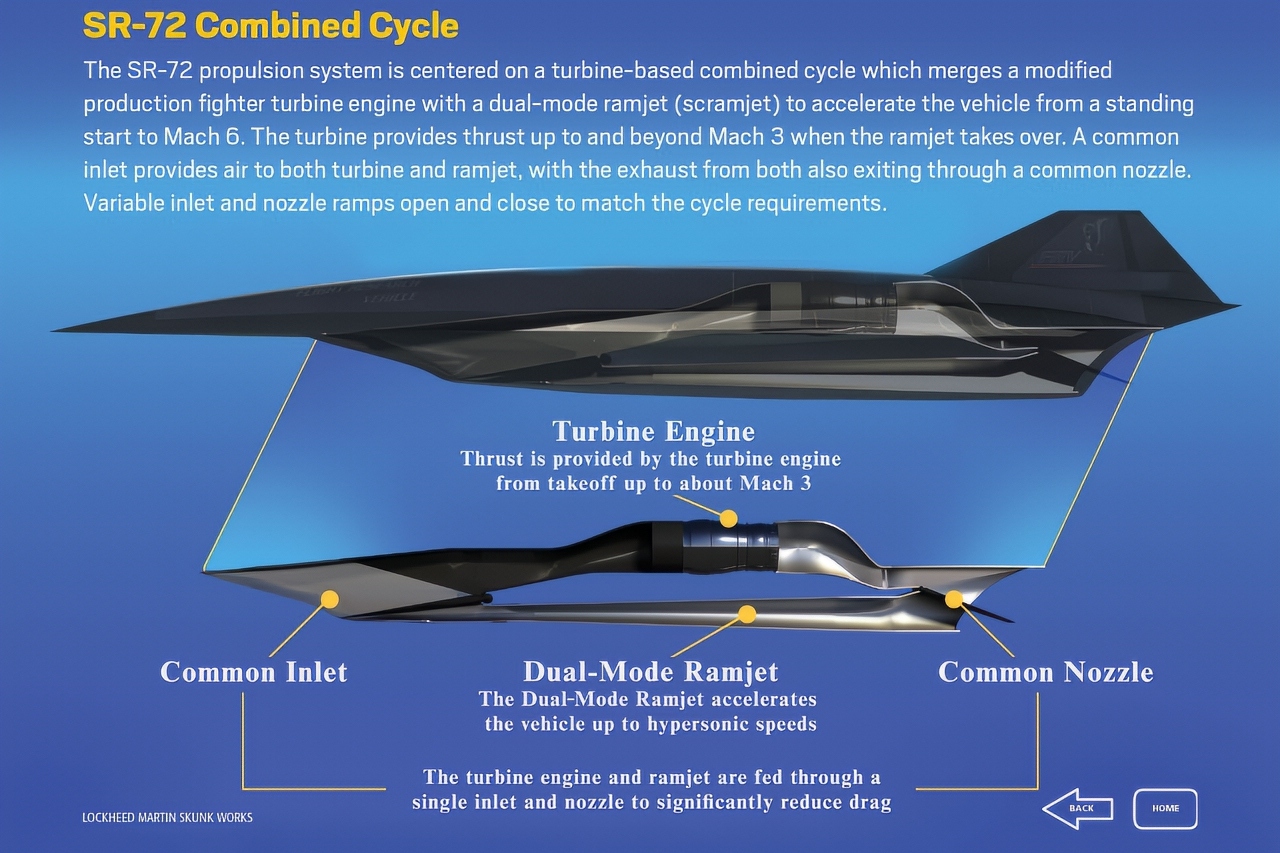
The aircraft’s projected top speed of Mach 6 is nearly double that of the SR-71, which maxed out at Mach 3.2. Achieving such speeds requires a revolutionary propulsion system. The SR-72 is expected to use a dual-mode engine that combines a turbojet for takeoff and subsonic flight with a scramjet (supersonic combustion ramjet) for hypersonic speeds at high altitudes.
This hybrid propulsion system allows the aircraft to transition smoothly from conventional jet speeds to hypersonic velocities, a feat that has long been a challenge in aerospace engineering.
In addition to its speed, the SR-72 is designed with advanced stealth technologies. These include radar-absorbing materials and a low-observable airframe that reduces its radar cross-section. Combined with its ability to fly at extremely high altitudes, possibly above 80,000 feet, these features make the SR-72 exceptionally difficult to detect and track.
Can the SR-72 Darkstar Evade Modern AD Systems?
One of the bigger selling points for the SR-72 is its ability to evade moder AD systems using its hypersonic speed. However, modern missile systems are quite sophisticated, raising the question as to whether Mach 6 is enough speed, to avoid the latest and greatest surface-to-air missiles.
Advanced air defense platforms such as Russia’s S-400 and S-500, China’s HQ-19, and the U.S. THAAD system are equipped with sophisticated radar, tracking, and interception technologies. Some of these systems can engage targets at speeds up to Mach 5 or slightly higher and at altitudes exceeding 100,000 feet.
That being said, intercepting a target moving at Mach 6 presents a unique set of challenges. The SR-72’s speed and altitude compress the engagement window for any interceptor missile to mere seconds, making successful interception extremely difficult.
Even if a missile can theoretically match or exceed Mach 6 in terminal velocity, it must also be able to detect, track, and maneuver to intercept a highly agile and stealthy aircraft in a very short time frame.
In 1 Word: Unstoppable?
Modern interceptor missiles are designed to counter a variety of threats, including ballistic missiles, cruise missiles, and aircraft. However, most are optimized for predictable ballistic trajectories or slower-moving aircraft.
The SR-72, with its hypersonic speed and maneuverability, does not fit neatly into these categories.For example, the Russian S-400 system can reportedly engage targets at speeds up to Mach 5–6, but it is unlikely to be effective against a Mach 6 aircraft with a low radar signature. Similarly, the U.S. THAAD system is designed to intercept ballistic missiles during their terminal phase and may not be suitable for engaging a maneuvering hypersonic aircraft.
The SR-72’s survivability is further enhanced by its ability to operate at high altitudes. At such elevations, the air is thinner, which reduces drag and allows for higher speeds.
It also places the aircraft above the effective range of many surface-to-air missile systems. Combined with its stealth features, this makes the SR-72 an extremely difficult target for any existing air defense system.
Still a Ways Away on SR-72
Of course, achieving and sustaining Mach 6 flight introduces significant engineering challenges. One of the most critical issues is thermal stress.
At such high speeds, the aircraft’s surface experiences extreme temperatures due to air friction. To withstand this, the SR-72 must be constructed from advanced materials such as carbon-carbon composites, which can endure the intense heat without degrading.
Navigation and control at hypersonic speeds also require sophisticated systems. Even minor course corrections demand precise and rapid adjustments. The SR-72 is expected to incorporate advanced artificial intelligence and autonomous control systems to manage these challenges in real time.
These systems would allow the aircraft to respond to threats and navigate complex environments without relying solely on human input.
Despite its stealth features, the SR-72 may still be detectable by infrared sensors due to its heat signature. That being said, detecting and tracking it in time to launch an effective interception remains a major hurdle for current defense systems. The combination of speed, altitude, and stealth significantly reduces the likelihood of a successful engagement.
If adopted, the SR-72 could revolutionize both reconnaissance and strike capabilities. It would be able to reach any point on the globe in under an hour, providing near-instantaneous intelligence or delivering precision-guided munitions before enemy defenses could react.
MORE – The F-47 Fighter Could Change Everything
MORE – The A-10 Warthog Is Headed to History Books
This makes it an ideal platform for first-strike or rapid-response missions.
Possessing an aircraft that can outrun any known missile and strike anywhere on Earth within minutes would give the United States a massive strategic advantage. It would serve as a powerful deterrent, signaling to adversaries that their air defense systems are effectively obsolete against such threats.
This could shift the balance of power in future conflicts and redefine the nature of aerial warfare.
About the Author:
Isaac Seitz, a Defense Columnist, graduated from Patrick Henry College’s Strategic Intelligence and National Security program. He has also studied Russian at Middlebury Language Schools and has worked as an intelligence Analyst in the private sector.
More Military
China’s New J-36 Fighter Has 1 Mission
America Wants ‘Drone’ Aircraft Carriers
Putin Might Have Made Strong Thanks to Drone Test in Poland


Tony
July 3, 2025 at 11:18 pm
Not going to happen. There’s a reason why the SR-71 was retired: obsolete. And so is any concept such as the SR-72. The Space Shuttle, a fat bus, achieved something like Mach 19 upon re-entry. We already have the technology. We don’t need to reinvent the wheel. We just don’t need it. You watch too many fictional movies. Give it a rest already. 😎 BTW, SR-71 was originally called RS-71 for “recon.”
SABRINA METZ
July 4, 2025 at 4:08 pm
I have seen and heard many threats against the USA.PEACE THROUGH STRENGTH has kept a WW111 from happening up to now. We just can’t sit idling by for some adversary to put us on watch. So with that, I rest my case.
TruthB Told
July 26, 2025 at 1:09 pm
So is the B52, but it’s still flying. 70 Yrs on the line. No aircraft will ever match it. The SR71 was never shot down.