

Summary and Key Points: Senior Defense Editor Christian D. Orr analyzes the Mikoyan-Gurevich MiG-31 “Foxhound,” a supersonic interceptor that evolved from the MiG-25 “Foxbat.”
-Powered by dual Soloviev D-30F6 afterburning turbofans, the Foxhound achieves a maximum speed of Mach 2.83.

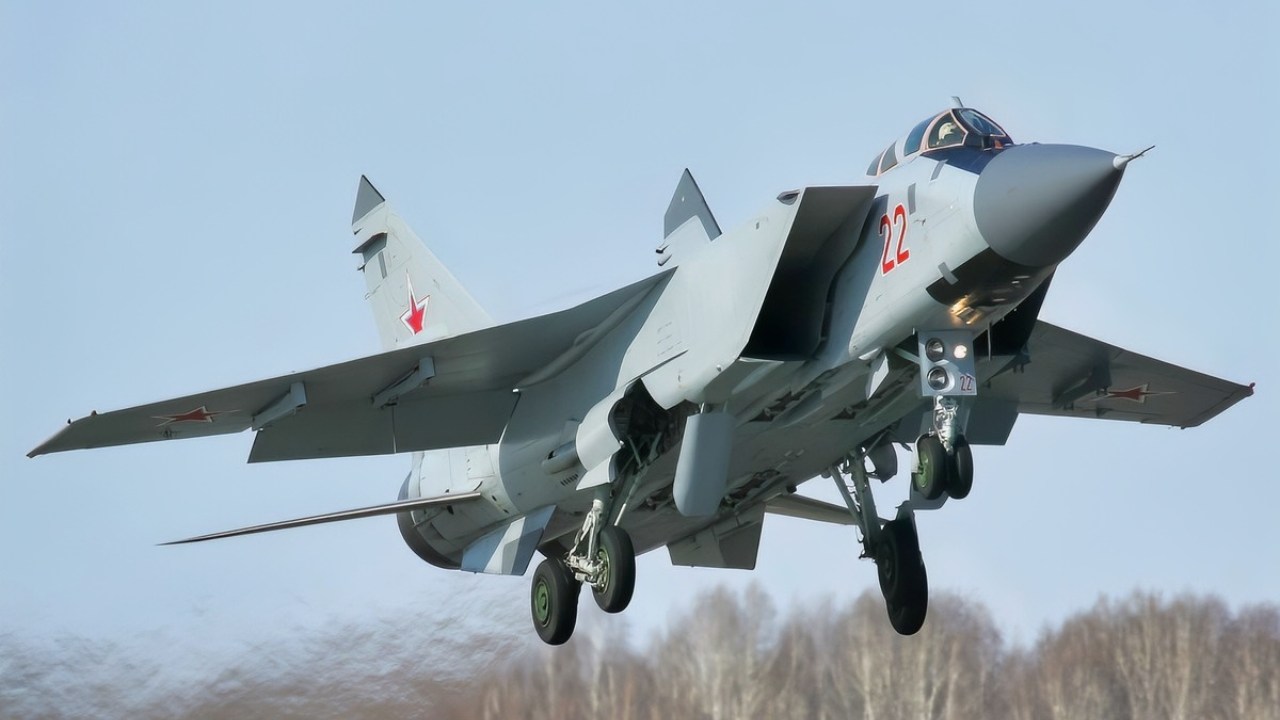
MiG-31 Russian Air Force. Image Credit: Creative Commons.

MiG-31 Flying High Russian Air Force. Image Credit: Creative Commons.
-Orr highlights the aircraft’s pioneering phased-array radar, which provides essential look-down/shoot-down capabilities for all-weather engagements.
-The report details its role in the Ukraine conflict, specifically the MiG-31K variant’s deployment of the Kh-47M2 Kinzhal hypersonic missile and the R-37 M’s air-to-air lethality.
-Despite confirmed losses to drones and MANPADS, the Foxhound remains a primary threat due to its fire-and-forget missile technology.
The MiG-31: The Technical Reality of Russia’s Premier Mach 2.83 Interceptor
To animal lovers and sportspersons, a foxhound is a self-explanatory name for a breed of dog that’s used for hunting foxes.
Therefore, it’s highly apropos that NATO would apply the hunting dog’s name to a Soviet-designed supersonic interceptor aircraft built for hunting Western warbirds. We now say “Dobriy dyen” (“Good afternoon” or “Good day”) to the Mikoyan-Gurevich MiG-31 “Foxhound.”
(Note, the real-world MiG-31 Foxhound is not to be confused with the fictitious MiG-31 “Firefox” of cinematic and bestselling novel fame, the common “fox” factor in the nomenclature notwithstanding.)
From “Foxbat” to “Foxhound”: MiG-31 Initial History
When the MiG-25 “Foxbat” entered service with the Soviet “Rodina” (Motherland) in 1970, it gave NATO airpower planners plenty to fret about.
The Foxbat was the fastest interceptor in the world at the time, and the ever-pervasive fear of the unknown flew alongside it.
However, much of that fear dissipated after the defection of MiG-25 pilot Lieutenant Viktor Belenko in 1976. Lt. Belenko’s daring escape helped eliminate the aura of mystery that had surrounded this previously mythical Foxbat.

MiG-31 Fighter. Image Credit: Creative Commons.
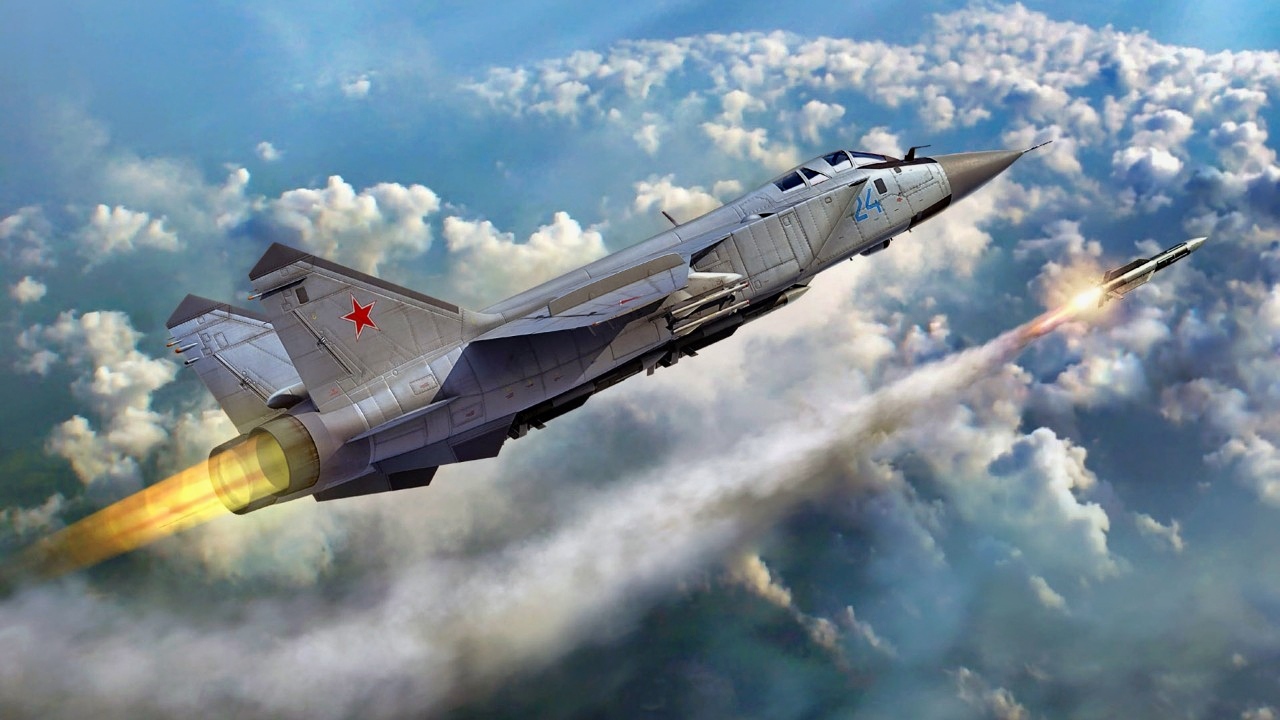
MiG-31 from Russian Air Force. Image Credit: Creative Commons.
But the Soviet war machine didn’t allow Comrade Belenko’s defection to deter it from improving upon the MiG-25’s basic concept. Thus, it came to pass that the MiG-31 “Foxhound” was born. The then-newfangled plane made its maiden flight in September 1975 and officially entered service with the Soviet PVO, or Anti-Air Defense Troops, in 1981.
The MiG-31 bears a striking external resemblance to the MiG-25, which probably explains at least in part why NATO retained the “Fox” portion when assigning its reporting name to the successor warplane. However, a deeper dive will reveal that the Foxhound was equipped with state-of-the-art digital avionics that its older foxy sibling lacked.
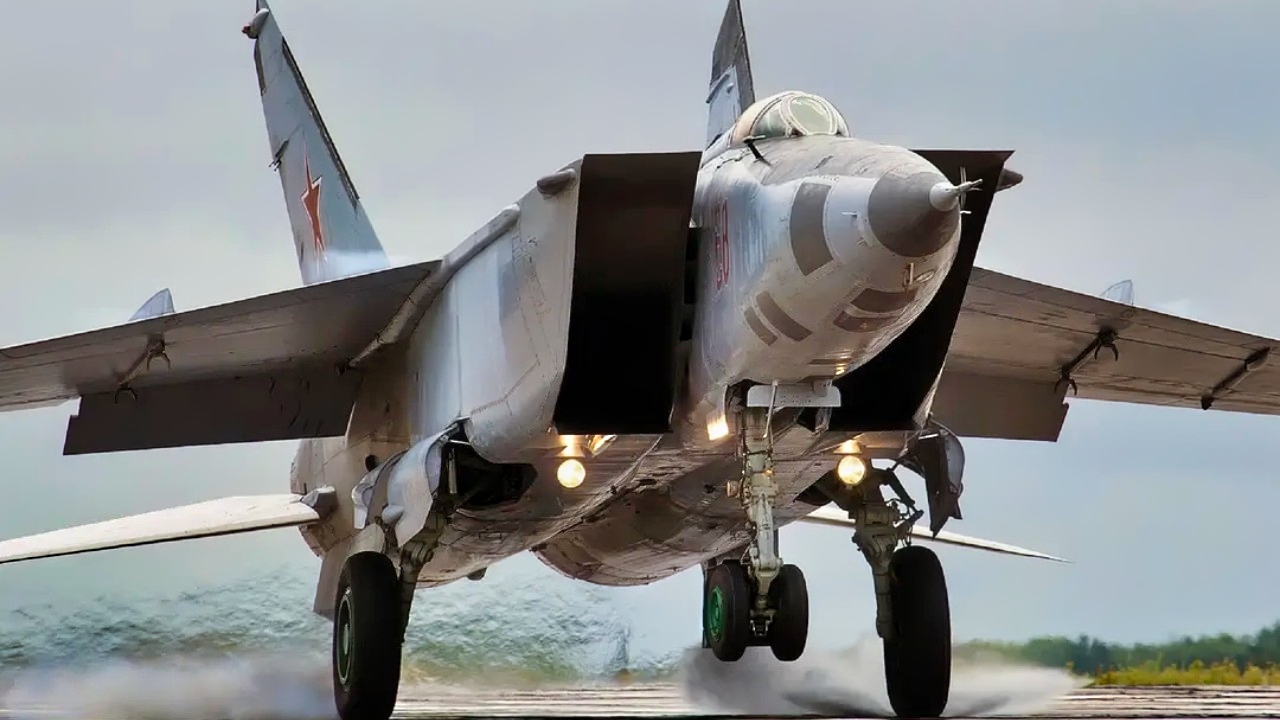
MiG-25 Foxbat Fighter. Image Credit: Creative Commons.

MiG-25. Image Credit: Creative Commons.
Among other things, the MiG-31 was the first Soviet fighter aircraft to have true look-down/shoot-down capability, thanks to its phased array radar.
This advancement cured its predecessors’ tendency for their radars to run afoul of ground clutter. In addition, the Foxhound can operate efficiently in all weather conditions, day and night, under both visual and instrument flight rules.
MiG-31 Tech Specs and Vital Stats Part I
Crew: 2 (pilot and weapon system officer)
Fuselage 22.69 meters (74 ft 5 inches)
Wingspan: 13.46 meters (44 feet 2 inches)
Height: 6.15 meters (20 ft 2 inches)
Empty Weight: 21,820 kilograms (48,100 pounds)
Max Takeoff Weight: 46,200 kilograms (101,900 pounds)
Powerplant: 2 × Soloviev D-30F6 afterburning turbofans, each generating 93 kilonewtons (20,900 pounds-force) of dry thrust and 152 kilonewtons (34,172 pounds-force) in afterburner mode
Ferry Range: 3,000 km (1,900 statute miles, 1,600 nautical miles); this extends to 5,400 km (3,400 statute miles, 2,900 nautical miles) with a single refueling
Combat Range: 720 km (450 miles, 390 nautical miles) when traveling in excess of Mach 2.0 (more on this in a bit); 1,450 km (900 statute miles, 780 nautical miles) when traveling at subsonic speed
Service Ceiling: In excess of 25,000 m (82,000 ft).
MiG-31 Tech Specs and Vital Stats Part II: Speed and Armament
These two particular statistical categories merit their own standalone subheading/segment, as they’re the Foxhound’s two most impressive features.
The MiG-31 has a max airspeed of Mach 2.83 (3,000 km/h; 1,900 mph; 1,600 knots). With its MiG-25 predecessor pretty much fully retired around the globe, that now leaves its successor, the MiG-31, as the fastest known operational combat aircraft.
As for the weaponry, to quote the famous dictum from early 20th-century airpower theorist General Giulio Douhet, “Flexibility is the key to airpower.” Going hand-in-hand with flexibility is the concept of versatility, and as can be expected of a good hunting dog (especially a mechanical flying hunting dog), the Foxhound is very versatile in the number of different weapons it can accommodate. In fact, it can carry up to 9,000 kg (20,000 lbs.) of ordnance.
Guns:
1 x 23mm Gryazev-Shipunov GSh-6-23M rotary cannon with 260 rounds of ammo
Air-to-Air Missiles:
4 × R-33
2 × R-40RD/TD
4 × R-60MK
4 × R-73
4 × R-37M and 4 x R-77M (MiG-31BM [Bolshaya Modernizatsiya – Big Modernization] variant only)
Air-to-Surface Missiles:
4 × Kh-58UShKE anti-radiation missile
1 x Kh-47M2 Kinzhal conventional or nuclear warhead-capable air-launched ballistic missile (MiG-31K variant only)
Operational History/Combat Performance in Brief
Like a true bloodhound, the Foxhound has been heavily “blooded” in Vladimir Putin‘s seemingly interminable “special military operation” in Ukraine. On March 18, 2023, a MiG-31K variant launched a strike on a Ukrainian arms depot near the Polish border, evidently using a Kh-47M2. In turn, on April 26 of that same year, the Ukrainians managed to shoot down a Foxhound with a British-made Starstreak missile.
So far, at least five MiG-31BMs have been confirmed as lost during this conflict. At least one of these losses was due to a non-combat incident on or about October 1, 2022, whereupon, according to The War Zone’s X page, “a jet ran off the end of the runway and fell off a cliff before exploding.” The most recent Foxhound death reportedly took place on December 18, 2025, via a Ukrainian drone strike at the Belbek Air Base in Russian-occupied Crimea (near Sevastopol); the Security Service of Ukraine released video stills that appeared to corroborate the claimed kill.
However, as much as the Russian Air Force has suffered embarrassing losses in the current conflict, the fight against the Foxhound has definitely not been a one-sided affair. Indeed, the MiG-31 has been the bane of the Ukrainian Air Force. thanks mainly to those aforementioned R-37M and R-77M missiles, which have true fire-and-forget capabilities. By contrast, the Ukrainian fighter jocks have been cursed with a relative lack of fire-and-forget missiles, instead relying on the R-27 missile, which, like the old U.S.-made AIM-7 Sparrow, requires radar illumination of an enemy aircraft to guide it to the target.
About the Author: Christian D. Orr, Defense Expert
Christian D. Orr is a Senior Defense Editor. He is a former Air Force Security Forces officer, Federal law enforcement officer, and private military contractor (with assignments worked in Iraq, the United Arab Emirates, Kosovo, Japan, Germany, and the Pentagon). Chris holds a B.A. in International Relations from the University of Southern California (USC) and an M.A. in Intelligence Studies (concentration in Terrorism Studies) from American Military University (AMU). He is also the author of the newly published book “Five Decades of a Fabulous Firearm: Celebrating the 50th Anniversary of the Beretta 92 Pistol Series.”


