
Ukrainian officials reportedly drew up plans to send as many as 1,000 AI-guided drones per night toward Moscow’s airports, according to The Atlantic.
Citing two unnamed sources speaking on condition of anonymity, the operation, codenamed “M&Ms”, would have involved nightly assaults on Moscow airports in order to keep Russian airspace closed.
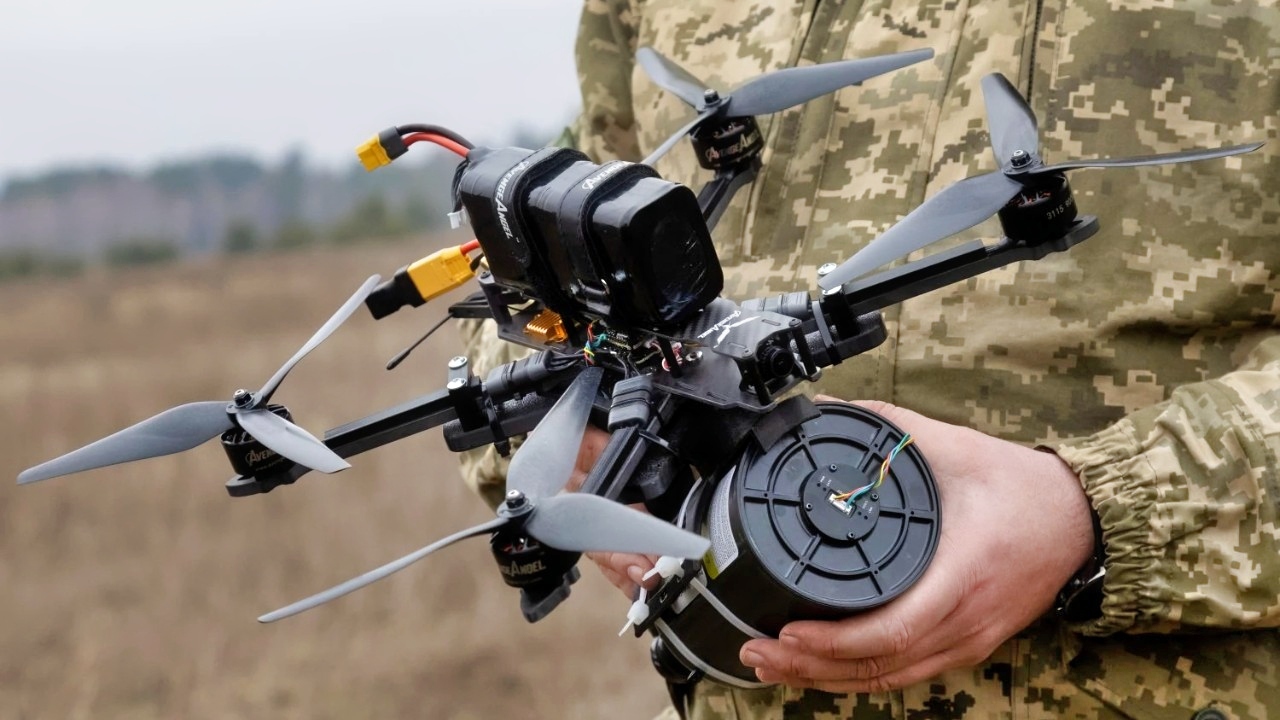
Ukraine Drone. Image Credit: Creative Commons.
A spokesperson for Ukrainian President Volodymyr Zelensky declined to comment, while another unnamed official for the president’s office described the plans as “total nonsense”.
Autonomous Attacks
The plan reportedly involved sending swarms of drones to Moscow’s main airports each night, forcing a prolonged shutdown of Russian airspace, in a major shift from traditional targets such as oil refineries, supply lines or military bases.
Ukraine has long targeted Russian airports, with drone attacks causing hundreds of airport shutdowns since the start of the conflict in February 2022. Drones continue to play a key role in Kyiv’s strategy, with almost 800 fired towards Russia in a single night last week.
However, Operation M&M would have marked a major escalation in the conflict, raising uncertainty over the legal use of AI in warfare.
According to the unnamed officials, the AI guidance systems – developed under recently dismissed Defense Minister Mykhailo Fedorov – would have allowed Ukraine to attack Russian airports without requiring a human operator to control each drone’s movements.
Although tested by a number of nations, autonomous drones have never been deployed at such scale in the history of warfare.
Piling on Pressure
Cheap to make and requiring no operator, the AI-guided drones could have caused havoc in Russian airspace.
The hope, according to one of the sources, was that this would “shut down the Moscow airspace to civilian flights for an extended period of time”.
For those who’ve been able to travel abroad during the war, such a plan would disrupt holiday-making Russians’ ability to travel freely outside the country.
“People in the elites might come to Putin and say: We have a problem here,” one of the sources told the Atlantic. The effectiveness of pressure from Russian elites is debatable, but growing dissent would become harder to ignore for a president whose special military operation is well into its fifth year.
Zelensky’s Reservations
The Ukrainian President reportedly expressed deep concerns, according to one of the sources.
A misplaced drone, striking a commercial airliner or airport worker, could be seen as “piracy.”
Nevertheless, desperate to find an issue which could bring Russia to the negotiating table, Zelensky allowed the preparations to continue.
Eventually, the plans became so developed that the aforementioned codename was bestowed upon them, and they only ceased when Fedorov was sacked in July.
The former defense minister had kept much of the operation a secret from many of his closest advisors, developing the AI system with a team of Ukrainian computer programmers while securing funding from European allies to mass-produce the drones.
Putting “AI” Into Ukraine
Kyiv has explored artificial intelligence throughout much of the full-scale war, with the Ukrainian government and Fedorov himself pursuing the use of Elon Musk’s Starlink to support the war effort.
The latter’s refusal to allow Starlink’s satellite imagery has forced Ukraine’s top strategists to explore alternatives.
Ukraine’s own development of AI has enabled the production of drones that no longer rely on radio signals or internet connections to operate effectively.
Alas, such technology avoids electronic jammers, designed to break the connection between the operator and the drone, due to the weapons’ self-operative nature.
This is possible because of map matching, which allows a drone to compare the terrain below with a pre-uploaded map. Once it has found its target, the drone flies into it and explodes.
The accuracy of AI drones raises major concerns – something which was reportedly shared by Zelensky during a presentation of the plan.
No automated device will be completely accurate, and AI drones have an accuracy slider that lets them destroy their target with as little as 30% certainty.
The Ukrainian plan is reportedly on hold for now, but the possibility of AI-guided drones in warfare could, according to an unnamed source, be revived in as little as three months.
About the Author: Shay Bottomley
Shay Bottomley is a British journalist based in Canada. He has written for the Western Standard, Business Insider, Maidenhead Advertiser, Slough Express, Windsor Express, Berkshire Live and Southend Echo.