

WARSAW, POLAND – According to a lengthy analytical assessment of Ukraine published in the London Financial Times this weekend, the situation the Russian military faces is beyond dire.
The analysis is dire: there is now no conceivable scenario in which Moscow could alter the deterioration of its situation on the battlefield, in its economy, and in its ability to sustain the war effort, says the London daily.
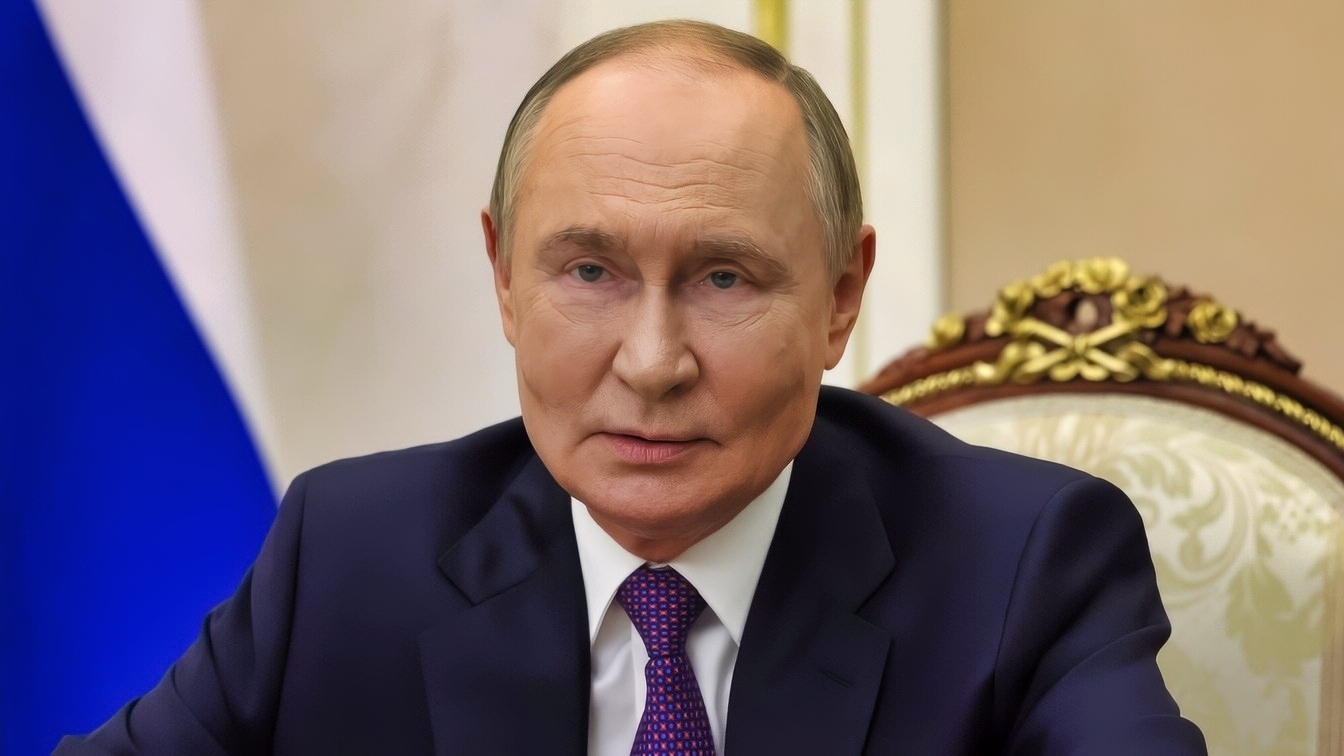
Russian President Putin Addressing the Nation Creative Commons Image
Perhaps more alarming from the Russian point of view is that sources who have served in senior roles in the Kremlin, now speaking on condition of anonymity, paint a dark portrait of both the mindset and the daily activities of Russia’s President Vladimir Putin.
The details reveal some uncomfortable, if not disturbing, parallels between the actions in the present day of Russia’s long-serving dictator and the last days of the Third Reich.
For some time now, it has been evident that the Russian military does not present the appearance of a “learning organization”- as the particular nature of that problem is sometimes described.
This is one of the chief reasons Moscow is not gaining ground on the battle lines. Ukraine’s armed forces are constantly analyzing how the conflict is evolving.
They have demonstrated far superior skills in applying innovation in the design, employment, and networking of command and control systems in what has become a drone war.
When the war began in February 2022, Russian forces were able to overpower the Ukrainians by relying on their ability to outmaneuver and outgun them on the battlefield – the traditional approach by Moscow to simply employ mass across the board.
At the same time, they were carrying out air strikes against cities and energy infrastructure located far behind the front line so as to destroy the morale of the Ukrainian military.

Putin in Briefing. Image Credit: Russian Government.
But in the intervening years, Ukraine’s innovative drone designs, now employed in mid- and long-range attacks, have turned the tide.
They have destroyed Russia’s air bases, the convoys to supply its army, and – as has been seen increasingly – oil refineries located hundreds of miles deep into Russian territory.
No New Tools
Ukraine’s success with these tactics has reduced the once-steady progress of Moscow’s advancing troops to a slow crawl.
Between February and May 2026, Russia captured only 63 square miles of territory. This compares with 444 square miles occupied during February to May 2025.
These and other comparisons come from the Finnish war monitoring organization, the Black Bird Group, which spoke to the London daily.
One ominous sign for Moscow is that Russian offensive campaigns usually pause in late winter and early spring before resuming in May.
But in another sign that Putin’s military is running on empty in terms of the resources, organization, and morale needed to move forward, there is no sign of any forward momentum along the front lines this year.
“The problem for Russia is that the current tactics do not provide the tools to enable larger successes, and the Russians haven’t been able to find new tools,” said Black Bird’s co-founder Emil Kastehelmi.
Simply put, the Ukrainian military has been able to neutralize almost any advantage that Moscow has tried to create, though the age-old method of just fielding more personnel and equipment.
“Robotification has made troop numbers much less important, which has changed the fortunes for the Kyiv regime,” said one source person who spoke to the FT and who is involved in the war effort. “You need 10 or 20 thousand drone operators, not hundreds of thousands of men sitting in trenches. So, the face of the war is changing.”
“The Russian state is either struggling to find belated answers to the enemy’s innovative new solutions or not finding them at all,” said one source to the FT who is reportedly engaged in back-channel communications with Moscow. “They’re technically backward, can’t scale it up, and don’t have [connectivity],” the same source said. “It’s very telling. You can’t get by using the ‘gunpowder empire’ methods [of artillery and gunfire] anymore.”
Bunkernym Dedom
In recent months, Putin’s growing paranoia and his tendency to sequester himself in one of his deep underground command centers have caused the Russian elite to tag him with the nickname of the “Bunkernym Dedom” (the old grandfather in the bunker).
They also charge that his multiple levels of security forces to protect him personally at teams exceed even those provided to the WWII Soviet leader Joseph Stalin.
But the comparisons to the Second World War become even more alarming when former senior Kremlin advisors have spoken to the FT about their daily activities.
One of them stated that the Russian president is now spending most of his time micromanaging the war effort. He reportedly receives briefings from Gen. Valery Gerasimov, the chief of the Russian General Staff, as often as twice a day, recounted two former senior Kremlin officials.

An M1A2 Abrams tanks, assigned to 1st Battalion, 16th Infantry Regiment, 1st Armored Brigade Combat Team, 1st Infantry Division, maneuver into fighting position during a battalion live-fire range during Agile Spirit 19 at Orpholo Training Area, Georgia, August 9, 2019. AgS19 is a joint, multinational exercise co-led by the Georgian Defense Forces and U.S. Army Europe which incorporates a command post exercise, field training and joint multinational live fires. (U.S. Army photo by Staff Sgt. True Thao)
This seems like a near-Hitlerian obsession with trying to turn around the fortunes of a war that has been lost for some time, all the while sitting in a bunker.
They also state that the Russian leader increasingly exhibits a warped sense of reality – particularly as it pertains to his more than ten-year effort to take all the territory of the Donbas Donetsk region.
“He thinks it’s a question of time. It might be faster or slower, but he’ll get it,” one of the former senior Kremlin officials recounted. “Putin’s very much under the influence of the military, who are really good at stringing him along. He understands that, but he really believes them and lets them do it.”
“If I were listening to Gerasimov’s reports three times a day from dawn until dusk, I’d perceive reality differently too,” said the former Kremlin insider, showing their growing lack of confidence in the Russian military to tell Putin anything other than what he wants to hear.
Konrad Muzyka, who directs the Polish analytical group at Rochan Consulting that monitors the war, pointed out that Putin has very few options left.
Russia, he said, “will seek different ways to influence Ukrainian decision-making, but apart from nukes, I don’t think they can really do much to change the course of how the fighting is going to develop over the course of the next months, unless they announce another partial mobilization.”
A mobilization – beginning to draft large numbers of personnel against their will – could very well set off a revolt inside of Russia, and Putin realizes this.
It is a move he has put off repeatedly in the past. But – as both he and his military are now running on empty – it may be the only remaining option.
About the Author: Reuben F. Johnson
Reuben F. Johnson has thirty-six years of experience analyzing and reporting on foreign weapons systems, defense technologies, and international arms export policy. Johnson is the Director of Research at the Casimir Pulaski Foundation. He is also a survivor of the Russian invasion of Ukraine in February 2022. He worked for years in the American defense industry as a foreign technology analyst and later as a consultant for the U.S. Department of Defense, the Departments of the Navy and Air Force, and the governments of the United Kingdom and Australia. In 2022-2023, he won two awards in a row for his defense reporting. He holds a bachelor’s degree from DePauw University and a master’s degree from Miami University in Ohio, with a specialization in Soviet and Russian studies. He lives in Warsaw.


