


Ukraine began its war on Russia’s oil industry in the early days of the war.
But its campaign of drone strikes on refineries, storage tanks, oil sea transport terminals and other infrastructure did not widen into a systemic assault on this vital sector of Russia’s economy until late 2024 and on into 2025.
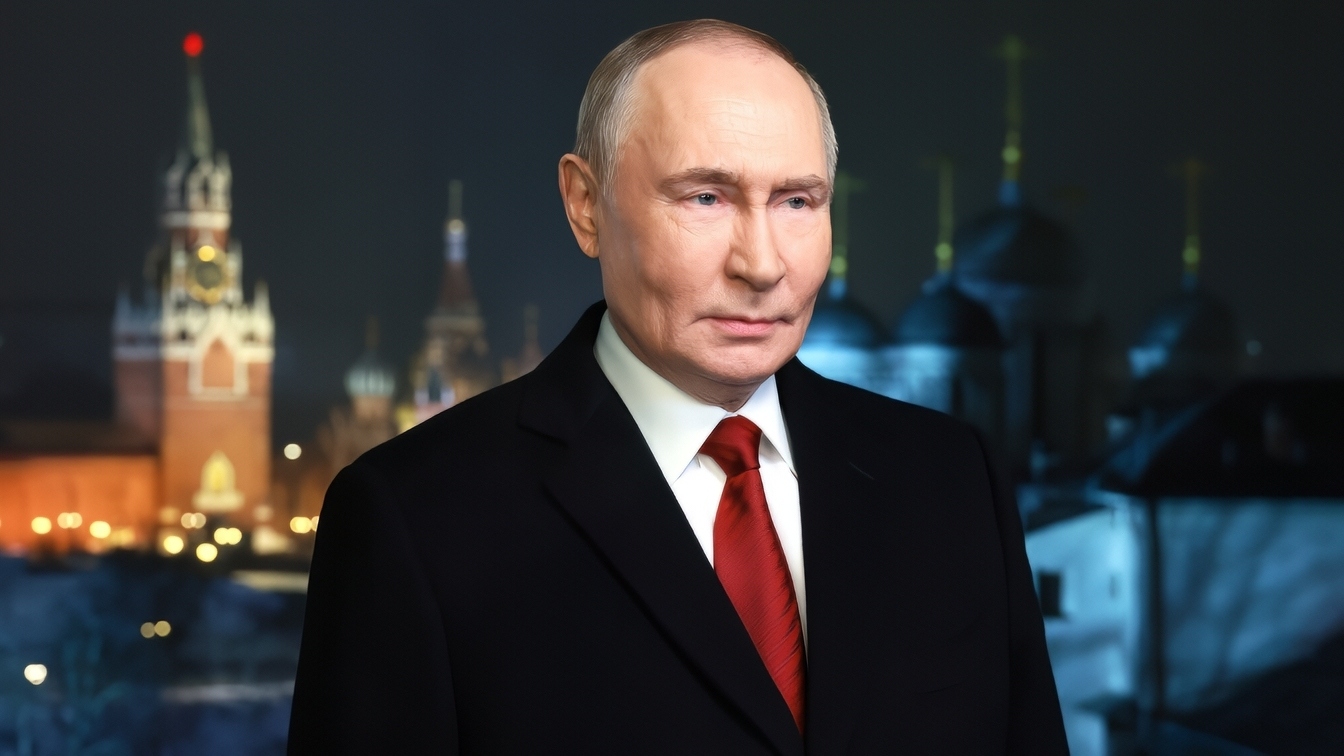
Putin New Year’s Message. Image Credit: Russian Government.
As an essay from the Center for European Policy Analysis (CEPA) described last month, Ukraine struck “Russia’s Central Nervous System.” As these attacks have continued and increased in their numbers, frequency, and in their distance from the Ukraine border, the preponderance of evidence is that Ukraine has found what is, as the author of the CEPA essay describes, “one of the few pressure points capable of changing the Kremlin’s cost-benefit calculation.”
“The purpose is not symbolic retaliation,” writes Sergiy Makogon, an executive with 20 years of experience in Central and Eastern Europe (CEE) energy markets. The purpose “is to raise the economic, military, and political cost of continuing the war until Moscow understands that prolonging it may become more expensive than ending it.”
Fuel shortages creating miles-long queues of motorists waiting to purchase petrol and fist fights breaking out among those lined up at the pump have by now become a common sight in Russia.
Once more or less insulated from these disruptions, Moscow has now felt their effects.
The Damage is Adding Up
As of 2 October 2025, 21 of the nation’s 38 large refineries had been hit since January 2025, a level of effectiveness that has only risen since. Those successful attacks represented an increase of 48 percent over that of the entirety of 2024.
By the beginning of 2026, these attacks had caused more than 20 percent of Russia’s refining capacity to be at least temporarily dismantled, severely undermining the Russian oil industry.
This situation led Russia to introduce gasoline and diesel export restrictions that remain in force until the end of 2026.
In 2024, approximately 30 percent of Russia’s budget was derived from revenues and tax receipts from the oil and gas sector.
In simple macroeconomic terms, anything Ukraine can do that would compromise the productive capacity of Russia’s oil industry reduces Moscow’s capacity to wage war.
As has been the case from the beginning of the conflict, Russian President Vladimir Putin’s economy remains overly reliant on the energy sector to keep his military machine running.
The Reuters news agency now reports that at least 30 regions (other reports say as many as 50) are affected by fuel shortages.
Unlike the previous wave of shortages, which began in late May and lasted until mid-July, the current crisis is not limited to cities far from western Russia and is now acutely affecting Moscow and nearby areas.
A common question is whether growing public anger could generate enough pressure on Putin to force him to end the war.
This calculus goes far beyond individual car owners swinging tire irons at one another in petrol queues.
A much bigger flashpoint is this fuel crisis.
A common question is whether growing public anger could generate enough pressure on Putin to force him to end the war.
This calculus goes far beyond individual car owners swinging tire irons at one another in petrol queues.
A much bigger flashpoint is driving this fuel crisis.
Domino Effect
“You can’t say there isn’t any fuel. But it’s obvious there’s a crisis,” says Oleg Grigorenko, who is editor-in-chief of the Russian independent media portal 7×7, which the Kremlin has branded as a “foreign agent.”
He points out the domino effect the crisis creates across the economy. “It’s not just a personal problem if you leave the city and don’t know whether you can get back again, for example. It’s also an economic problem. “
Grigorenko reports that in several regions, taxi drivers, courier services, and the construction industry are already losing business, as many supply chains they need to access depend on fuel. “The logistics of private construction companies are heavily reliant on gasoline,” Grigorenko explained using one industry as an example.
Another analyst, the now living-in-exile economist Nikolai Korzhenevsky, has projected that the ongoing problems in the oil and gas industry are harbingers of a much larger, longer-lasting crisis.
He also sees no quick-fix solution and instead projects Russia’s situation deteriorating into a state of crisis not unlike what befell Venezuela. In other words, an economy with its national income in chronic decline and little to no hope of a reversal.
Vyacheslav Shiryaev, a Russian business journalist who also now lives abroad, sees the crisis as undermining Putin’s military capability and the regime in general.
Ukrainian attacks on Russian targets serve both military objectives and could disrupt society as a whole – with the possibility that between the two they could hasten the end of the war.
“If there’s no diesel, Russia’s 6,000-kilometer railway network comes to a halt,” he explains. “It could also cripple hundreds of factories and businesses.
Without diesel, tens of thousands of trucks would be unable to run, food wouldn’t get to the stores, and farmers wouldn’t be able to harvest their crops.”
Ultimately, all these effects could result in a curtailing of Putin’s plans to continue the war,” he concludes.
“If Ukraine destroys the whole oil refining infrastructure, Putin will find that, when he gives an order, it isn’t implemented,” he predicts as a possible end-game scenario. “Everything will grind to a halt for lack of fuel.”
About the Author: Reuben F. Johnson
Reuben F. Johnson has thirty-six years of experience analyzing and reporting on foreign weapons systems, defense technologies, and international arms export policy. Johnson is the Director of Research at the Casimir Pulaski Foundation. He is also a survivor of the Russian invasion of Ukraine in February 2022. He worked for years in the American defense industry as a foreign technology analyst and later as a consultant for the U.S. Department of Defense, the Departments of the Navy and Air Force, and the governments of the United Kingdom and Australia. In 2022-2023, he won two awards in a row for his defense reporting. He holds a bachelor’s degree from DePauw University and a master’s degree from Miami University in Ohio, specializing in Soviet and Russian studies. He lives in Warsaw.


