


Key Points and Summary – Russia’s sole aircraft carrier, the Admiral Kuznetsov, is a notorious symbol of naval failure, defined by the thick black smoke from its stacks.
-This is a symptom of its cursed propulsion system, designed to burn “Mazut”—a tar-like, low-grade fuel.
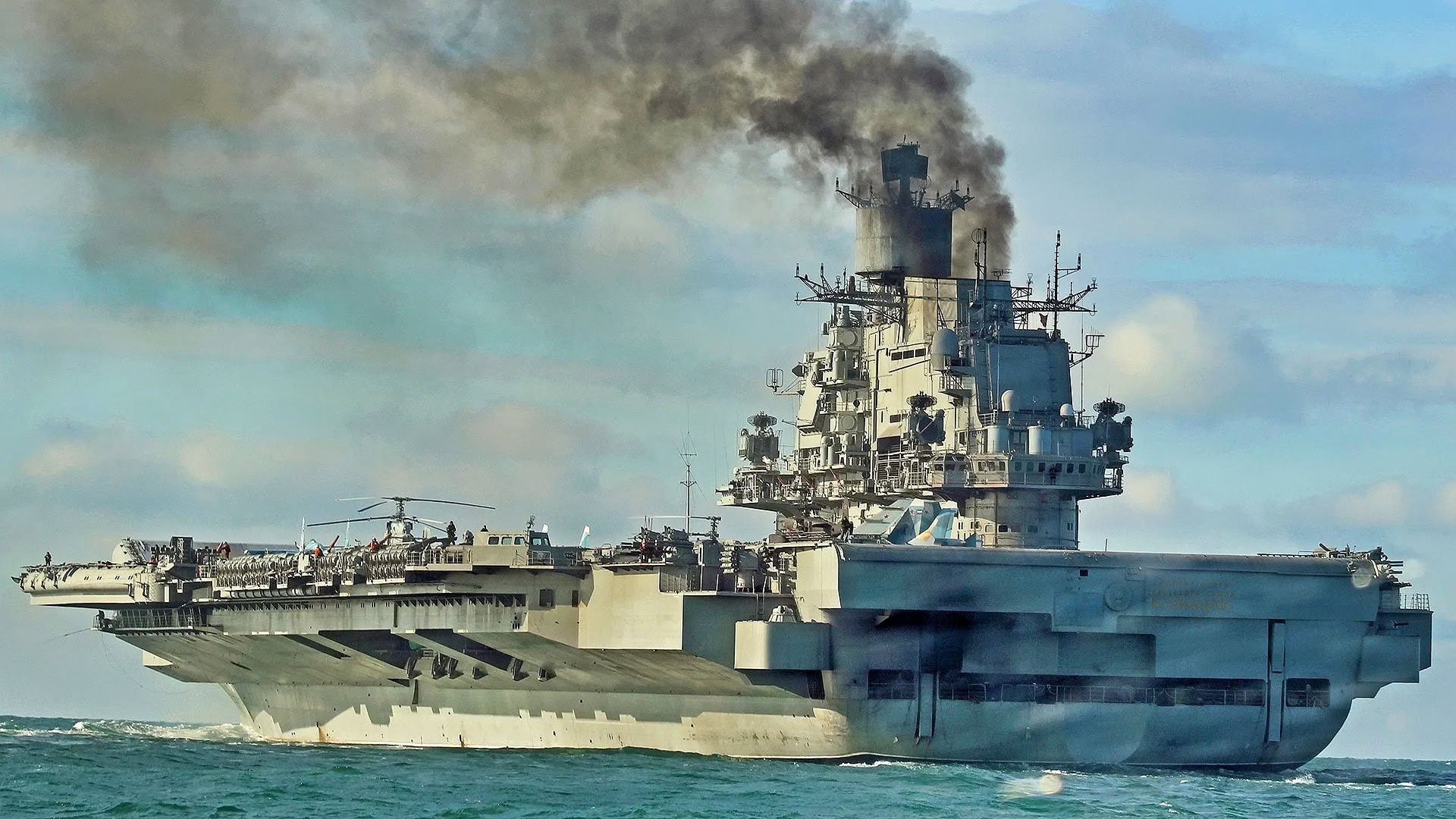
Admiral Kuznetsov Russian Navy. Image Credit: Creative Commons.
-This choice has plagued the ship with chronic unreliability, constant breakdowns, and fires. Its disastrous 2016 combat deployment to Syria, combined with a sunken drydock and a devastating fire during its refit, has rendered the carrier a wounded giant.
-A relic of failed Soviet ambition, its future is likely the scrapyard, not the high seas.
Russia’s Admiral Kuznetsov Aircraft Carrier: The Black Smoke Won’t Go Away
The Admiral Kuznetsov is instantly recognizable on the world stage, but not for its complement of fighter jets or its imposing size.
And, to be frank, as an editor and think tank director of several different defense and national security publications since the late 2000s, I have assigned countless stories on this career for what feels like one reason: it is a massive failure for numerous reasons.
However, there appears to be one reason it fails above all else: poor propulsion that leads to even worse aesthetics. Its defining characteristic is the pillar of thick, noxious, black smoke that constantly billows from its smokestack. This isn’t just an unsightly cosmetic issue; it is the unavoidable, very public symptom of a deep, congenital disease in the ship’s heart.
This trail of black smoke is a constant reminder of a series of catastrophic design choices, a history of crippling breakdowns, and a strategic dead-end that has plagued the Russian Navy for three decades.

Admiral Kuznetsov Aircraft Carrier Russia. Image Credit: Creative Commons.

Admiral Kuznetsov back in 2011. Image Credit: Royal Navy.

Admiral Kuznetsov. Image Credit: Creative Commons.
What a mess. To understand that column of smoke is to understand the entire tragic story of the Admiral Kuznetsov.
It tells a tale of a ship born at the end of an empire, a machine saddled with a power plant so fundamentally flawed that it was doomed from the start.
That smoke is the ghost of Soviet ambition, a rolling, toxic testament to why this carrier has spent more of its life broken than deployed, and a powerful argument for why its future likely lies not on the high seas, but in a scrapyard.
A Compromise Born of Collapse for This Aircraft Carrier
The story of the Kuznetsov’s cursed power plant begins with the grand, and ultimately unfulfilled, naval ambitions of the Soviet Union.
In the 1970s and 1980s, Soviet planners envisioned building a fleet of massive, nuclear-powered supercarriers—the Ulyanovsk-class—that would directly challenge American naval supremacy.
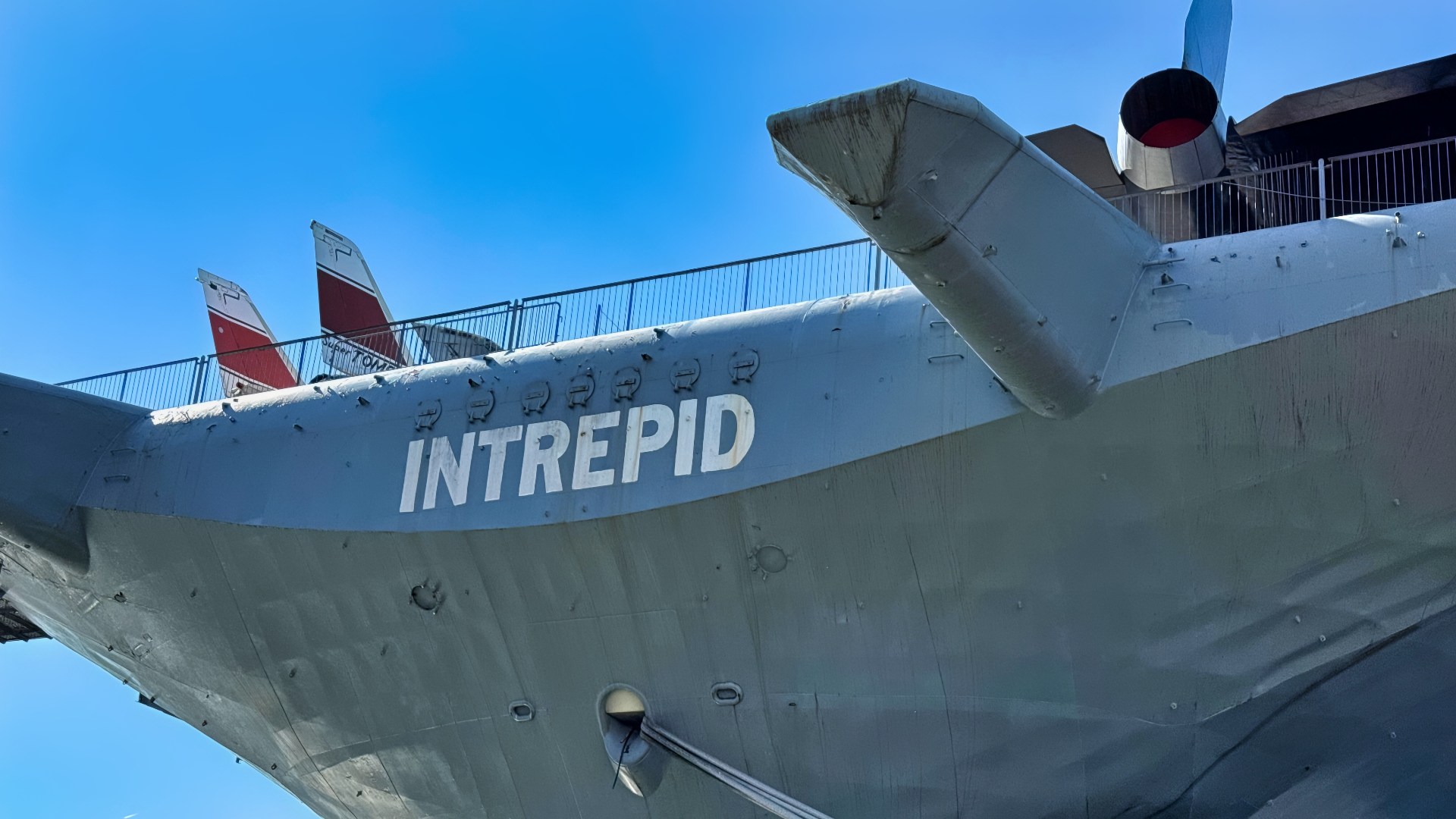
Essex-Class Carrier USS Intrepid NSJ Photo.
These would have been true global platforms, capable of sustained, blue-water operations far from home.
But the technological and financial costs of such a leap were immense, and the creaking Soviet economy could not bear the strain.
As a stopgap, a less ambitious design was approved. This new class, of which the Admiral Kuznetsov would be the lead (and ultimately only) ship in Russian service, was a compromise in every sense of the word.
Critically, the dream of nuclear propulsion was abandoned, a big mistake in my own view.
Instead, the ship was fitted with a conventional steam turbine power plant. But this was no ordinary power plant. It was a notoriously complex and unreliable system of eight massive boilers powering four steam turbines.
This decision, made out of expediency and technological limitation, would prove to be the ship’s original sin.
Admiral Kuznetsov Looks Cursed From the Start
The timing of its construction was catastrophic. And as one U.S. Navy Admiral long since retired told me years ago about this carrier: “[R]ussia’s Admiral Kuznetsov aircraft carrier never had a chance at success thanks to the waves of history that were coming to sink it.” Gulp.

Admiral Kuznetsov. Image Credit: Creative Commons.
Laid down in Ukraine in 1982, the ship was launched in 1985 and was still undergoing sea trials and fitting out when the Soviet Union itself began to crumble. The vessel that was meant to be the pride of a superpower’s navy was instead born into an era of political chaos, economic collapse, and industrial disintegration.
When the USSR dissolved in 1991, the partially completed carrier was rushed from the Ukrainian shipyard to its new homeport with the Russian Northern Fleet to avoid being claimed by the newly independent Ukraine.
It arrived incomplete, with a poorly trained crew and a power plant that had never been properly finished or tested. The seeds of its future failures were already sown.
Admiral Kuznetsov’s Devil Tar: The Curse of Mazut
So, what about that black smoke?
The core of the Kuznetsov’s propulsion problem can be summed up in one word: Mazut.
This is the fuel its massive boilers were designed to burn. Mazut is not a refined fuel like the marine diesel used in most conventional warships. It is a heavy, low-grade residual fuel oil—essentially the tar-like, viscous sludge left at the bottom of the barrel after the lighter, more valuable components, such as gasoline and diesel, have been distilled from crude oil. It is cheap, abundant in the former Soviet Union, and absolutely miserable to work with.
Burning Mazut is a complex and filthy process. It is so thick at normal temperatures that it has the consistency of asphalt. Before it can be injected into the boilers, it must be preheated for hours by a separate system of steam pipes to make it liquid enough to flow. This complex network of pipes, pumps, and heaters is a maintenance nightmare, prone to clogging and failure.
The real trouble begins during combustion. Mazut is contaminated with impurities, including sulfur, heavy metals, and other pollutants. When it burns, it leaves behind a thick, corrosive slag and a tremendous amount of soot.
This fouls the inside of the boilers’ intricate network of water tubes, creating a layer of insulation that dramatically reduces their efficiency and causes dangerous hotspots that can lead to tube ruptures. The result is a power plant that requires constant, back-breaking maintenance by a highly skilled crew. The Kuznetsov has never had either in sufficient quantity. Due to poor training and the general decline of the Russian naval-industrial complex, the ship’s boiler systems have been plagued by problems from day one.
That infamous black smoke is the direct, visible evidence of this profoundly inefficient and dirty combustion process. It is a cloud of unburnt fuel particles and soot, a clear sign that the boilers are not operating correctly and are incapable of completely burning the low-grade fuel they are fed. It is the signature of a failing, labor-intensive, and fundamentally unreliable power plant.
A Career Defined by Breakdowns for Admiral Kuznetzov
The Kuznetsov’s operational history is less a record of naval deployments and more a litany of embarrassing and often dangerous failures, nearly all of them stemming from its cursed propulsion system.
From its very first attempt at a long-range deployment in the mid-1990s, the carrier has been perpetually shadowed by a large ocean-going tugboat. This isn’t an optional escort; it is a mandatory requirement, a tacit admission by the Russian Navy that they fully expect their flagship to break down at sea. What a mess.
And it has, repeatedly.
Almost every deployment has been marred by propulsion failures that have left the carrier dead in the water, sometimes for days, until it could be taken under tow. These breakdowns are not just embarrassing; they are strategically crippling. A warship that cannot be relied upon to move under its own power is not a credible instrument of force.
The problems go beyond simple unreliability. The poorly maintained boiler systems have been the source of multiple fires, a sailor’s worst nightmare. The accumulation of soot and the potential for fuel leaks in a poorly managed engine room create a constant fire hazard. In 2019, during what was supposed to be a major refit, a fire sparked by a welding accident tore through the ship’s power spaces, killing two and injuring over a dozen more.
This was not an isolated incident.
Admiral Kuznetsov: Going to War and Retirement?
This litany of failures reached a grim crescendo during the carrier’s one and only major combat deployment, a 2016 mission off the coast of Syria. The voyage through the English Channel was a spectacle, with NATO observers watching in disbelief as the Kuznetsov belched its signature black smoke, escorted by its ever-present tug.
Once on station, the carrier’s performance was a disaster, and I remember covering it at the time and wondering how Russia could have ever sent this thing out to sea in the first place.
It lost two of its precious carrier aircraft—a MiG-29K and an Su-33—in separate, non-combat landing accidents in less than three weeks, reportedly due to failures in its arresting gear. The humiliation was so great that the remainder of its air wing was eventually relocated to a land base in Syria to conduct its combat missions. The one time the Kuznetsov was called upon to perform its primary function, it failed utterly.
The Final, Inglorious End?
The ship’s return from its Syrian misadventure marked the beginning of what may be its final chapter. Thank god.
Sent into a shipyard in Murmansk for a long-overdue and extensive overhaul, the carrier’s run of bad luck turned into a full-blown catastrophe. In 2018, the massive PD-50 floating drydock—the only one in Russia large enough to hold the carrier—sank while the Kuznetsov was aboard.
A 70-ton crane from the collapsing drydock crashed onto the carrier’s flight deck, tearing a 200-square-foot gash in the hull. The aircraft carrier was saved from sinking with the drydock, but it was now a severely damaged ship with no facility in Russia capable of properly repairing it.
The aforementioned fire in 2019 only compounded the damage. Today, the Admiral Kuznetsov sits pier-side, a wounded giant. And it seems the Russian government is ready to admit what I have said for years: she needs to be scrapped. Forget about losing prestige points or embarrassment. It’s time to do the right thing.
The Bottomline on Russia’s Last Aircraft Carrier
The black smoke that has trailed the Admiral Kuznetsov throughout its troubled life was always a harbinger of its fate.
It was the signal of a flawed design, a failing industrial base, and a naval ambition that had outstripped its grasp.
The ship was conceived as a weapon to challenge a superpower, but it has proven to be a greater danger to its own crews and a bigger embarrassment to the Russian Navy than it ever was a threat to an adversary.
It is a hollow giant, a Potemkin carrier whose story will likely end not with a bang in a decisive battle, but with the quiet hum of a shipbreaker’s torch.
As one retired NATO offical put it to me just a few months back: “If Russia were smart, they would give up trying to make carriers and move on.”
Who can’t agree with that? History seems to suggest that’s obviously good advice.
This will be one topic I won’t miss covering ever again, unless we are covering the scraping details. Stay tuned for that.
About the Author: Harry J. Kazianis
Harry J. Kazianis (@Grecianformula) is Editor-In-Chief and President of National Security Journal. He was the former Senior Director of National Security Affairs at the Center for the National Interest (CFTNI), a foreign policy think tank founded by Richard Nixon based in Washington, DC. Harry has over a decade of experience in think tanks and national security publishing. His ideas have been published in the NY Times, The Washington Post, The Wall Street Journal, CNN, and many other outlets worldwide. He has held positions at CSIS, the Heritage Foundation, the University of Nottingham, and several other institutions related to national security research and studies. He is the former Executive Editor of the National Interest and the Diplomat. He holds a Master’s degree focusing on international affairs from Harvard University.
More Military
India’s Big Blunder Purchase of Russia’s ‘Mothball’ Aircraft Carrier Still Stings
North Korea’s 10/10 Military Parade: What To Watch For
The New B-21 Raider Stealth Bomber Has Only 1 Real Enemy
Meet the AbramsX: The U.S. Army’s Next-Generation Super Tank
Russia’s Typhoon-Class Missile Submarine Was Something the U.S. Navy Still Can’t Match


