


Key Points and Summary – After 25 years of deep refurbishment, Russia’s nuclear-powered Kirov-class cruiser Admiral Nakhimov has completed initial sea trials, boasting 176+ VLS cells for Kalibr, Oniks, and Tsirkon missiles, plus layered air defenses reportedly including S-400.
-Displacing 28,000 tons and powered by twin reactors, the behemoth signals Kremlin pride—yet practicality is debatable.
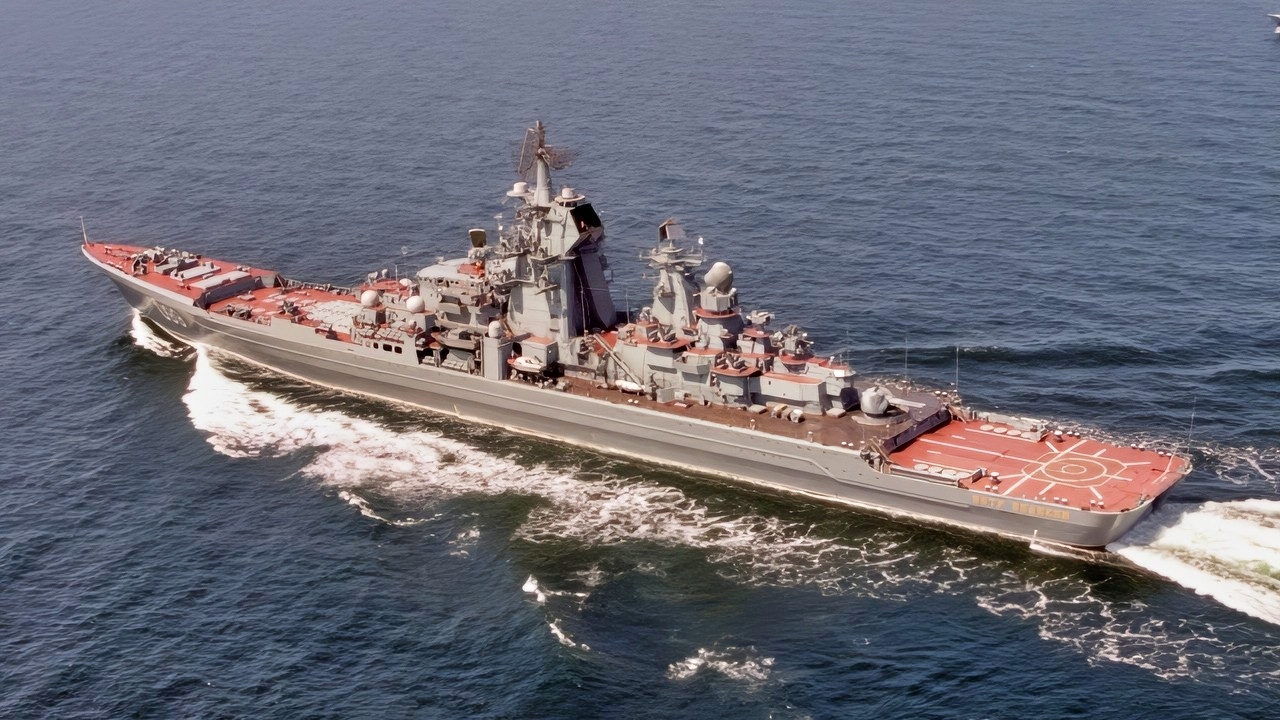
Russian Navy Kirov-Class. Image Credit: Creative Commons.
-Modern anti-ship weapons, as seen in Moskva’s 2022 sinking, challenge large surface combatants, which are costly, crew-intensive, and high-value targets.
-Nakhimov’s comeback underscores Russia’s struggle to field new major warships while leveraging legacy hulls—but whether the cruiser adds real combat value or serves mainly as propaganda remains an open question.
The Russian Navy Cruiser Admiral Nakhimov Is Back: Does Her Return Make Sense?
The military is an institution replete with acronyms, and among those acronyms is “RHIP,” which stands for “Rank Has Its Privileges.” This is especially true of naval forces, wherein flag officers, AKA admirals, have disproportionately higher chances of getting warships named in their honor. For example, in the United States Navy, you have the Nimitz-class aircraft carriers and Spruance-class destroyers, both named for WWII heroes.
Meanwhile, back during the 1982 Falklands War, the Argentine Navy (Armada de la República Argentina) had the ill-fated light cruiser ARA General Belgrano (which ended up being sunk by the Royal Navy submarine HMS Conqueror).
Not surprisingly, the Russian Navy (Voyenno-morskoy flot Rossiyskoy Federatsii) also has its fair share of vessels named for historically significant flag officers. The most (in)famous example is the star-crossed aircraft carrier Admiral Kuznetsov. There’s also the frigate Admiral Makarov (not to be confused with the inventor of the Makarov pistol).
And then there’s the current subject at hand, the battlecruiser Admiral Nakhimov. The Nakhimov is back on the scene and making headlines again after a long hiatus. But is this necessarily a good thing for the Russian Navy?
Bottom Line Up Front (BLUF)
The latest news comes to us from a September 16, 2025, article written by Will Xaiver for Baird Maritime titled “Russian Navy cruiser Admiral Nakhimov completes initial sea trials following long-term lay-up.”
To wit: “Russian shipbuilder Sevmash has completed conducting the first sea trials of the Russian Navy nuclear-powered guided-missile cruiser Admiral Nakhimov after it spent more than 25 years in deep refurbishment. The trials covered the operation of the ship’s propulsion system, as well as several other critical systems. Additional testing will be undertaken in the Barents Sea according to schedule, the Russian Ministry of Defence has confirmed.”
NOTE: Yes, you read that correctly: 25 years.
Admiral Nakhimov (Kalinin) Initial History
Originally christened the Kalinin, the vessel was built at the Baltic Shipyard in Leningrad as the third ship out of the total of four Project 1144 Orlan (NATO reporting name Kirov-class) nuclear-powered battlecruisers (or to use the official Russian Navy classification, “heavy nuclear-powered guided-missile cruiser” [tyazhyoly raketny kreiser na yadernoy energy]) built between 1974 and 1988. She was laid down on May 17, 1983, launched on April 26, 1986, and commissioned on December 30, 1988
On April 22, 1992 (four months after the collapse of the Soviet Union that officially ended the Cold War), the Kalinin was renamed in honor of Pavel Stepanovich Nakhimov (July 1802 – 12 July 1855), an Imperial Russian Navy hero best known for his smashing victory over Ottoman Empire forces in the Crimean War Battle of Sinope on November 30, 1853.
Admiral Nakhimov Technical Specifications and Vital Stats
Courtesy (in part) of Army Recognition (yes, that’s right; Army-Navy rivalry notwithstanding, Army Recognition also covers naval technology):
-Displacement: 28,000 tons fully laden
-Hull Length: 251.1 m (823 ft 10 in)
-Beam Width: 28.5 m (93 ft 6 in)
-Draught: 10.3 m (33 ft 10 in)
-Primary Propulsion: 2 × KN-3 nuclear reactors producing 2×150 MW, supported by two auxiliary boilers and two turbines generating a combined 140,000 hp (103 MW) on shafts
-Secondary Propulsion: 4 x power plants with a capacity of 18 MW, four steam turbine generators producing 3 MW each, and four gas turbine generators rated at 1.5 MW each
-Max Speed: 32 knots (59 km/h; 37 mph)
-Range: Unlimited distance (thanks to that nuclear power factor)
-Crew Complement: 710 commissioned officers and enlisted seamen
-Aircraft Carrying Capacity: 3 x Kamov Ka-27 “Helix” helicopters
-Armament: 1 × 130 mm (5 in) A-129M dual-purpose main gun; 10 × 3S14 universal vertical launch systems (VLS), each containing eight Kalibr-NK or Oniks cruise missiles or 3M22 Tsirkon hypersonic missiles; navalized S-400 air defense system containing 96 launch cells; Pantsir-ME and a naval adaptation of the S-350 Vityaz for short-range defense; 10 × 533 mm (21 in) torpedo tubes
The tonnage figure makes the Admiral Nakhimov and her sister ships the largest surface warships to have been built since World War II, besides aircraft carriers.
Kalinin/Admiral Nakhimov Operational History in Brief
Much ado about relatively little to report here. On 21 April 1989, she joined the Red Banner Northern Fleet. According to one source, “In February 1991, while on combat service in the Mediterranean Sea, [s]he assisted the crew of the Turkish dry cargo ship Sveroglu-1, in the same year [s]he won the prize of the Commander-in-Chief of the Navy for missile training.”
Following the aforementioned Soviet collapse, the Nakhimov was rarely deployed, and the last time she sailed under her own power was in July 1997.
Nakhimov’s Return: Does It Really Make Sense?
The return of the Nakhimov is undoubtedly a point of pride for the Russian Navy brass and for Vladimir Putin. But looking past pride and propaganda for the sake of practicality and pragmatism, does bringing the cruiser back to service really make sense in light of anti-ship ballistic missiles (ASBMs), or ship-killing missiles in general?
Back in April 2022, the Russian Navy was utterly humiliated on the world stage when its Black Sea Fleet flagship, the guided missile cruiser Moskva, was sunk by two Ukrainian Navy R-360 Neptun (“Neptune”) missiles. Granted, the Kirov-class battlecruisers wield a heavier air defense arsenal than the Moskva did. Nonetheless, the bigger ships provide a bigger, juicier target. Nevertheless, Putin and his admirals probably see the Nakhimov as an important tangible symbol of the revitalization of the Russian Navy, which in turn would explain why they’re no more willing to give up on that beleaguered battlecruiser than they are on the Kuznetsov.
According to the World Directory of Modern Military Warships (WDMMW), the Russian Navy currently has two operational Kirovs along with two Slava-class cruisers.
About the Author: Christian D. Orr, Defense Expert
Christian D. Orr is a Senior Defense Editor. He is a former Air Force Security Forces officer, Federal law enforcement officer, and private military contractor (with assignments worked in Iraq, the United Arab Emirates, Kosovo, Japan, Germany, and the Pentagon). Chris holds a B.A. in International Relations from the University of Southern California (USC) and an M.A. in Intelligence Studies (concentration in Terrorism Studies) from American Military University (AMU). He is also the author of the newly published book “Five Decades of a Fabulous Firearm: Celebrating the 50th Anniversary of the Beretta 92 Pistol Series.”
More Military
China Claims New J-35 Stealth Fighter Has Radar Cross-Section ‘Smaller Than a Human Palm’
The SR-71 Blackbird Mach 3 Bomber?
5 Reasons A U.S.-China War Could Start


