

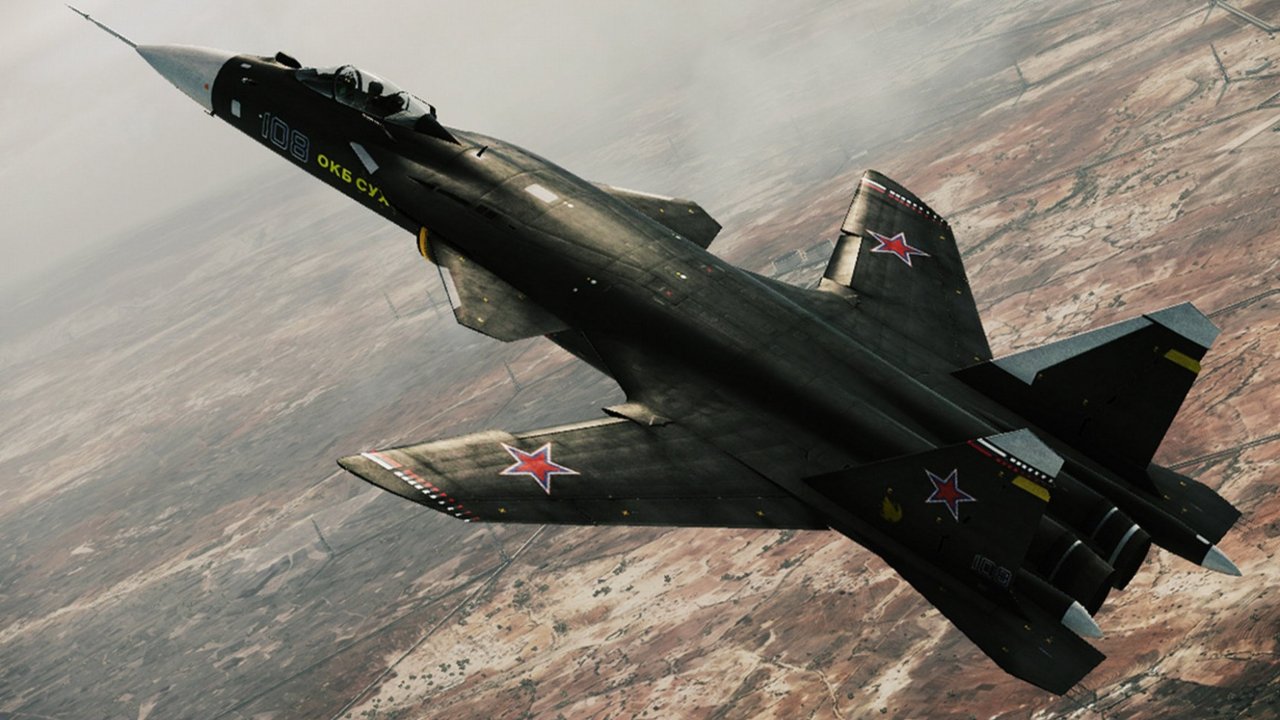
Key Points and Summary – Russia’s Su-47 Berkut was Sukhoi’s forward-swept, fly-by-wire testbed—not a frontline fighter.
-First flown in 1997, the lone prototype combined composite-heavy wings, internal-bay volume, advanced avionics and thrust-vectoring D-30F6s to chase extreme agility and high-AoA control.
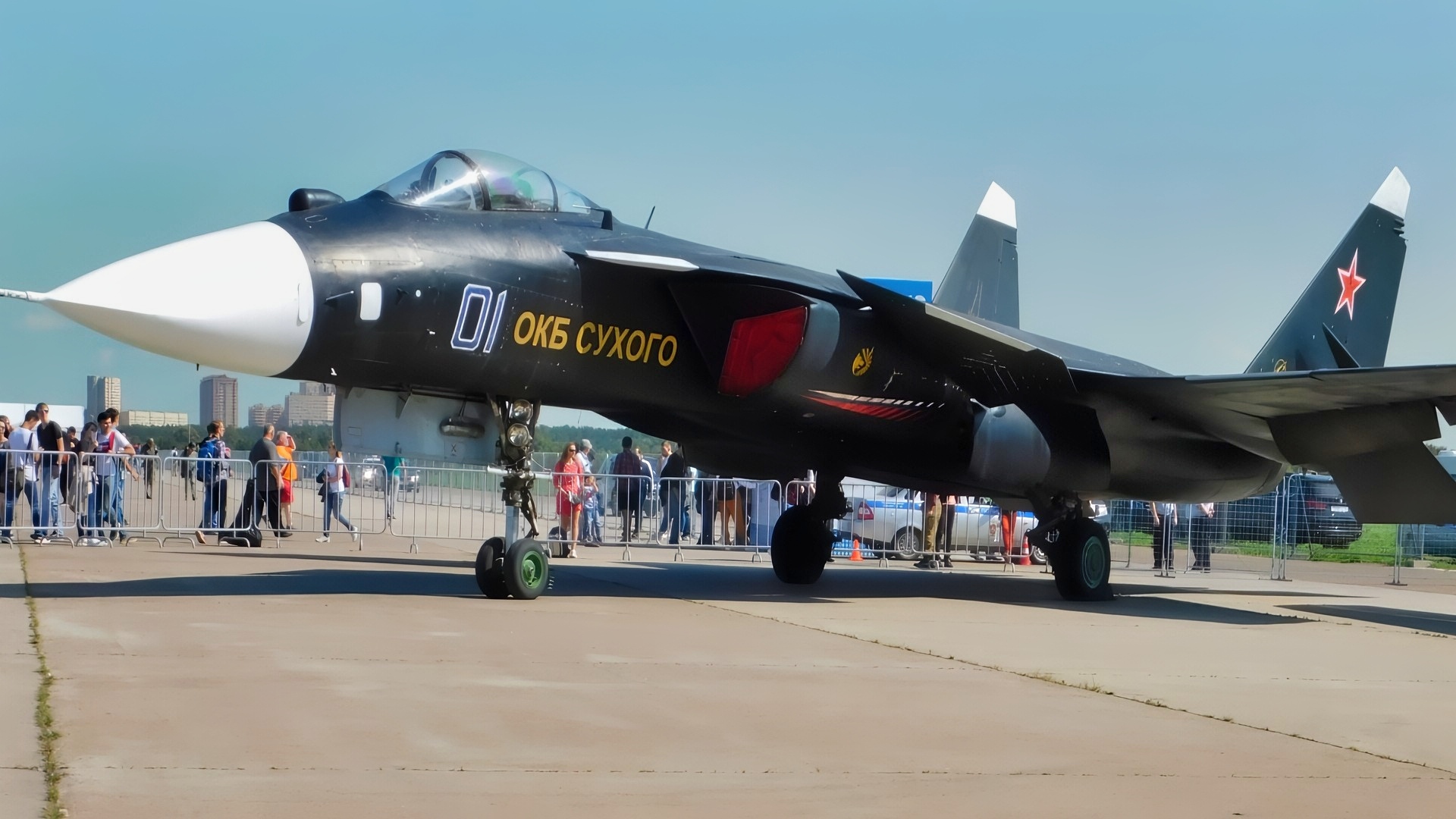
Sukhoi Su-47 Berkut. Image Credit: Creative Commons.

Su-47. Image Credit: Creative Commons.
-The gains were real: higher lift, better stall resistance and rich data for digital controls, structures and weapons-bay integration.
-The costs were steep: complex composites, severe wing loads, and post-Soviet funding cuts—plus a shift to conventional stealth layouts.
-As Russia prioritized Su-35 upgrades and the Su-57, Berkut stayed a demonstrator. Its lessons on controls, materials and handling now underpin modern Russian fighters.
Russia’s Su-47 Berkut Experimental Fighter, Explained
The Su-47 Berkut is a Russian experimental fighter jet known for radical forward-swept wings that provided exceptional agility. It was designed and manufactured by Sukhoi as a technology demonstrator and was designated S-37 during early development.
The experimental design featured an internal weapons bay, advanced radar space, and some stealth characteristics; the Su-47 was never fitted with weapons.
While it flew for the first time in 1997, only one prototype was ever built. The Su-47 was limited by funding issues and stymied by a shift toward more conventional stealth designs for future fighters such as the Su-57. Its design, which prioritized agility and control at high angles of attack, provided valuable data for later Russian aircraft programs.
Development and Purpose Of the Su-47
Development on the Su-47 began during the 1980s, in the final years of the Cold War. At the time, the Soviet Union was actively pursuing next-generation fighter concepts to counter the technological advancements of the United States and NATO.
The primary goal was to test advanced aviation concepts, not to produce a frontline aircraft. The Su-47 Berkut is one of the most easily identifiable aircraft in the world due to its forward-swept wings.
No forward-swept-wing aircraft has ever entered full-scale production, but several countries tried to develop them, including Germany and Japan during World War II. The U.S. tried to build the XB-53 bomber, the Douglas D-558, and a forward-swept version of the P-51. Grumman later built a pair of X-29 aircraft, but they were never fully realized.
The forward-swept wing design was intended to drastically improve agility and control, especially during high-angle-of-attack maneuvers.
The Su-47’s first flight occurred on Sept. 25, 1997, at the Paris Air Show.
The Forward-Swept Wings Key Benefit
The aircraft’s distinctive wings offered advantages such as a higher lift-to-drag ratio, better maneuverability, and improved stall resistance.
The airframe used extensive titanium alloys, aluminum, and carbon-fiber composites. The engines were equipped with thrust vectoring for added agility.
The Su-47 was equipped with a modern avionics suite. It included a fly-by-wire control system, multifunction displays, a helmet-mounted sighting system, and advanced radar and sensor arrays.
The Russians towed out the Su-47 in 2019 at the MAKS-2019 show at Zhukovsky International Airport, just outside of Moscow. It was the Su-47’s first appearance in a dozen years, and a curious choice by the Russians to put it on static display for one show.
Su-47 Berkut Power Plant
Two Soloviev D-30F6 afterburning turbofan engines powered the Su-47 Berkut.
These engines provided each with around 93.1 kiloNewtons of dry thrust, increasing with afterburner to a maximum of 153 kN.
The engines were chosen for their high dry thrust and fuel efficiency, and they were designed to be equipped with 2D and 3D thrust-vectoring nozzles for enhanced maneuverability.
The Su-47 had a maximum speed of Mach 2.21 and a range of 3,400 kilometers. The aircraft had a service ceiling of 59,000 feet and could handle 9 g’s. With a climb rate of 45,900 feet per minute, its performance was outstanding.
Why Was Development Stopped For The Su-47?
The Su-47 was canceled primarily because it was intended as a technology demonstrator, rather than a production aircraft, and its forward-swept wing design presented significant technical challenges.
Contributing factors included immense manufacturing and maintenance costs, the structural vulnerabilities of the wings, the collapse of the Soviet Union—which halted funding—and the emergence of more practical, stealth-focused designs, such as the Su-35 and the Su-57.
The forward-swept wings caused severe stress, requiring complex and expensive composite materials and a sophisticated fly-by-wire system for stability. This made the aircraft prohibitively costly to build and maintain.
The collapse of the Soviet Union in 1991 led to severe funding freezes. The project was continued with private funding; however, Russia’s economic crisis rendered large-scale military production unsustainable.
As technology evolved, Russia’s focus shifted to stealth aircraft. The Su-47’s design was not considered ideal for stealth, and by the time funding for a fifth-generation fighter was approved, the design was deemed outdated compared to the more conventional stealth layout of the Su-57.
The forward-swept wing configuration offered advantages at lower speeds but was not superior to conventional, aft-swept wings at higher, supersonic speeds. This made the Su-47 less practical for a wider range of combat scenarios compared to its contemporaries.
Su-47 Legacy
While many analysts consider the Su-47 a failure because it never entered production, it was never intended to do so.
Despite being a one-off prototype, the Su-47 made significant contributions to the development of later aircraft—in particular to Su-35 upgrades and the Su-57—by refining digital flight controls and materials science.
About the Author: Steve Balestrieri
Steve Balestrieri is a National Security Columnist. He served as a US Army Special Forces NCO and Warrant Officer. In addition to writing on defense, he covers the NFL for PatsFans.com and is a member of the Pro Football Writers of America (PFWA). His work was regularly featured in many military publications.
More Military
Russia’s Mach 2 Su-30SM Fighter Has A Message for Any Air Force on Earth
The Mach 2.2 B-1A Bomber Has A Message for the U.S. Air Force
The Mach 2.35 ‘Super’ Eurofighter Typhoon Fighter Has a Message for Any Air Force On Earth
Canada’s CF-18 Hornet Fighter Crisis
Forget NGAD or the J-20: A 7th Generation Fighter Could Hit Mach 5


