


When the Russians unveiled the Uralvagonzavod T-14 Armata tank at Moscow’s 2015 Victory Day Parade, the T-14 was touted as the most advanced main battle tank in the world, boasting a suite of technological innovations that, on paper, placed it a generation ahead of Western counterparts.
The T-14 design is a significant departure from Soviet/Russian tank designs, as it boasts an uncrewed turret, reducing the crew to three, a smoothbore 125mm main gun, and the ability to fire both conventional ammunition and anti-tank guided missiles.
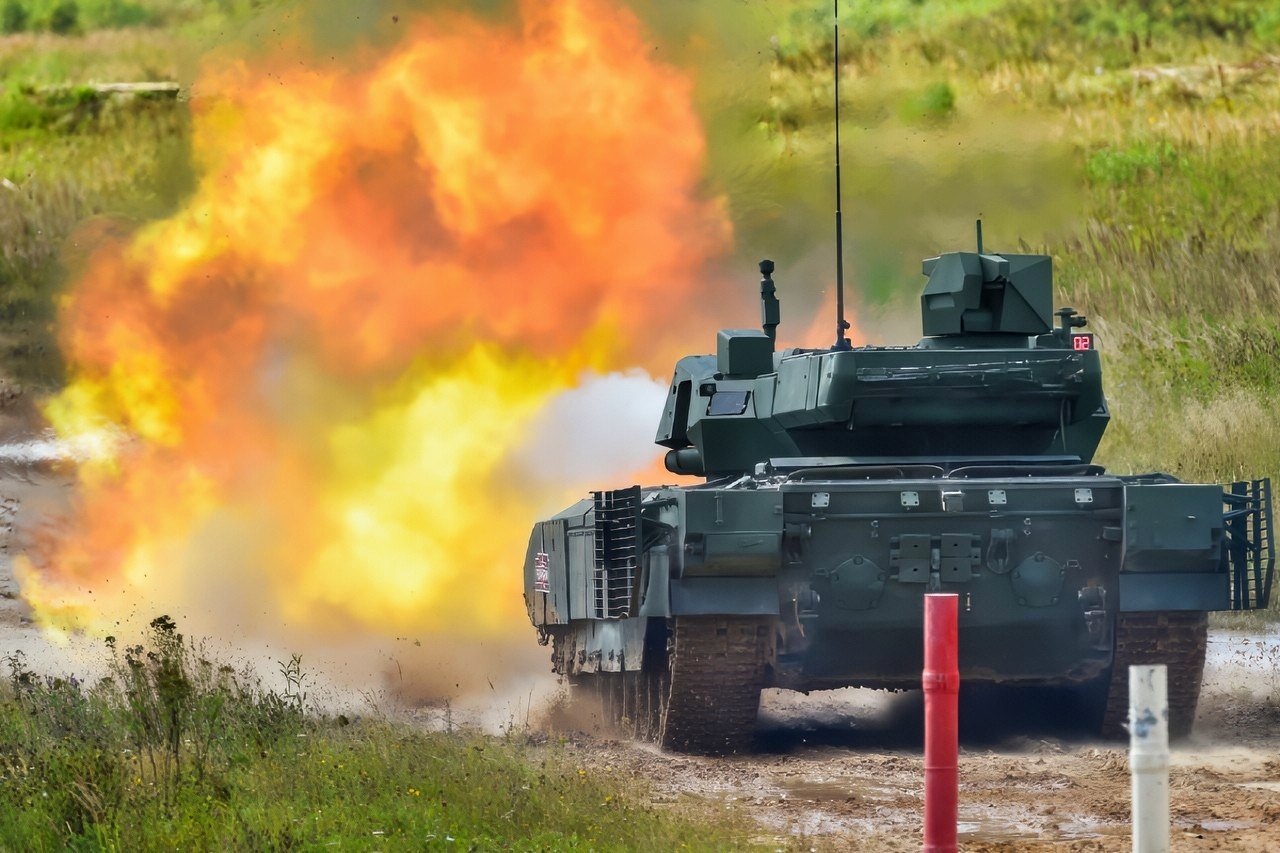
T-14 Armata Tank Russian Army. Image Credit: Creative Commons.
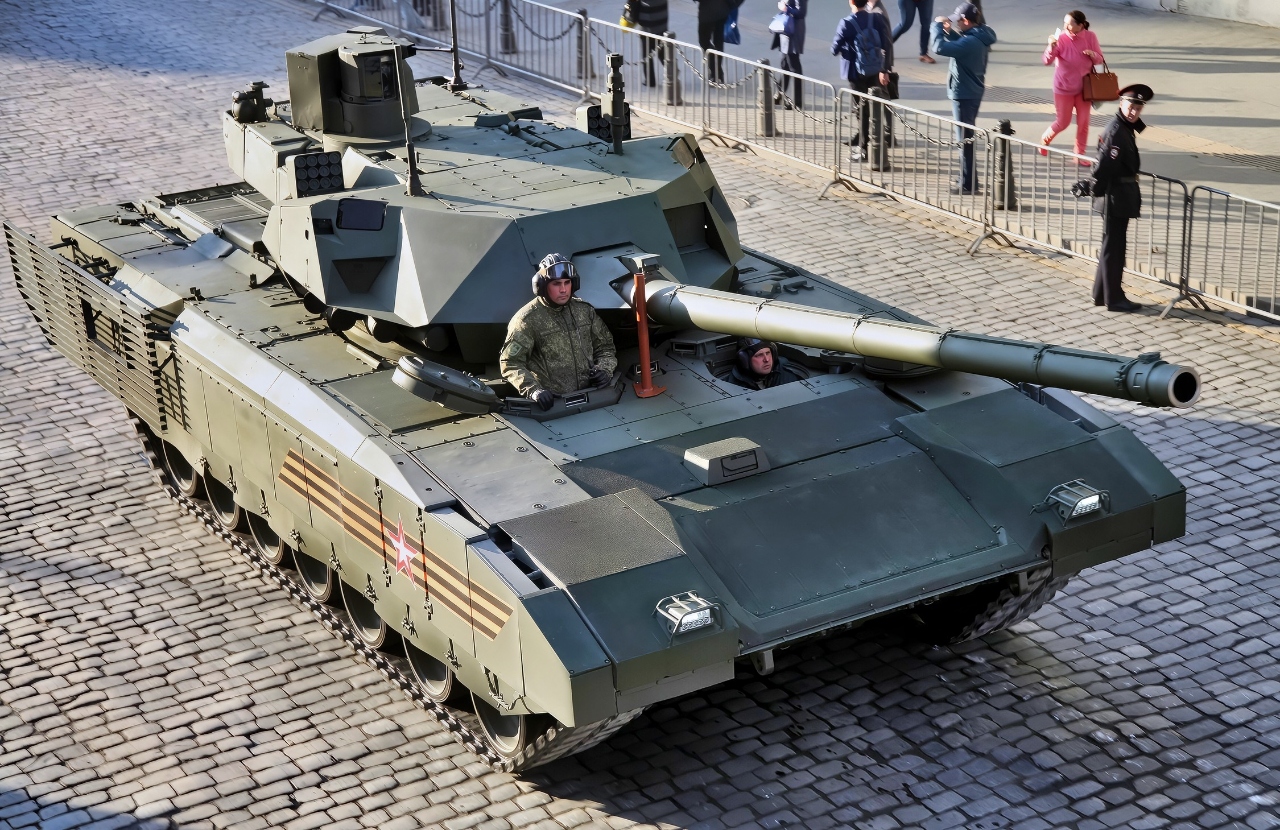
T-14 Armata Tank Russia. Image Credit: Creative Commons.

T-14 Armata. Image Credit: Creative Commons.
Boasting Afghanit active protection systems and cutting-edge sensors, the West was supposed to play catch-up. The reality was quite different from the typical Russian hype.
However, the T-14 Armata has been a microcosm of the Russian military. Heavily hyped, beset by problems, production was planned at around 2,300; the Russians produced only about 50, and it has been unused during a war that had been going on for more than three years, during which their armor had been decimated.
Meet The T-14 Armata
In a departure from the historical tradition of Russian tanks being pragmatically designed and easily mass-producible, the T-14 Armata is technologically ambitious and, theoretically, very impressive.
The tank’s primary weapon is a 125mm smoothbore gun in its unmanned turret, which is controlled electronically from a protected crew capsule compartment located in the center of the tank.
An autoloader feeds the main gun, and in addition to traditional rounds, it can also fire the Sprinter Anti-Tank Guided Munition (ATGM), an effective guided missile.
The autoloaders have proved to be a major issue with Russian tanks, because the ammunition for it is stored in a carousel under the turret ring. When the turret is penetrated by enemy fire, the 125mm rounds usually explode, launching the turret skyward (Jack-in-the-box) and dooming the crew.
More Advanced Western-Style Crew Protection
The Armata, by contrast, emphasizes Western-style crew protection and advanced sensor integration, featuring an unmanned turret, an active protection system (APS) to intercept incoming projectiles, and a suite of digital battlefield networking capabilities.
A February 2015 Rossiyskaya Gazeta article by Sergey Ptichkin states that: “The forward (protected crew shell) has multilayered, combined armor protection that can withstand a direct hit from any type of round that exists today.”
Additional protection comes in the form of an Afghanit Active Protection System (APS), which tracks incoming projectiles and uses charges to detonate them before they hit the tank’s armor.
T-14 Production Has Been Virtually Non-Existent
Due to the war in Ukraine and Western sanctions, the much more expensive T-14 has taken a backseat to legacy tanks that are being upgraded and shipped off to the meatgrinder that is Ukraine. Russian tank losses in the war (Special Military Operation) are reported to be more than 2,000, and possibly more.
The T-14 numbers are only about 50 tanks. The Russians sent it to Syria to get a combat baptism, but it didn’t go well, and it was withdrawn. The Russians aren’t even bothering to send it to Ukraine for fear that it will fall into Western hands.
This begs the question of why Russian commanders are so loath to use it in battle. If it were truly the best tank in the world, why not use it when Russian armored doctrine has fallen flat and they are beginning to revert to Soviet tactics?
The Armata tank is powered by an A-85-3A turbocharged diesel engine that produces approximately 1,200 horsepower. It has a top speed of 47 mph.
However, the engine has encountered various issues, including overheating and oil consumption, as well as difficulties sourcing components due to sanctions.
Too Valuable To Lose In Ukraine?
In April 2024, a senior Russian leader and a key Putin ally said that the T-14 Armata was “too valuable” to be used in the war in Ukraine.
Sergey Chemezov, the CEO of Rostec, the country’s state-owned defense conglomerate, said this in an interview with the Russian state-run news agency RIA Novosti.
“The Armata, in general, is a little expensive,” Chemezov said. “In terms of functionality, it is, of course, much superior to existing tanks, but it is too valuable, so the army is unlikely to use it now. It’s easier for them to buy the same T-90s.”
“Now we need money to create new tanks, new weapons, perhaps cheaper ones. Therefore, if there is an opportunity to buy cheaper ones, why not?” he added.
The Russian military reportedly briefly deployed several main battle tanks for combat operations in July 2023 before withdrawing them from the front line.
The first batch of T-14 Armata tanks was reportedly rejected by Russian commanders because they were in such poor condition, according to UK defense ministry officials.
Those same officials added that the tank had been dogged by delays and faced a host of manufacturing problems. Also, Russia’s deployment of the tanks would most likely be for propaganda purposes, as Russian commanders “are unlikely to trust the vehicle.”
If the Russian military shows little faith in the tank, one is forced to wonder how good (or bad?) it really is. While it is understandable that the Russians don’t want video of T-14 hulks on fire in Ukraine, to protect foreign sales possibilities, production is so low that they’ve only produced 50 or so.
How many tanks can the military sell abroad when they can’t produce or trust them enough for use in a protracted war where its armor has been taking a huge beating against what was perceived as a weak opponent?
Of course, the war in Ukraine has demonstrated that armor has been largely negated as an offensive weapon on both sides due to the proliferation of anti-tank missiles and drones.
Still, it speaks volumes why the Russians are ordering more upgraded T-90s, if they have what is purported to be a superior tank in the inventory.
The T-14’s cost, about double that of the T-90, may be a significant factor in the low production rate, given the state of the Russian economy.
About the Author: Steve Balestrieri
Steve Balestrieri is a National Security Columnist. He served as a US Army Special Forces NCO and Warrant Officer. In addition to writing for defense, he covers the NFL for PatsFans.com and is a member of the Pro Football Writers of America (PFWA). His work was regularly featured in many military publications.


