


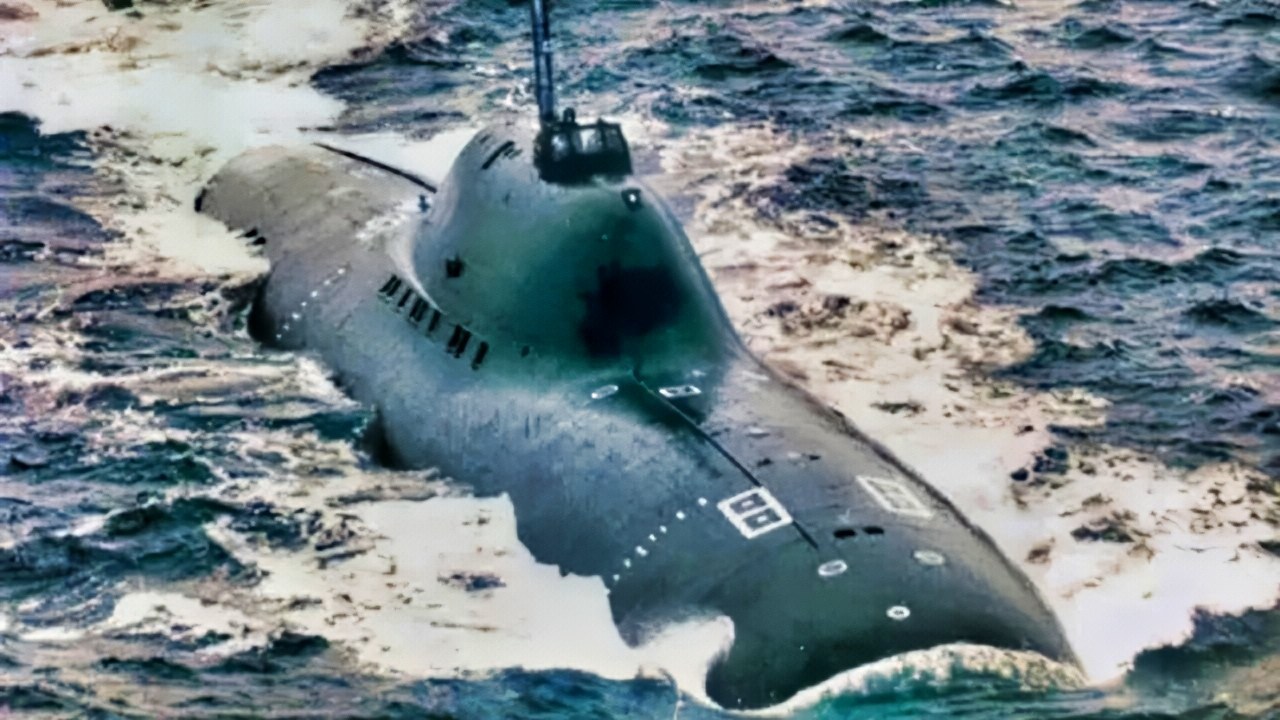
Key Points and Summary – The Sierra I-class was the Soviet Navy’s bold attempt to build an ultra-high-performance nuclear attack submarine using a titanium hull.
-Fast, deep-diving and quieter than earlier Soviet boats, the Sierra was designed to hunt NATO subs and surface ships with torpedoes and anti-ship missiles.

Akula-Class. Image Credit: Creative Commons.
-But titanium’s cost and manufacturing complexity were brutal. Specialized yards, strict inert-gas welding, and cramped internal volume left the class only marginally better than cheaper steel-hulled Akulas. With just two boats built and post-Cold War budgets collapsing, the concept stalled.
-Technologically impressive, the Sierra I ultimately became a beautiful but unsustainable dead end.
Sierra-Class: Moscow’s Exotic Hunter-Killer That Became a Dead End
The Sierra I-class was intended not to launch nuclear missiles underwater at far-off targets within the NATO alliance, but rather as a high-performance hunter-killer submarine — an attack sub.
In this role, the Sierra I-class were tasked with tracking down and sinking NATO submarines and surface ships. The submarines could fire conventional torpedoes, depth charges, and launch anti-ship and anti-submarine missiles, too.
Displacing around 8,000 tons, the Sierra I-class was not a particularly large submarine class, but its nuclear reactor gave it a high top speed of approximately 34 knots and virtually unlimited underwater endurance.
Compared to earlier Soviet submarines, the Sierra I-class was acoustically much superior. Isolating machinery from the hull, careful hull shaping, and other sound-dampening measures reduced the class’s noise levels.

Russian Akula-Class Submarine X Screenshot Image.
And while the Sierra I-class was a marked improvement over previous Soviet submarines, it was still considered louder than its contemporaries in the United States Navy, such as the Los Angeles-class. But within the Soviet Navy, the Sierra I-class was one of the best of the best, combining a respectable top speed with presumably a deep-dive capability and refined acoustic stealth measures.
Titanium Hulls
One of the Sierra-class’s most defining characteristics, however, was its hull material.
Instead of opting for the ubiquitous high-strength steel that navies across the world have relied on for building submarine hulls, the Sierra-class opted instead for a much more exotic material: titanium.
The material offers clear advantages. Not only is it less dense than steel, but it is also highly corrosion-resistant and is incredibly strong.
Compared to traditional steel, titanium offered Soviet submarine builders several on-paper advantages. In theory, a titanium-hulled submarine could have greater structural resilience — potentially diving deeper than other submarines — and would have a significantly reduced magnetic signature, making it more difficult to detect by magnetic anomaly detectors.
There was a significant drawback to the extensive use of titanium in submarine hulls. The material was costly.
And though very strong, it was very complex to manipulate, necessitating specialized manufacturing techniques and facilities.
While titanium can be machined in much the same way as steel, using the same processes and equipment, manipulation of the metal, such as refining and welding, must be done in an inert atmosphere to prevent contamination with other elements.
This often requires large facilities where the normal atmosphere we breathe is replaced with an inert gas, such as helium or argon. And while technically feasible, the titanium manufacturing process is significantly more complex than for traditional steel submarine hulls.
HI Sutton, a naval expert, has written extensively about the Sierra-class and its unique materials, and why its build characteristics were not integrated more widely into the Soviet submarine fleet.
“The SIERRA employed the Titanium hull in a way intended to be both faster and deeper diving,” Sutton explains. “But consequently neither as fast as the ALFA (40 kt+) nor as deep diving as the MIKE (1,000m+). And the end result was a boat with only a marginal performance advantage over the steel hulled AKULA, if any.”
Alfa-Class Submarine Creative Commons Image.
“In hindsight the SIERRA class was not as successful as the AKULA, and offered less potential. The titanium hull was extremely difficult to build and all boats had to be constructed at a single yard. And the yard itself restricted the maximum dimensions of the submarine. This meant it had to be much smaller than the AKULA in terms of internal space. This translated into a less stealthy boat, although the SIERRA was still very stealthy compared to previous generations.”
Due to the underlying complexity, only two Sierra I-class submarines were ever built for the Soviet Navy: the K-239 Karp and the K-276 Kostroma.
Interestingly, Sutton explains that the Sierra’s maintenance suffered more than that of other submarines. “Like most modern SSNs the [Sierra] class is covered in sonar absorbing Anechoic tiles,” he writes. “These often fall off creating a pockmarked surface and disheveled appearance. The SIERRAs suffer from this more than most other classes, possibly due to difficulty attaching the tiles to the titanium hull.”
What Happens Now?
The Sierra I-class represents a unique moment in the Soviet Navy, one in which significant material and manufacturing resources were made available to give Soviet submarines an edge.
While the Sierra I-class’s unique titanium hull certainly offered distinct advantages, the prohibitively high cost meant the material was used by only a handful of other Soviet submarines and was not introduced more widely into the Soviet Navy submarine fleet.
Though the class did lay the significant groundwork for their follow-on, the Sierra II-class, which incorporated several improvements and design tweaks, the collapse of the Soviet Union and shifting geopolitical realities in the late 1980s meant there was less interest or justification for the expensive class of submarines that, seemingly overnight, lacked a precise application.
Innovative though the Sierra I-class was, it fell victim to cost, complexity, and history.
About the Author: Caleb Larson
Caleb Larson is an American multiformat journalist based in Berlin, Germany. His work covers the intersection of conflict and society, focusing on American foreign policy and European security. He has reported from Germany, Russia, and the United States. Most recently, he covered the war in Ukraine, reporting extensively on the war’s shifting battle lines from Donbas and writing on the war’s civilian and humanitarian toll. Previously, he worked as a Defense Reporter for POLITICO Europe. You can follow his latest work on X.
More Military
The Army’s AH-64E Apache Helicopter Can Destroy Drones with Missiles
U.S. Navy Iowa-Class Battleship USS New Jersey’s ‘Comeback’ Is Now Complete
Blaze of Glory: The SR-71 Blackbird Retired Hitting Mach 3.21


