
Tomahawks, Stealth, and Shock: How the Iran Air Campaign Is Built to Win Fast – Summary and Key Points
-In the early hours of February 28, 2026, the United States and Israel launched Operation Lion’s Roar and Operation Epic Fury—coordinated strikes across Iran aimed at missile infrastructure, air defenses, naval assets, IRGC nodes, and elements of Tehran’s nuclear program.

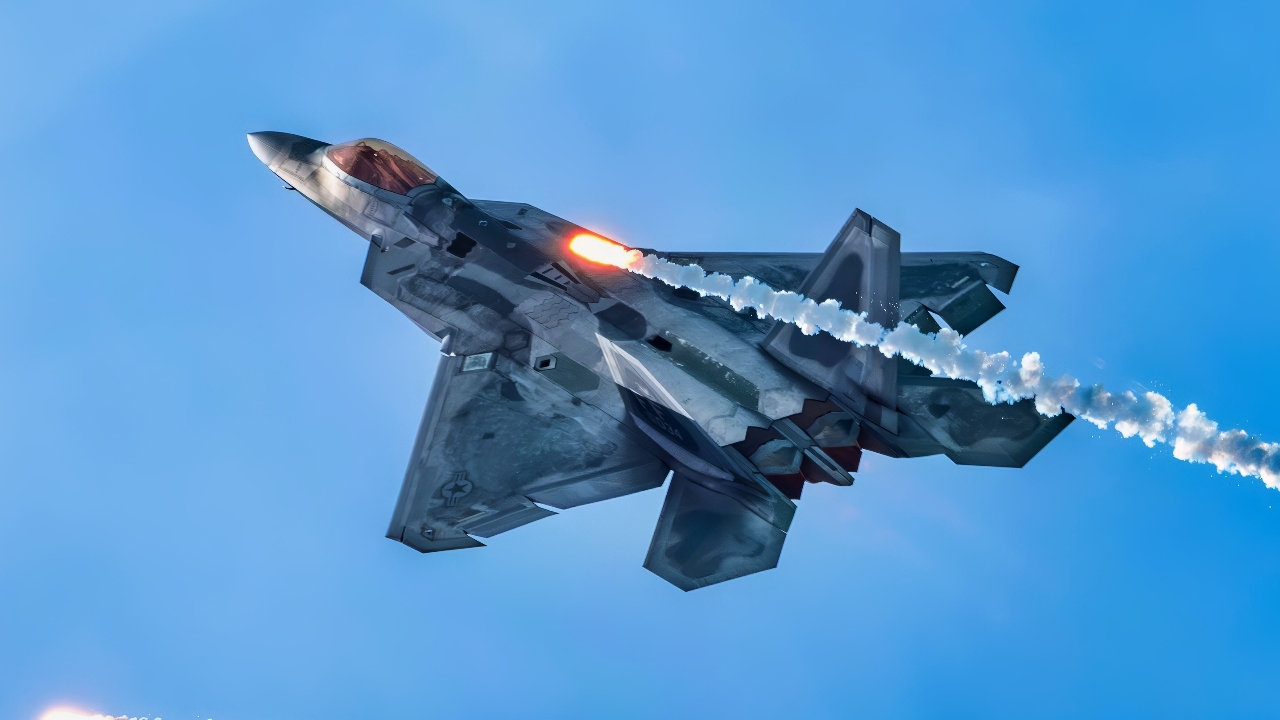
U.S. Air Force Maj. Joshua “Cabo” Gunderson, F-22 Raptor Demonstration Team commander and pilot, performs during the Orlando Air and Space Show at the Orlando Sanford International Airport, Florida, Oct. 30, 2022. The F-22A is a fifth-generation fighter incorporating fourth-generation technology, radical maneuvering capabilities, the ability to fly at supersonic speed without afterburners and unprecedented pilot situational awareness. (U.S. Air Force photo by Airman 1st Class Joshua Hastings)

U.S. Air Force Capt. Nick “Laz” Le Tourneau, F-22 Raptor Aerial Demonstration Team commander, performs an aerial maneuver during the Hyundai Air and Sea show at Miami, Florida, May 25, 2025. The F-22 Aerial Demonstration Team highlights cutting-edge airpower, precision, skill, all while reinforcing public confidence in the Air Force’s ability to protect and defend. (U.S. Air Force photo by Staff Sgt. Lauren Cobin)
-President Trump framed the campaign as major combat operations driven by an imminent threat, urging Iranian civilians to shelter and calling on the public to seize the moment to take control from the regime.
-Iran’s response has included missiles and drones aimed at Israel and U.S. facilities across the region.
-The campaign is presented as a contained, multi-day pressure operation designed to neutralize Iran’s strategic leverage and enable internal political change.
Why Trump Hit Iran Now—and What Comes Next
In the early hours of February 28, 2026, the United States and Israel launched coordinated military strikes against targets in the Islamic Republic of Iran, marking the most significant escalation in U.S.-Iranian hostilities in decades. Explosions were reported across Tehran and other urban centers shortly after midnight local time – strikes that marked the beginning of a potentially short campaign that President Donald Trump has described as “major combat operations” against the Iranian regime.
President Trump announced the offensive in a video posted to his social media platform in the early hours of the morning, describing the strikes as a necessary strategic response to imminent threats posed by Tehran’s nuclear and ballistic missile programs. In the address, Trump said U.S. forces had begun “massive and ongoing” military action and acknowledged that American casualties were likely. Trump’s framing of the operation was markedly different than his announcement of military operations in Venezuela in January – an operation that lasted only hours.
“The lives of courageous American heroes may be lost, and we may have casualties,” Trump said, adding, “That often happens in war.”
The operation, a joint campaign with Israeli forces, has been dubbed “Operation Lion’s Roar” and Operation Epic Fury. It is the culmination of extensive planning by the Israel Defense Forces in coordination with the Pentagon.
Explosions have been witnessed throughout Tehran, with additional reported strikes in other Iranian cities.

Iran F-14 Tomcat Fighter. Image Credit: Creative Commons.

Iran Missiles. Image Credit: Creative Commons.
In his statements, Trump framed the strikes as defensive in nature, noting that U.S. forces were narrowly targeting Iranian missile infrastructure and working to degrade the country’s naval capabilities and, therefore, eliminating the threat posed by Iran to the United States and its regional allies. Trump appealed directly to the Iranian public, urging civilians to “stay sheltered” during the bombardment and telling them that, once the military phase was complete, they should seize the moment to “take over your government” – language that suggests Washington does not expect a protracted ground operation in the country. Trump also promised that soldiers who lay down their weapons would be granted “complete immunity.”
Israeli Prime Minister Benjamin Netanyahu also released a statement asserting that Tel Aviv and Washington had acted to remove what he described as an existential threat posed by the Islamic Republic’s leadership and military apparatus. According to that statement, the coordinated strikes were intended to blunt Iran’s ability to project power regionally and to prevent further progress in terms of Iran’s nuclear program.
The strikes follow months of growing tensions with Iran, diplomatic efforts that have failed to produce a binding agreement curbing Iran’s nuclear and missile development, and the deployment of two U.S. carrier strike groups near Iran. Negotiations in Geneva ended without agreement, even as Oman and other intermediaries sought to bridge differences on the limitations of Tehran’s programs.
What Is Happening Now
The operation began with a mixed salvo designed to hit Iran fast and from multiple directions.
According to U.S. officials cited by U.S. media outlets, the initial U.S. strike package included sea-launched Tomahawk cruise missiles and air-launched missiles fired from U.S. Air Force and Navy jets. Those officials indicated that the strikes were the beginning of what is likely to be a multi-day pressure campaign that will run through at least the weekend.
What began in the early hours was not a quick decapitation raid as we saw in Venezuela, but a structured and sustained strike sequence that saw stand-off weapons launched from ships, followed by air strikes and then repeated waves of additional strikes designed to keep Iranian launch infrastructure under constant pressure while the U.S. and regional partners attempted to blunt retaliation. Iran’s air force may be outdated, but it does have the largest and most diverse ballistic missile arsenal in the Middle East, with more than 3,000 missiles capable of reaching targets up to 2,000 km away.

Iran’s missile capabilities. Image Credit: Creative Commons.
Reporting so far indicates that the first coordinated strikes hit a broad array of Iranian military and governmental infrastructure rather than being limited to a narrow set of targets. According to multiple international reports, explosions were observed not just in Tehran, but also in other major cities, including Isfahan, Qom, Karaj, and Kermanshah, consistent with a planned campaign against Iranian missile sites, command and control facilities, and elements of the Islamic Revolutionary Guard Corps (IRGC). Satellite imagery released in the aftermath showed extensive damage to buildings at several key facilities, including structures near Iran’s supreme leader’s compound.
Within hours of the opening strikes, Iranian forces began their response. The Islamic Revolutionary Guard Corps announced multiple waves of ballistic missiles and drones had been fired toward both Israeli territory and U.S. military bases across the Middle East, according to reports citing the Iranian military and regional defense officials. Iran’s retaliation was wide-ranging, targeting government and coalition facilities in Jordan, Kuwait, Qatar, Bahrain, and the United Arab Emirates – countries that all host significant U.S. military assets.
State media and unnamed Gulf defense sources reported that in Abu Dhabi, the United Arab Emirates, a missile strike resulted in at least one civilian fatality and widespread damage from debris, while Bahrain confirmed that a U.S. Fifth Fleet service centre was struck. Air defense systems in Kuwait and Qatar reported multiple interceptions of incoming missiles.
The Threat Iran Poses
The strikes did not occur in a vacuum. They follow Operation Midnight Hammer in June 2025, when U.S. forces struck Iranian nuclear sites at Fordow, Natanz, and Isfahan in a limited offensive designed to destroy Tehran’s nuclear infrastructure. That operation significantly damaged enrichment facilities and set back Iran’s program by approximately two years, according to Pentagon assessments at the time.
In parallel with that military pressure, the United States engaged Tehran in a series of indirect nuclear negotiations throughout 2025 and into early 2026, primarily mediated through Oman and European partners.

A U.S. Sailor, assigned to Airborne Command and Control Squadron 124, signals the launch of a Carrier Air Wing 8 E-2D Hawkeye aircraft on the flight deck of the world’s largest aircraft carrier, Ford-class aircraft carrier USS Gerald R. Ford (CVN 78), while underway in the Caribbean Sea, Nov. 29, 2025. U.S. military forces are deployed to the U.S. Southern Command area of responsibility in support of Operation SOUTHERN SPEAR, Department of War-directed operations, and the president’s priorities to disrupt illicit drug trafficking and protect the homeland. (U.S. Navy photo)
Washington’s chief demands included transferring enriched uranium abroad, halting enrichment that could bring Tehran close to weaponization, constraining ballistic missile development, and limiting support for regional armed groups. Iran repeatedly insisted its program was peaceful, resisted the most stringent U.S. demands, and insisted that enrichment was its sovereign right. Despite efforts from Washington, Tehran refused to ship the remaining uranium out of the country and still sought sanctions relief.
U.S. negotiators had at times set deadlines for concessions, including 10- to 15-day windows in which Tehran was expected to accede to key terms – periods that repeatedly lapsed without agreement and were followed by a U.S. military build-up in the region.
That U.S. pressure is a direct response to the threat that Iran poses to Israel, the West, and America’s posture in the Middle East. A nuclear-armed Iran with intercontinental ballistic missiles (ICBMs) would effectively render U.S. power projection far less effective, undermining deterrence and emboldening Tehran’s proxies across the Levant and beyond.
North Korea Nuclear Program Example
Compare the situation to that of North Korea – another extreme and isolated state forging ties with anti-Western forces. Once Pyongyang crossed the nuclear threshold and paired that capability with long-range missile development, U.S. options narrowed dramatically, and the debate in Washington therefore changed. The focus shifted from stopping the program to containing the threat. The United States cannot afford to allow Iran to reach that same position.
An argument could be made that North Korea’s primary strategic objective is to ensure its regime’s survival. Its nuclear arsenal is primarily a shield – but Iran’s posture is different. Over the past decade, Tehran has expanded its ballistic missile inventory, armed and funded proxy militias across Iraq, Syria, Lebanon, and Yemen, and deepened its strategic ties with both Russia and China. U.S. intelligence assessments and international watchdog reports have repeatedly cited Iranian non-compliance, undeclared enrichment activity, and obstruction of inspectors during and after the Obama-era nuclear framework. The collapse of recent negotiations – and Tehran’s refusal to transfer enriched material abroad – reinforce the view in Washington that Iran was once again buying time rather than abandoning its nuclear plans.

Hwasong-20 ICBM. Image Credit: North Korea State Media.
With that in mind, the stakes here are very real. An Iran with a survivable nuclear deterrent and advanced missile capabilities that go beyond its current short- and medium-range missile arsenal would significantly constrain U.S. military leverage in the Middle East. It would complicate Israeli defense planning, embolden regional proxies, and reduce the credibility of American security guarantees to Gulf partners. A decision to simply “stay out of Iran,” as some Republicans and European political figures argue, would be the right move, would guarantee this future, and grant an enormous amount of power and influence to one of the most dangerous Islamic powers in the world.
This Won’t Be A Protracted War
This is not Iraq in 2003 or Afghanistan in 2001, despite what some Western commentary might want readers to believe.
Claims that we are on the verge of a long and protracted war are the result of lingering trauma from the Bush era, with some critics even claiming that the strikes risk “destabilizing” Iran. But Iran is not a stable status quo power. It is a state under heavy sanctions, internally repressive and regionally aggressive, and already engaged in proxy conflicts across the Middle East. These strikes are designed to stabilize the region and, as Trump has made quite clear, give power to the Iranian people to take over their government in what he described as a once-in-a-generation opportunity.
Warfare has changed since the 2000s. Precision stand-off munitions and layered missile defenses, persistent ISR, and real-time targeting networks all mean that the United States and Israel can strike with far greater accuracy than in previous decades. Iran’s response options are also hugely constrained: it can fire missiles and activate proxies, yes, but it cannot conventionally match U.S. air and naval power. Even its asymmetric tactics – perhaps the use of Midget submarines against naval forces, for example – carry the risk of an overwhelming military response that Iranian forces simply cannot defend against.
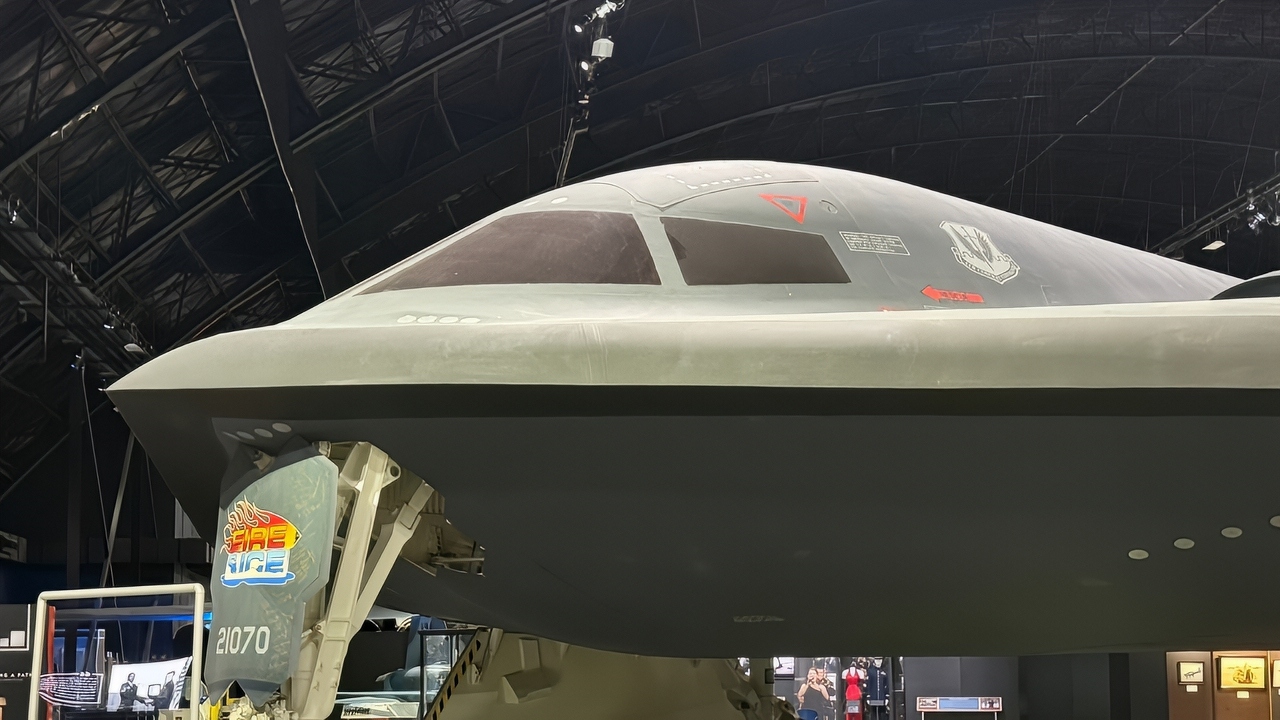
Really Close Up of B-2 Bomber in Dayton, Ohio Museum. Image Credit: National Security Journal Image.
Domestic politics matter here, too. With the midterm elections approaching, President Trump is unlikely to risk a drawn-out regional war that could paralyze his ability to achieve anything in the final two years of his presidency. The decision to strike suggests that he and the Pentagon are confident the campaign can remain contained and will be successful within days.
If the current momentum continues, the United States appears capable of neutralizing the bulk of Iran’s remaining strategic military leverage and preventing further nuclear and missile development – and allowing the Iranian people to chart a different course.
About the Author:
Jack Buckby is a British researcher and analyst specialising in defence and national security, based in New York. His work focuses on military capability, procurement, and strategic competition, producing and editing analysis for policy and defence audiences. He brings extensive editorial experience, with a career output spanning over 1,000 articles at 19FortyFive and National Security Journal, and has previously authored books and papers on extremism and deradicalisation.


zhduny
February 28, 2026 at 11:02 pm
In 1989, the US invaded panama, employing F-117 stealth fighters and troopers who fired at civilians, thus causing people to describe it as the prelude to Iraq.
The same US president went on to fight Iraq. In 1991. Employing space assets and using depleted uranium ammo.
Then, in 2003, the US again attacked Iraq, employing rumsfeld’s shock and awe warfare.Children playing in local playground and parks were left mangled and crippled.
About a million Iraqis died as a result, plus creating 5 million orphans. Many of them trafficked into unknown hands.
Now, another US president is revisiting the old military playbook, employing tomahawk missiles and bombs, blasting schools and residential areas, and boasting about regime change.
Is that the template for the coming war, the ‘high-end’ war or ww3. The war to end all wars.
Let’s hope everyone is prepared. World war three this year, possible, likely unavoidable, now, today.
Fred T Adams
March 2, 2026 at 12:20 pm
We must eliminate Iran’s nuclear research and production facilities. I doubt this can be accomplished from the air with full assurance. JDAMs and other bombs can be used with good effect to target the known installations. But boots on the ground are needed to enter these facilities and assess whether the objective has been accomplished, and, if necessary, complete it. The question of where and whether there are nuke facilities unknown at present can be answered only by careful observation and on-the-ground intelligence.
Command echelons of the IRGC must be eliminated. They are undoubtedly being attacked, likely with good success. Whether Iranian planning has included significant underground facilities as in Gaza I don’t know. Again, boots on the ground are necessary for assessment and mission completion.
The hope that “the Iranian people” will rise and form a defensible government is likely a vain one. Armed and organized forces, regardless their ideology, will reign. It occurs to me that one likely candidate is the remnants of the IRGC. Other armed and organized forces may come from outside the country. That said, Iran is not a warlord society like Afghanistan and pre-Mao China. As I understand it, Iranians civilians are unarmed.
The US and Israel can’t just destroy Iran’s entire defensive capability and leave. Iran would in that case be left at the mercy of the strongest aggressors. Turkey and Syria might seek a controlling role there, even China, after the initial US/Israeli attacks have accomplished their purpose.
Successful revolution requires successful succession. The US and Israel will want an independent Iran that is a peaceful ally and also a capable ally. That can’t be achieved without a great deal of planning, boots on the ground, and focused effort. President Trump has masterfully handled this phase. But he can’t just leave it to the Iranian people after that, or the succession will fall into enemy hands.
I know that these points are known and agreed by the President and his circle of advisors. I’m hoping that the President, realist that he is, has planned for post-Khamenei Iran.