

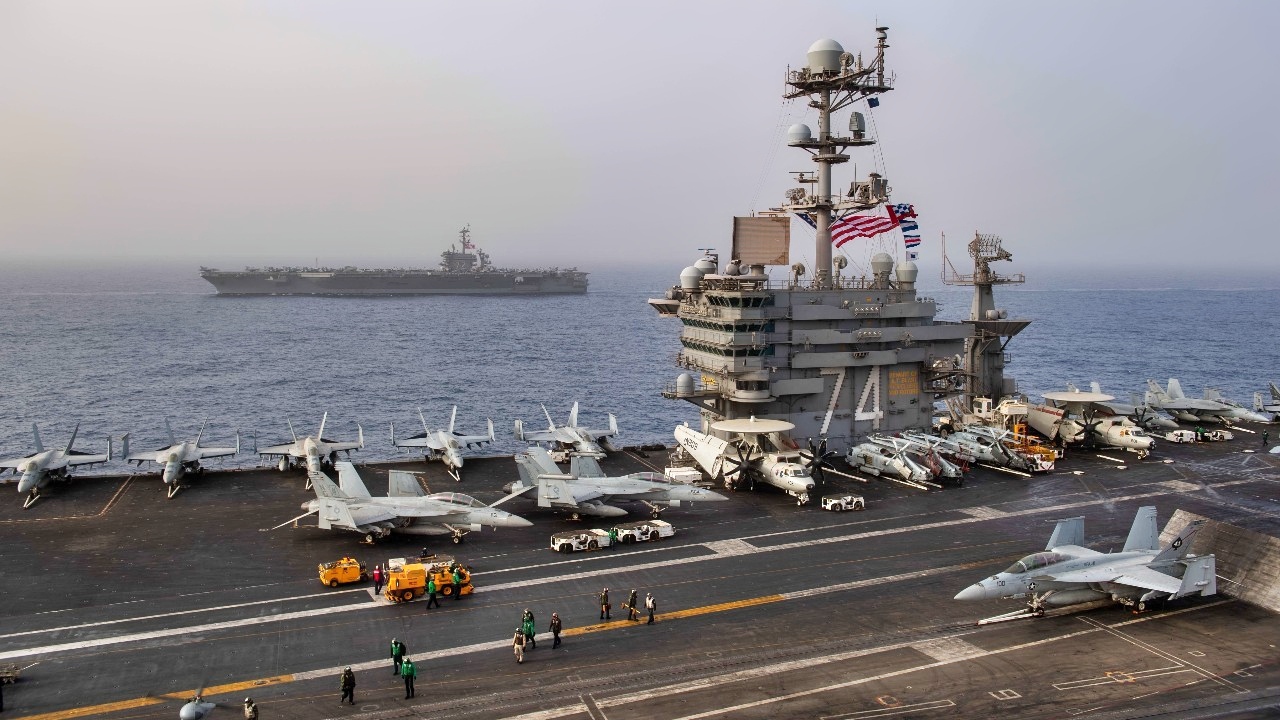
Key Points and Summary – Sinking a modern American aircraft carrier is an incredibly difficult task due to its formidable, multi-layered defense system.
-The carrier itself is a massive, mobile, and heavily armored warship at the center of a Carrier Strike Group (CSG) that includes Aegis-equipped cruisers and destroyers, attack submarines, and a powerful air wing of F/A-18 and F-35 fighters.
-While threats from advanced anti-ship ballistic missiles from adversaries like China and Russia are real, successfully penetrating this dense shield of interceptors, electronic warfare, and combat air patrols to land a fatal blow remains a monumental challenge for any navy.
Sinking a Navy Aircraft Carrier Is Close to Impossible: Here’s Why
In recent years, the role of aircraft carriers in modern warfare has become a contentious topic in certain defense circles. Some argue that carriers will always be relevant, regardless of age, while others contend that modern missiles render carriers obsolete.
This raises an ever-important question: How difficult is it to sink an aircraft carrier?
Despite the advancement of weaponry, American aircraft carriers are, unsurprisingly, quite difficult to hit due to their multi-layered defense structure.
Carriers Don’t Sink Easy
To begin with, the sheer size and construction of a U.S. aircraft carrier make it incredibly difficult to destroy. A Nimitz-class carrier displaces over 100,000 tons and stretches more than 1,000 feet in length. The newer Ford-class carriers are even more advanced.
These ships are built with multiple layers of armor, watertight compartments, and redundant systems designed to keep them afloat and operational even after sustaining damage. Their nuclear propulsion systems allow them to operate for decades without refueling, giving them unmatched endurance and mobility. This mobility makes them moving targets, which are far harder to hit than stationary ones.
But the carrier itself is only part of the equation. It is the centerpiece of a Carrier Strike Group (CSG), a powerful naval formation that includes guided missile cruisers, destroyers, submarines, and supply ships. These vessels form a multi-layered shield around the carrier, providing defense against threats from the air, sea, and undersea. The cruisers and destroyers are equipped with the Aegis Combat System, which integrates radar and missile systems to detect and intercept incoming threats. Submarines patrol beneath the surface to detect and neutralize enemy subs, while supply ships ensure the group can remain at sea for extended periods.
The Multi-Layered Defense Structure
The carrier’s own air wing adds another formidable layer of defense. Aircraft such as the F/A-18 Super Hornet and the F-35C Lightning II conduct combat air patrols, intercepting enemy aircraft and missiles before they can get close. These jets are supported by electronic warfare aircraft like the EA-18G Growler, which can jam enemy radar and communications. Surveillance aircraft and drones extend the carrier’s situational awareness, allowing it to detect threats at great distances.
In addition to these active defenses, the ships in the strike group are equipped with a variety of missile defense systems. These include long-range interceptors like the SM-2 and SM-6, medium-range systems like the Evolved Sea Sparrow Missile (ESSM), and close-in weapon systems (CIWS) such as the Phalanx and SeaRAM, which are designed to shoot down incoming missiles at the last moment. This layered defense makes it extremely difficult for any single weapon to reach the carrier, let alone cause enough damage to sink it.
Carriers Are Not Invincible
Despite these formidable defenses, there are theoretical scenarios in which a carrier could be sunk. One possibility is a submarine attack. A stealthy enemy submarine might be able to get close enough to launch torpedoes or anti-ship missiles.
Russia is particularly threatening in this regard, possessing a sizeable fleet of highly stealthy deep-water submarines. However, this is easier said than done. The U.S. Navy invests heavily in anti-submarine warfare, using aircraft like the P-8 Poseidon, sonar-equipped ships, and its own submarines to detect and track enemy subs. The ocean is vast, and finding a moving carrier without being detected is a monumental challenge.
Another potential threat comes from long-range missiles, particularly those designed to target ships at sea. China’s DF-21D and DF-26 ballistic missiles, often referred to as “carrier killers,” are designed to strike moving naval targets from thousands of miles away. In theory, a coordinated barrage of such missiles could overwhelm a carrier’s defenses and leave it vulnerable. Hypersonic missiles also pose a massive threat to aircraft carriers.
Both Russia and China have been investing heavily into hypersonic missiles that can, in theory, bypass enemy air defenses through their speed and maneuverability.
Other Methods of Disabling Carriers
Air attacks are another theoretical method of sinking a carrier. A large-scale assault involving bombers or fighter jets could potentially inflict serious damage. But again, the carrier’s air wing and the strike group’s defenses make this a high-risk endeavor. Any attacking aircraft would have to penetrate multiple layers of radar and missile defense, and even if they succeeded, they would likely face devastating retaliation.
Cyber and electronic warfare present more modern threats. A sophisticated cyberattack could, in theory, disrupt a carrier’s systems or communications. However, U.S. carriers are hardened against such threats and have manual overrides for critical systems. Electronic warfare might degrade sensors or communications, but it is unlikely to cause physical damage or sink the ship.
Sinking an Aircraft Carrier is Possible but Incredibly Hard
Historically, no U.S. aircraft carrier has been sunk in combat since World War II. During that era, carriers were vulnerable to torpedoes and bombs, but modern carriers are vastly more advanced. In military simulations and war games, carriers have been “sunk” under specific conditions, but these often involve unrealistic assumptions, such as the carrier being stationary, unaware, or stripped of its defenses. In real-world conditions, these scenarios are highly unlikely.
To successfully sink a U.S. aircraft carrier, an adversary would need to locate it with precision, coordinate a massive and sustained attack, penetrate multiple layers of defense, and inflict catastrophic damage, all while avoiding detection and retaliation.
Few nations have the capabilities to achieve all of these conditions. As seen in the Red Sea, even with asymmetric tactics, the Houthi’s were unable to hit a carrier, let alone sink it. The only states that are likely capable of sinking a carrier are China and maybe Russia with their large stockpiles of missiles that can overwhelm a CSG’s defense layers.
About the Author:
Isaac Seitz, a Defense Columnist, graduated from Patrick Henry College’s Strategic Intelligence and National Security program. He has also studied Russian at Middlebury Language Schools and has worked as an intelligence Analyst in the private sector.
Russia’s Bomber Forces
Tu-22M3: The Bomber Ukraine Hit With Drones


