


Key Points and Summary – The 1975 mutiny that inspired The Hunt for Red October had a radically different motive than the fiction it spawned.
-The real-life figure was Valery Sablin, a Soviet naval political officer and fervent Communist.

Russia’s Typhoon-Class Submarine. Image Credit: Creative Commons.
-Believing the Brezhnev regime was corrupt and had betrayed Leninism, Sablin seized his frigate, the Storozhevoy, not to defect, but to sail to Leningrad and broadcast a call for a new, purer revolution. The Soviet leadership, fearing a high-profile defection to the West, scrambled the Baltic Fleet.
-Soviet jets located and bombed the ship, stopping the mutiny. Sablin was captured, tried for treason, and executed.
The Real Hunt for Red October
The Hunt for Red October is a fantastic book and film. Written by Tom Clancy, the story centers around a Soviet submarine captain, Marko Ramius, who is given command of an advanced submarine but decides to defect to the West.
It is a fantastic film (even today, it is probably the most accurate depiction of submariners ever put out by Hollywood).
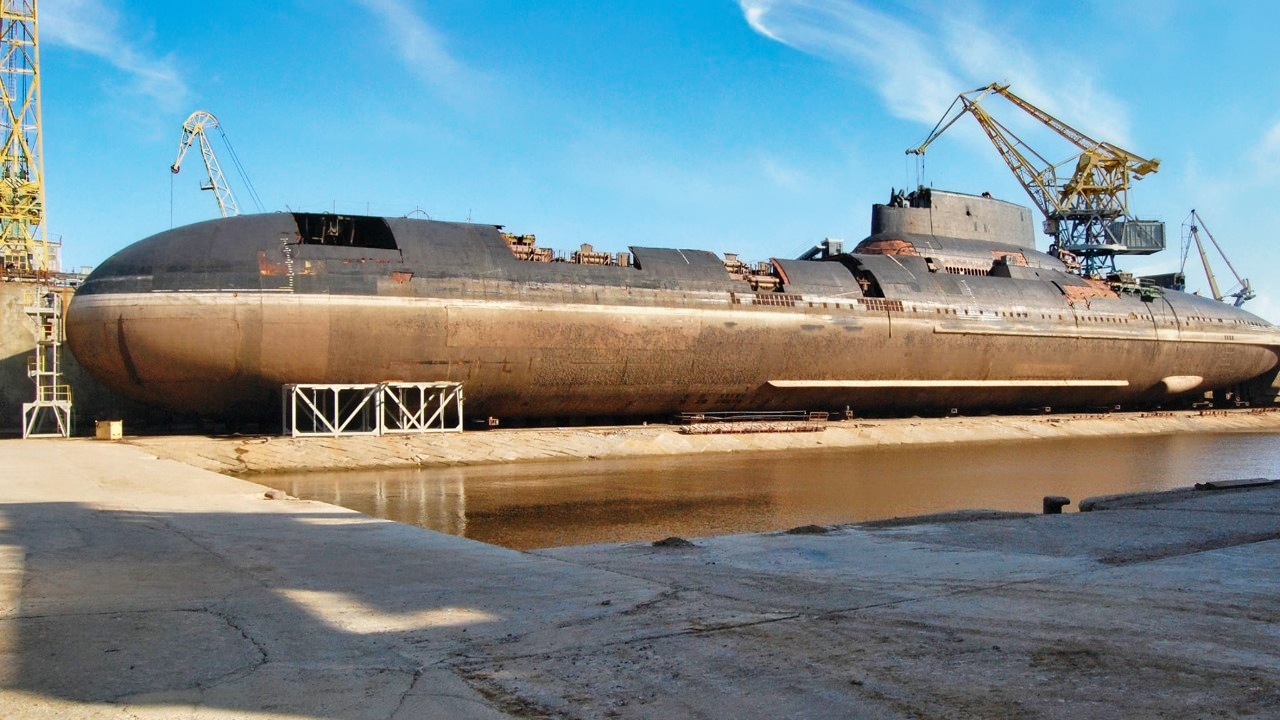
Typhoon-Class Submarine. Image Credit: Creative Commons.

Typhoon-Class. Image Credit: Creative Commons.
However, what most people don’t realize is that Tom Clancy was himself inspired by a real Soviet mutiny in which a Soviet Captain of the Third Rank staged a mutiny and seized control of a missile frigate.
Sablin and the Brezhnev Era
Valery Sablin was born in 1939 into a family with a strong naval tradition. His father and grandfather were naval officers, and Sablin followed in their footsteps, graduating from the Frunze Military Maritime Institute in 1960.
He was a committed Communist, joining the party as a cadet and later attending the Lenin Military Political Academy, where he graduated with honors. Sablin’s belief in the ideals of the 1917 Bolshevik Revolution, justice, equality, and transparency, remained steadfast even as he witnessed the growing privilege and corruption among the Soviet elite.
By 1973, Sablin had become the political officer (Zampolit) aboard the Storozhevoy, a Krivak-class anti-submarine frigate stationed in Riga.
His role was to ensure ideological conformity among the crew, but Sablin quietly cultivated dissent from his position. He believed the Soviet Union had strayed far from Leninist ideals and saw the Brezhnev regime as emblematic of stagnation and betrayal of the revolution.
The Mutiny Begins
The mutiny was carefully timed to coincide with the 58th anniversary of the October Revolution on November 7, 1975. With half of the Storozhevoy’s 250-man crew on shore leave, Sablin seized the opportunity.
On the evening of November 8, he lured the ship’s captain, Anatoly Potulny, into the forward sonar compartment under the pretense that officers were drunk. Once inside, Sablin locked him in and declared his intentions: to sail the ship to Leningrad and broadcast a revolutionary message from Kronstadt Island, a historic site of past naval uprisings.
Unlike Ramius in Hunt for Red October, Sablin’s plan was not to defect but to spark a new revolution within the Soviet Union.
He envisioned a return to Leninist purity and hoped his actions would inspire others in the military and beyond. The crew’s reaction was mixed. A vote was held using black-and-white checker pieces, resulting in a tie. Nevertheless, Sablin and his loyalists locked dissenting officers in their cabins and took control of the ship.
The Journey and Soviet Response
At around 2:00 AM on November 8, the Storozhevoy quietly departed Riga, heading toward the Irben Channel and the open Baltic Sea.
Sablin managed to operate the vessel effectively, sailing at 30 knots with its lights off to avoid detection.
The alarm was raised when a conscript not aligned with Sablin jumped overboard and swam to shore, eventually reaching the naval headquarters to report the mutiny.
Initially, Soviet authorities were slow to respond. Still, panic set in when an emergency radio message, “Mutiny onboard the Storozhevoy, we are heading for the open sea,” was intercepted, even by Swedish forces.
Fearing a defection similar to the 1961 incident involving Lithuanian Captain Jonas Plaskus, the Soviet leadership, including Premier Leonid Brezhnev, authorized lethal force to prevent the ship from reaching international waters.
Almost the entire Baltic Fleet was mobilized, and over 60 aircraft, including Tu-16 bombers and Yak-28 jets, were dispatched to intercept the Storozhevoy.
The Attack and Capture
Dense fog initially shielded the Storozhevoy, but radar emissions eventually gave away its position.
In a tragic case of mistaken identity, Soviet jets bombed a freighter bound for Finland, thinking it was the mutinying ship.
When the Storozhevoy was finally located, Yak-28 jets strafed it with cannon fire, and a bomb struck the stern, damaging the steering mechanism and causing the ship to circle helplessly just 50 nautical miles from Swedish waters.
Amid the chaos, three crew members freed Captain Potulny, who shot Sablin in the leg and retook control of the bridge.
At 10:32 AM, he sent a message: “The ship is stopped. I have taken control.” The attack was aborted, and Soviet marines boarded the vessel, arresting the crew.
Aftermath and Legacy
The Soviet government quickly covered up the incident, staging naval exercises the next day to divert attention. Casualty reports vary, but one crew member later claimed fewer than fifteen were killed or wounded.
Most of the crew faced months of detention, though only a few were formally tried. Sablin was convicted of treason and executed by firing squad on August 3, 1976. His second-in-command, Alexander Shein, received an eight-year prison sentence.
In 1994, Sablin’s case was posthumously reviewed, and his treason charge was commuted to lesser military offenses, though the original sentence was upheld.
His grave remains unmarked, a silent testament to the Soviet regime’s desire to erase his legacy.
Sablin’s Place in History
Valery Sablin’s mutiny was not a betrayal of the Soviet Union but a desperate attempt to save it from itself. Unlike Tom Clancy’s fictional Marko Ramius, who sought asylum in the West, Sablin was a true believer in communism.
His rebellion was rooted in idealism, not just disillusionment. He hoped to reignite the revolutionary spirit and restore the values he believed had been corrupted.
Sablin reflected how many in the Soviet Navy thought during the Brezhnev era. Many were disillusioned not because of communism, but because the regime had strayed away from its original communist values (their beliefs, not mine).
The Brezhnev era can be defined as stable but decadent. Corruption was rampant at the top, and the black market was thriving. While it was preferable to Stalin’s terror, many ardent communists like Sablin believed that the regime had strayed too far from the bread, peace, and work preached by Lenin.
About the Author: Isaac Seitz
Isaac Seitz, a Defense Columnist, graduated from Patrick Henry College’s Strategic Intelligence and National Security program. He has also studied Russian at Middlebury Language Schools and has worked as an intelligence Analyst in the private sector.
More Military
The Air Force Only Has 19 B-2 Spirit Stealth Bombers
Why the U.S. Navy Needs Lasers for an ‘Infinite Magazine’
U.S. Navy F/A-18 Super Hornet Fighter: How Hard Is It To Fly?
Unstoppable: Delta Force Is the Very Best Special Forces Unit on Planet Earth
Could a U.S. Navy Nuclear Aircraft Carrier Tip Over In a Storm?


