


Key Points and Summary – The French Air Force has released a viral video showing one of its Dassault Rafale fighters achieving a simulated “kill” against a U.S. F-35A during a recent multinational dogfighting exercise.
-The footage from the Atlantic Trident 25 exercise shows the 4th-generation Rafale achieving a radar lock and declaring a shot.
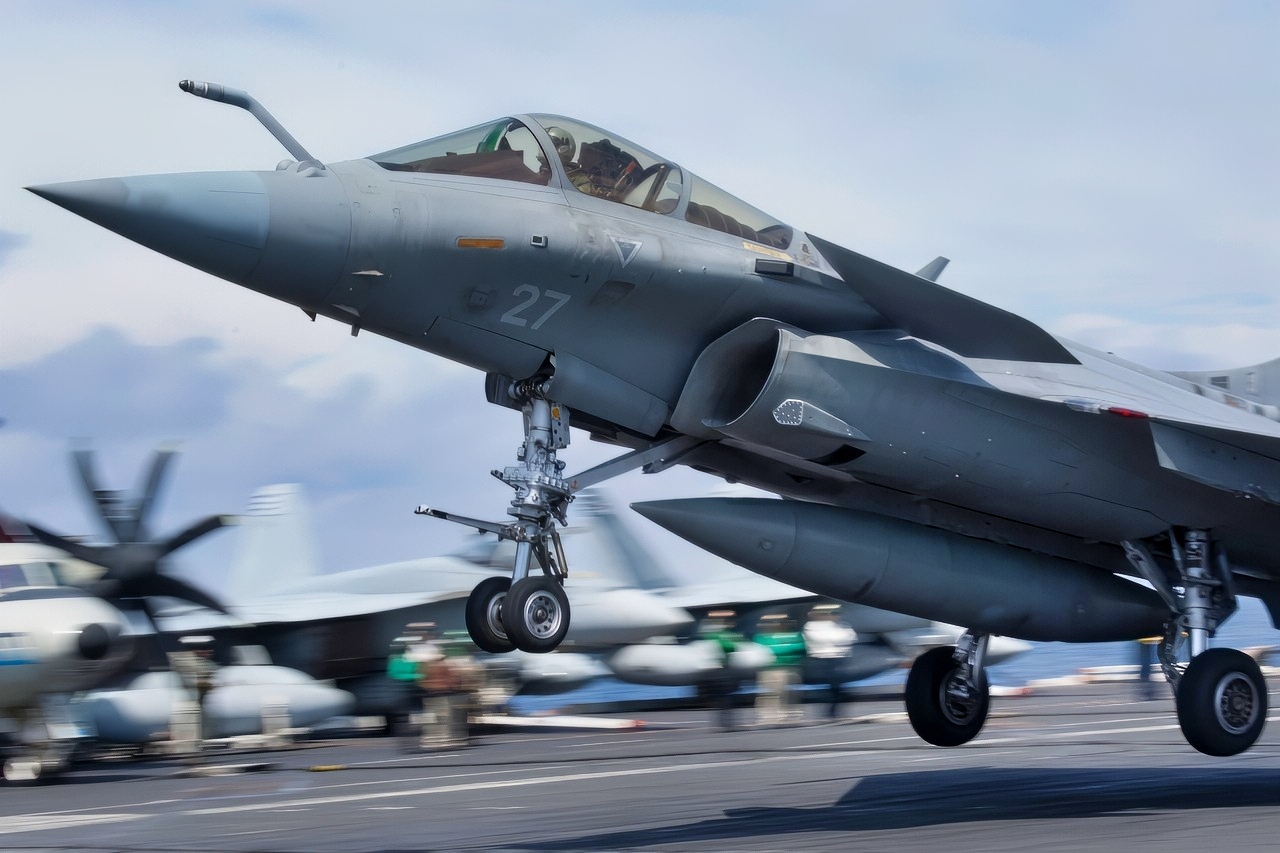
(July 3, 2018) A French Dassault Rafale M Fighter touches down on the flight deck aboard the Nimitz-class aircraft carrier USS Harry S. Truman (CVN 75). Harry S. Truman is currently deployed as part of an ongoing rotation of U.S. forces supporting maritime security operations in international waters around the globe. (U.S. Navy photo by Mass Communication Specialist 3rd Class Rebekah A. Watkins/Released)
-While the clip has sparked debate, experts caution that the engagement was a short-range, within-visual-range scenario.
-The F-35 is primarily designed for beyond-visual-range combat, where its stealth and advanced sensors give it a decisive advantage that isn’t reflected in a close-quarters dogfight.
Dassault Rafale Wins a Fighter Against the F-35 Fighter?
WARSAW, POLAND – On August 20, 2025, the French Air Force (Armée de l’air) published a 44-second video on its official X account (@Armee_de_lair) that has generated a myriad of reactions among military and aviation analysts, particularly those in the low-observable/stealth community.
These engagements took place this past June during the Atlantic Trident 25 multinational military exercise in Finland. The results of these one vs one shootouts may give a boost to the public image of the Rafale, which received some adverse publicity earlier this year. In the French Air Force video, a Rafale is seen achieving a radar lock against the F-35A before an audio transmission of “take the shot” is heard, indicating that the pilot has declared a simulated missile shot.
In another segment of the video, the Rafale is also seen achieving target lock on a Finnish Air Force F-18C/D twice. Both of these engagements occurred during this live, multinational exercise, which featured close air combat (CAC) dogfights.
Over 40 aircraft and approximately 1,000 military personnel participated in this exercise, featuring a mix of current-day and legacy aircraft.
In addition to “killing” the F-35, the Rafale was also shown winning engagements against a US Air Force (USAF) F-15E and a Finnish F/A-18C/D, also in simulations.
F-35: Short Range v. Long Ball
Although the video has since gone viral, combat aviation experts have come forward to remind those declaring the Rafale has shown superior performance that these results demonstrate only simulated short-range combat (CAC). The F-35 is designed to first and foremost score its kills in beyond visual range (BVR) air-to-air engagements, they say.
Within that long-range engagement envelope, sensors—particularly the advanced Active Electronic Scanning Array (AESA) radar, stealthy airframe design, and network integration—give the F-35 a decisive edge. However, the loss-kill results from (BVR) simulations from this exercise were not made public.
This is also not the first symbolic “kill” of a 5th-generation US fighter by the Dassault Rafale. In 2009, during exercises in the Middle East, the French twin-engine fighter also scored a simulated victory over an F-22 Raptor.

Dassault Rafale Fighter in India. Image Credit: Creative Commons.
Combat aviation specialists who spoke to National Security Journal and who had consulted with the producers of the 2022 film Top Gun: Maverick recounted the history of how the F/A-18E/F Super Hornet became the aircraft that took the place of the F-14 Tomcat occupied in the original Top Gun film, rather than the US Navy F-35C.
There were several reasons, said one consultant, not the least of which was that “there are no two-seat F-35 aircraft,” which means there is no way to film the actors in actual flight in a live cockpit.
“But another more compelling reason is that when the film makers asked about how to shoot close-in dogfighting sequences with the F-35 they were told ‘this aircraft does not dogfight—it kills the bad guys from miles and miles away’. This would have made for a fairly boring movie,” he recalled.
The Dassault Rafale in Action
After the disputed results and the claimed loss of at least one Rafale from this past May’s engagements between the Indian and Pakistan Air Forces, the question has been asked whether or not the Rafale would be effective against the latest Chinese fighter designs like the Chengdu J-20 and Shenyang J-35.
The fact is, said a retired Dassault executive, that “those questioning the Rafale’s combat capability forget just how long the aircraft has been around, how Dassault was one of the first aircraft design companies to seriously mitigate the aircraft’s signature by treating the inlets with radar absorbing materials, how it was one of the first aircraft to have an electronically-scanning array radar, and so on.”
“These and other features of Rafale make it more than a match for these US aircraft within the visual range part of the engagement envelope,” he continued.
However, there is one aspect of the aircraft that has always been its weak point: the slightly underpowered SAFRAN M-88 engine.
This is a design shortcoming that is now being addressed with the new M-88 T-REX, a higher-thrust version of the engine, which the engine’s designers state will bring significant performance improvements to the Rafale.
About the Author: Reuben F. Johnson
Reuben F. Johnson has thirty-six years of experience analyzing and reporting on foreign weapons systems, defense technologies, and international arms export policy. Johnson is the Director of Research at the Casimir Pulaski Foundation. He is also a survivor of the Russian invasion of Ukraine in February 2022. He worked for years in the American defense industry as a foreign technology analyst and later as a consultant for the US Department of Defense, the Departments of the Navy and Air Force, and the governments of the United Kingdom and Australia. In 2022-2023, he won two awards in a row for his defense reporting. He holds a bachelor’s degree from DePauw University and a master’s degree from Miami University in Ohio, specializing in Soviet and Russian studies. He lives in Warsaw.
More Military
The B-21 Raider Is So Much More Than a Bomber


JL
August 27, 2025 at 3:53 pm
Different mission objectives.