

Key Points and Summary – Is NGAD slipping? China has flown tailless stealth prototypes, fueling claims the U.S. lags. But NGAD is a system-of-systems: the Boeing-built F-47 fused with sensors, datalinks, and Collaborative Combat Aircraft.
-USAF leaders say first F-47 airframes are in build with a 2028 first flight, following earlier U.S. demonstrator sorties that quietly de-risked tech.

NGAD F-47 Fighter. Image Credit: Creative Commons.
-China may sprint from prototype to production, yet America’s integration depth, industrial base, and kill-web architecture could deliver superior combat power—even if the “first in service” headline goes to Beijing.
-In sixth-gen warfare, fielding the best networked capacity at scale—not the earliest ribbon-cutting—wins.
Is F-47 NGAD Really Falling Behind?
Some argue that the United States is already losing the next air-power race – that NGAD’s crewed fighter, the F-47, is lagging behind China’s own sixth-generation efforts.
But scratch below the surface (and don’t forget, an NGAD demonstrator already flew for the Air Force back in 2020), and a far more complex picture is revealed.
Despite delays, the U.S. looks to be further ahead than some analysts suggest and could still beat China to the finish line.
And, even if the U.S. is ultimately second to officially field a sixth-generation fighter, the winner will ultimately be decided on the battlefield or the specsheets.
Think Deeper
NGAD, or Next Generation Air Dominance, is America’s flagship effort to develop a sixth-generation family of air combat systems. A
t its core is a crewed fighter – the F-47 – built by Boeing to replace or supplement the F-22.

U.S. Air Force Maj. Paul “Loco” Lopez, Air Combat Command F-22 Raptor Demonstation Team commander, flies the F-22 Raptor, demonstrating its combat capabilities at FIDAE (Feria Internacional del Aire y del Espacio) in Santiago, Chile, April 7, 2018. The Raptor is a multirole fighter capable of supporting both air-to-air and air-to-ground missions worldwide.
But NGAD isn’t about a single jet; the aim is to develop a sixth-generation fighter jet that will work alongside a mesh of sensors, datalinks, and collaborative combat aircraft (CCA) drones to extend reach, resilience, and lethality of the platform.
The goal of NGAD, therefore, is to enable the U.S. to operate inside even the most formidable integrated air-defense systems – even in regions like the Indo-Pacific.
What the Air Force Is Saying…
Earlier this month, Air Force Chief of Staff Gen. David Allvin announced that Boeing has begun manufacturing the first F-47 airframes, with a maiden flight planned for 2028.
The news was a clear signal that the U.S. is pushing forward steadily with the program, and still intending to win the race.
And doing so matters: being first confers both prestige and operational advantage. A country that fields a sixth-generation fighter that combines stealth, networked warfare, advanced sensors and a long reach, benefits from a psychological and tactical edge over rivals. That is true, at least, for as long as it takes for rivals to finalize their own platforms and deploy them in significant numbers.
The Race Begins…
In the race to field a sixth-generation fighter, China and the United States are the top contenders. In December 2024, analysts widely reported that China had flown at least two new tailless stealth prototypes: one by Chengdu, known as J-36, and another by Shenyang, known as J-50.
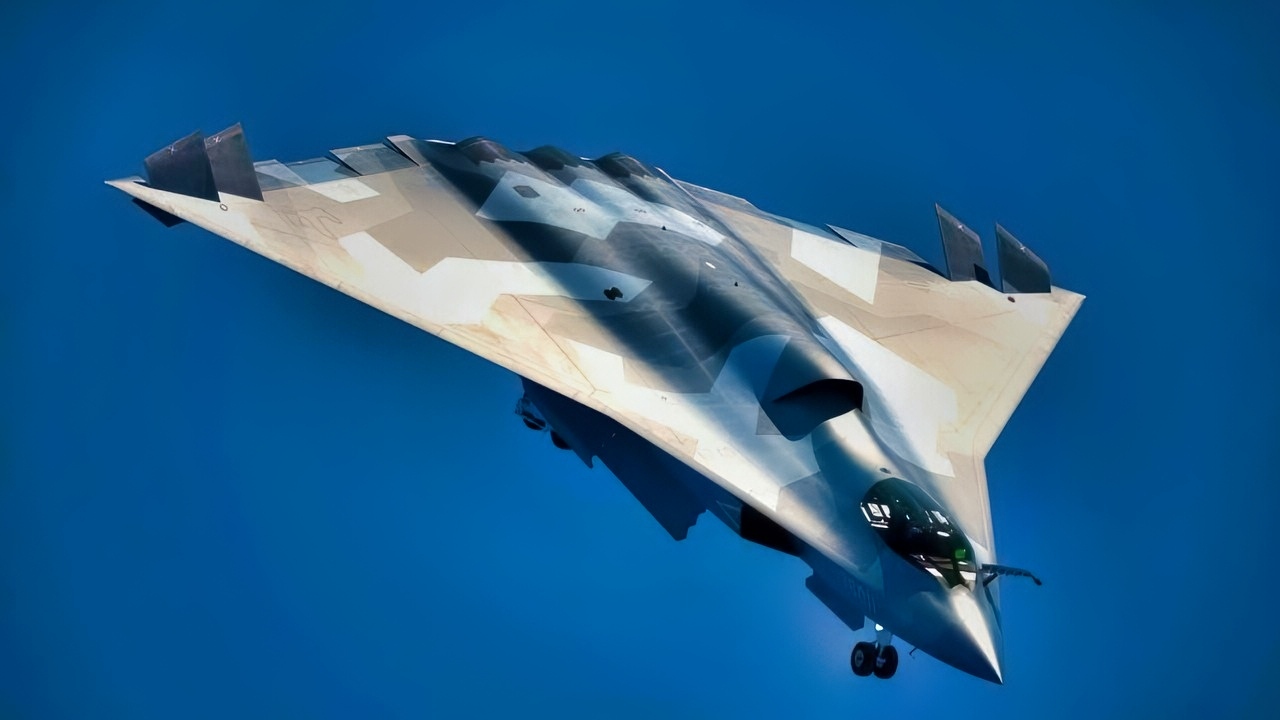
J-36 Fighter Artist Rendition from X Screenshot
Images shared online clearly showed the aircraft had radical stealth shaping, sparking speculation that they may be China’s first foray into sixth-generation aircraft. Observers noted that China could begin converting the prototype aircraft into fighters more quickly than originally anticipated – and since then, those fears have only grown.
And it is against this backdrop that critics now warn that the F-47 could be trailing behind China by as much as four years. Some point to the fact that China’s prototypes were already flying by late 2024, and that the United States is only now beginning production and aiming for a 2028 first flight (again, NGAD demonstrator flew back in 2020…).
NGAD Is Falling Behind?
Those sounding the alarm point to several converging lines of evidence to suggest that the United States may already be ceding ground in the sixth-gen fighter race.
Chief among them are the delays. The U.S. timeline for the F-47 remains aggressive, but it is now technically behind schedule. With a first flight pushed into 2028 and full service entry likely in the mid-2030s, skeptics argue that the margin for error is now slim. And, adding weight to their concern, senior officials have acknowledged that the program has paused or restructured some elements in recent years in order to manage cost and complexity.
China also arguably has a head start. By December 2024, China publicly revealed not one but two stealth aircraft prototypes, the J-36 and J-50. Notably, the J-36 has also been filmed during subsequent test flights, confirming that the platform is already airborne.
What’s more, analysts have pointed to the J-20 program as a cautionary tale. The J-20 stealth fighter, which first flew in 2011, transitioned from a demonstrator to operational deployment in approximately six years. That’s much faster than it took the U.S. to field the F-22 or F-35.
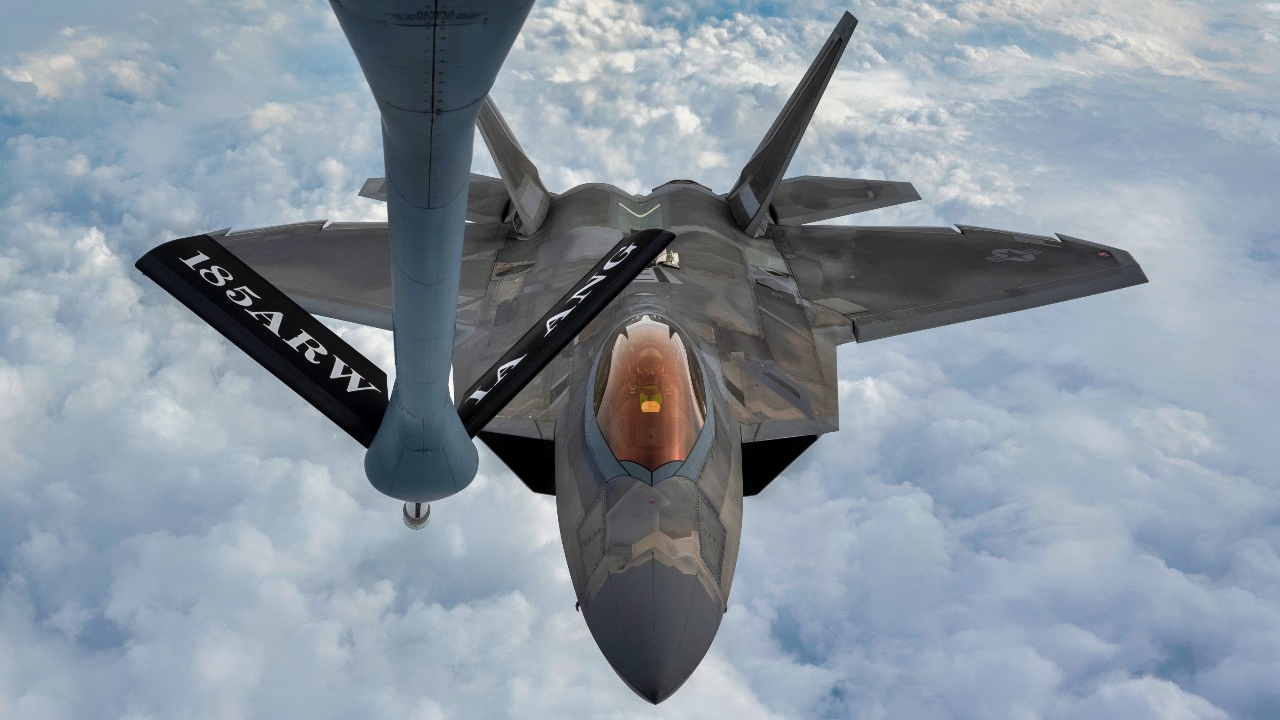
A U.S. Air Force F-22 Raptor approaches the boom of a KC-135 Stratotanker during a refueling mission over the Florida Panhandle, Dec. 14, 2022. Aerial refueling allows pilots to stay airborne for longer periods of time, increasing the mission capabilities individual aircraft can support. (U.S. Air Force photo by Tech. Sgt. Betty R. Chevalier)
But That’s Not the Full Story
While China may be forging ahead with its own sixth-generation platform, the full story paints a bigger picture – one in which the United States is preparing to deploy a superior platform, rather than simply being beaten to the finish line.
U.S. leadership has repeatedly insisted that NGAD is more than just a jet – it is a networked, systems-based warfighting concept. Speaking in September at the annual Air, Space and Cyber Conference in National Harbor, Maryland, Gen. Allvin stressed that NGAD is a broader program that relies on much more than just one jet.
“The adversary is not taking a knee. They’re not stopping and saying, ‘Well, maybe the U.S. is slowing down, we’ll slow down too,” the Air Force chief of staff said. “As we look into the future, when we develop all the next-generation capabilities, we can’t get enamored with the platforms. It’s not just the weapons and the weapons systems; we’ve got to understand systems over platform. It’s the things that links [sic] them together that makes it work.”
That 2020 NGAD Flight…
Adding to this point is the fact that the U.S. may have quietly taken an early lead. Again, back in 2020, the Air Force confirmed that it had already flown a full-scale NGAD demonstrator, years before China’s stealth prototypes first appeared in the skies. Then-acquisition chief Will Roper revealed that the aircraft had flown with mission systems onboard and was part of a push to accelerate development through digital design and advanced manufacturing techniques. Reports have since suggested that one or more of these demonstrators have most likely logged additional test hours in classified settings.
That first flight matters because it shows the U.S. was actively de-risking critical technologies that form the core of the NGAD fighter years before China’s J-36 or J-50 were revealed in late 2024. And even if the demonstrator was not the final F-47 design, it allowed the Air Force and its contractors to experiment with stealth shaping, avionics integration, and new manufacturing techniques long before China reached a similar stage.
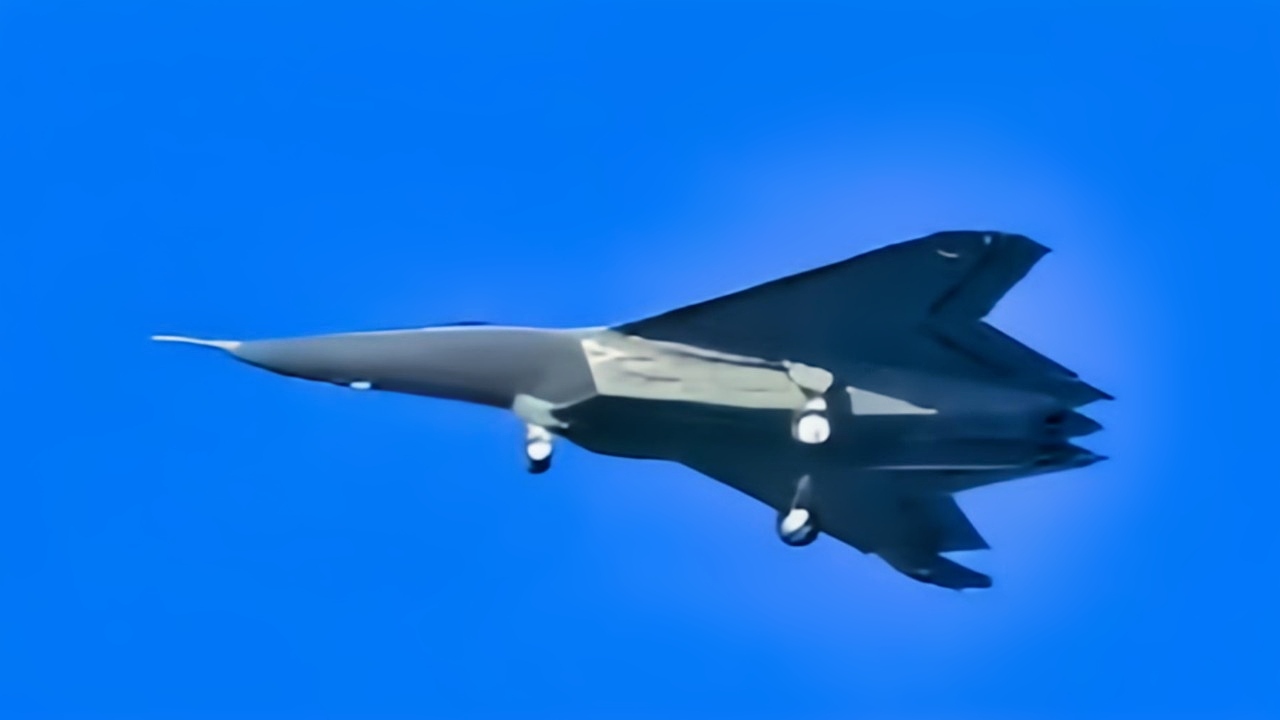
J-50 Fighter from China. Image Credit: Creative Commons.
Viewed in this light, the narrative that the F-47 is years behind may be too simplistic. The gap between America’s classified demonstrator flights and China’s public prototypes suggests that Washington may have a head start in technology maturity. And while Beijing may move quickly from prototype to production, the U.S. has the advantage of an established industrial base, combat-tested systems integration, and a focus on building a system of systems that could still prove more capable than China’s “loyal wingmen” drone efforts.
NGAD: We Need to See the Full Picture…Not Who Is ‘First’
Ultimately, the race may not be about which sixth-gen fighter enters operational service first, but who fields the most capable aircraft in numbers.
About the Author:
Jack Buckby is a British author, counter-extremism researcher, and journalist based in New York who writes frequently for National Security Journal. Reporting on the U.K., Europe, and the U.S., he works to analyze and understand left-wing and right-wing radicalization, and reports on Western governments’ approaches to the pressing issues of today. His books and research papers explore these themes and propose pragmatic solutions to our increasingly polarized society. His latest book is The Truth Teller: RFK Jr. and the Case for a Post-Partisan Presidency.
More Military
The F-35A Stealth Fighter Is Also a Stealth Bomber
Mach 2.65 F-111 ‘Aardvark’ Strike Fighter Has a Message for the U.S. Military
Russia’s MiG-29 Fulcrum Fighter Has a Message for NATO
The X-40A Space Plane Has a Message for the U.S. Military
The Mach 6.7 X-15 Space Plane Has a Message for the U.S. Air Force


Calhoun Street
September 27, 2025 at 4:13 am
But remember the NGAD contract was awarded to Boeing, a company that had multiple issues with quality control with their B737 MAX airplanes, a Starliner spacecraft that just didn’t work and left astronauts stuck in space, fuel system issues with brand new F-15EX fighters just coming off the line, and now union/labor issues at the ST. Louis facilities where the future F-47 airframes are going to built. Production-ready NGAD F-47 ready by 2028?? Good luck!
Calhoun Street
September 27, 2025 at 4:37 am
But remember the NGAD contract was awarded to Boeing, a company that has had numerous quality control issues with their B737 MAX commercial airplanes, a Starliner spacecraft that just didn’t work and left astronauts stranded in space, fuel systems issues with brand new F-15EX fighters coming off the line, and now union/labor issues at the ST. Louis facilities where the F-47 airframes are to going to be built. Production-ready NGAD F-47 ready by 2028?? Good luck!