

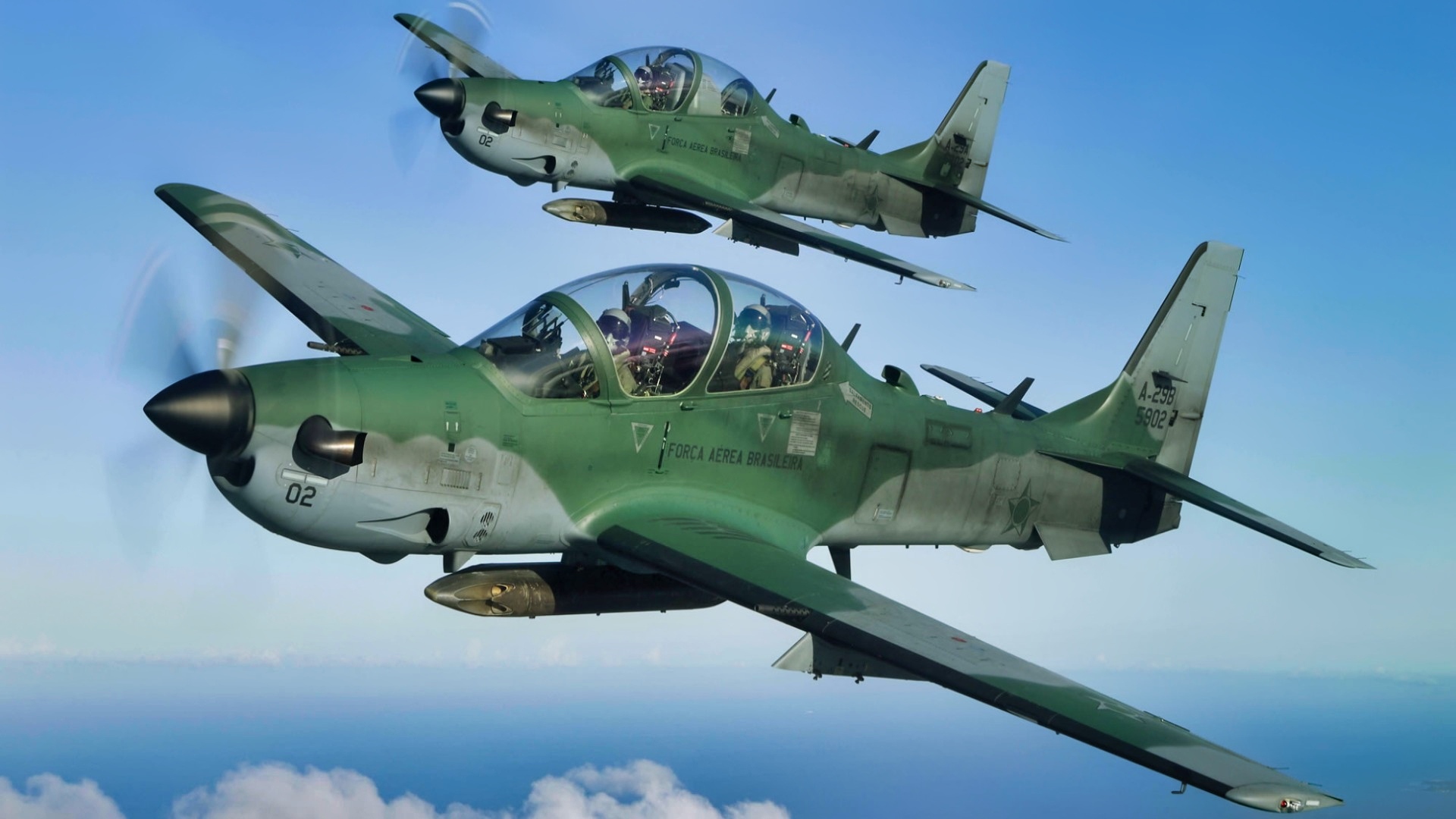
Key Points and Summary on the A-29 Tucano: The Embraer A-29 Super Tucano, a Brazilian-made turboprop, has proven to be a surprisingly lethal and effective light attack and reconnaissance aircraft in modern counterinsurgency warfare.
-Despite its unassuming appearance, the “Tinker Toy” has a distinguished combat record with the air forces of Colombia, Afghanistan, and Brazil, where it has been used to hunt down FARC terrorists, bomb Taliban compounds, and destroy the airstrips of drug traffickers.
-Its low cost, long loiter time, and ability to operate from rough runways make it an invaluable asset for nations needing a rugged and reliable close air support platform.
A-29 Super Tucano Profile
Unsurprisingly, quite a few military aircraft, especially fixed-wing fighter planes, are named for birds of prey: the F-15 Eagle, F-16 Falcon, and F-22 Raptor are a few examples, and they make explicit the affectionate appellation of fighter jets as “warbirds.”
Then, there are toucans, which are not classified as birds of prey. Nor do these birds look particularly intimidating. Nonetheless, the toucan is the namesake for a mechanical warbird that is indeed quite deadly: the A-29 Super Tucano turboprop light attack and advanced trainer aircraft. (Tucano is Portuguese for “toucan.”)
A-29/ALX/EMB-314 Super Tucano Initial History
The Super Tucano was designed by the Defense and Security division of Brazil’s Embraer S.A., a company best known to American travelers for its corporate jets and smaller commercial airliners. Actual manufacturing labors are split between Embraer and U.S.-based Sierra Nevada Corporation; the latter is licensed to build the birds for export customers.
Designed for counterinsurgency and reconnaissance missions, the Super Tucano made its maiden flight on June 2, 1999, and officially attained operational status with the Brazilian Air Force in 2003. The timing of the Super Tucano’s debut made it a strong choice for operations during the war on terror.
Although its originally intended primary customer/benefactor, the U.S. Air Force’s Light Attack Aircraft program, fell through, the cancellation of that program certainly didn’t stop Air Force Special Operations Command from using the plane to train the pilots of partner nations.
At least 10 air forces around the world have adopted the plane, and at least 260 A-29 airframes have reportedly been built as of April 2023.
Super Tucano Technical Specifications and Vital Stats
Courtesy of War Wings Daily:
Crew: 2 (pilot, navigator/student)
Fuselage Length: 33.4 feet (10.21 meters)
Wingspan: 36.5 feet (11.14 meters)
Powerplant: Pratt & Whitney Canada PT6A-68C turboprop engine, producing 1,600 shaft horsepower
Max Airspeed: 320 knots (370 mph, 593 km/h)
Operational Range: 720 nautical miles (1,334 km).
Service Ceiling: 35,000 feet (10,668 meters)
Armament:
5 x hardpoints with carrying capacity of 3,400 lbs. (1,542.21kg) of missiles and bombs
2 x .50 caliber (12.7mm) wing-mounted machine guns
1 x pod-borne GIAT M621 20mm cannon below the fuselage
The A-29’s other standout features include an electro-optical/infrared system with laser designator; night vision goggles; secure communications; a data-link pack; a constantly computed impact point (CCIP) capability; and the ability to operate from remote and unpaved runways.
Operational History in Brief
The Super Tucano was first blooded in combat by the Colombian Aerospace Force (FAC) during that country’s fight against the Revolutionary Armed Forces of Colombia (FARC) narcoterrorist group. On Jan. 18, 2007, a squadron of four FAC A-29s struck FARC positions in the jungle with Mk 82 bombs, aided by the CCIP system. The mission was judged a success, and the plane was used in multiple anti-FARC operations thereafter, including Operation Sodoma on Sept. 21, 2010, and Operation Odiseo on Nov. 4, 2011. These resulted in the killings of senior FARC leaders Jorge Briceño and Guillermo Sáenz Vargas, respectively.
Not to be outdone, Brazil’s air force has put its homegrown warbird to good use in battles against drug traffickers via the ongoing Operation Agata, which began on Aug. 5, 2011. Super Tucanos have been used to destroy illicit airstrips as part of this campaign.
On March 22, 2018, the Afghan Air Force used an A-29 plane to drop a GBU-58 Paveway II bomb to destroy a Taliban compound in Farah, near the Iranian border, thus marking the first time the Afghan military had dropped a laser-guided weapon against the Taliban.
After the Taliban re-seized power in Afghanistan in 2021, they found most of the leftover Super Tucanos to be inoperable; they also lacked the necessary expertise to use them, and the planes remained grounded. In addition, some of the Afghan A-29s managed to escape to Uzbekistan, and the Uzbeks bluntly refused the Taliban government’s request to return the planes.
For good measure, Nigeria, Lebanon, and the Philippines have deployed the A-29 Super Tucano in support of their military operations against insurgent groups and criminal organizations. As of April 2022, “In addition to 500,000 flight hours, the A-29 has also accumulated more than 60,000 hours in combat,” according to Bosco Costa Jr, Embraer Defense and Security chief commercial officer.
The A-29 Super Tucano in 4 Words: They Can Really Fight
Even in the age of supersonic fifth-generation stealth fighters (and sixth-generation warplanes under development, including those with presumptive hypersonic capabilities), subsonic piston-engine/prop-driven aircraft still have a military niche to fill. Beside the Super Tucano, there is also the example of the militarized version of the Cessna Caravan, which the Iraqi Air Force used to take the fight to the Islamic State before and even after receiving F-16s.
As former National Security Adviser and former Congressman—indeed, the first Green Beret ever elected to Congress—Mike Waltz put it, “They have long loiter time and can stay close to the fight. They are interoperable in a very close-knit way with operations on the ground.”
In short, the A-29 Super Tucano isn’t going away anytime soon.
About the Author: Christian D. Orr, Defense Expert
Christian D. Orr is a Senior Defense Editor. He is a former Air Force Security Forces officer, Federal law enforcement officer, and private military contractor (with assignments worked in Iraq, the United Arab Emirates, Kosovo, Japan, Germany, and the Pentagon). Chris holds a B.A. in International Relations from the University of Southern California (USC) and an M.A. in Intelligence Studies (concentration in Terrorism Studies) from American Military University (AMU).
Russia’s Bomber Forces
Tu-22M3: The Bomber Ukraine Hit With Drones


